
Denim Fabric: 7 Essential Facts for Better Jackets
The cotton twill behind every jean and jacket you've owned — what it's made of, how a mill weaves and dyes it, and how we cut it into private label denim jackets from just 10 units.
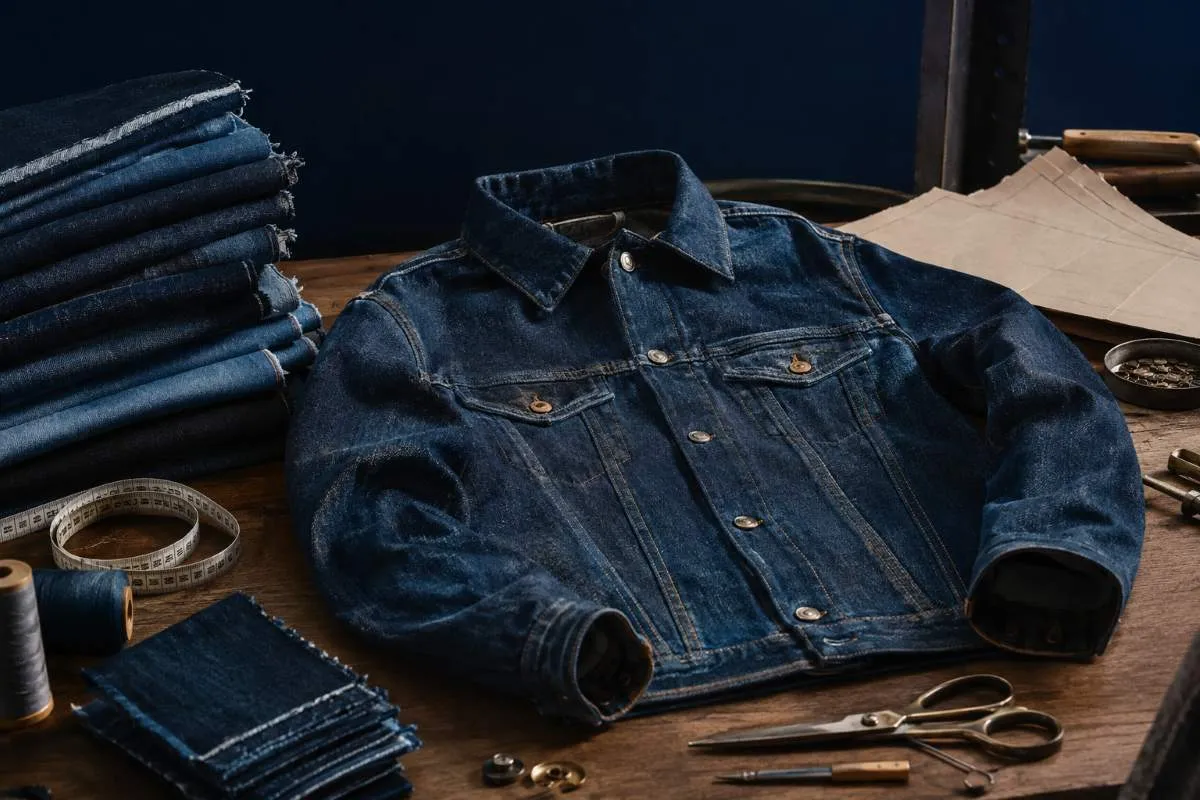
Denim fabric is a durable, warp-faced cotton twill. Indigo-dyed yarns run lengthwise (the warp), undyed white yarns run crosswise (the weft), and the diagonal weave between them gives denim its blue face, grey-white back, and signature fade. Apparel-weight denim runs roughly 4oz to 16oz per square yard — we cut and sew private label denim jackets in 10–14.5oz cotton and cotton-blend denim, OEKO-TEX-compliant dyed, from an MOQ of 10 pieces per style, per colour.
What Is Denim Fabric?
Denim is a woven cotton textile — not a garment. Jeans, jackets, skirts and overalls are all things you can make from denim, but the fabric itself is defined by its weave, not its shape. As Britannica notes, the fabric and the finished garment get used interchangeably in everyday speech, though textile makers draw a clear line between the two.
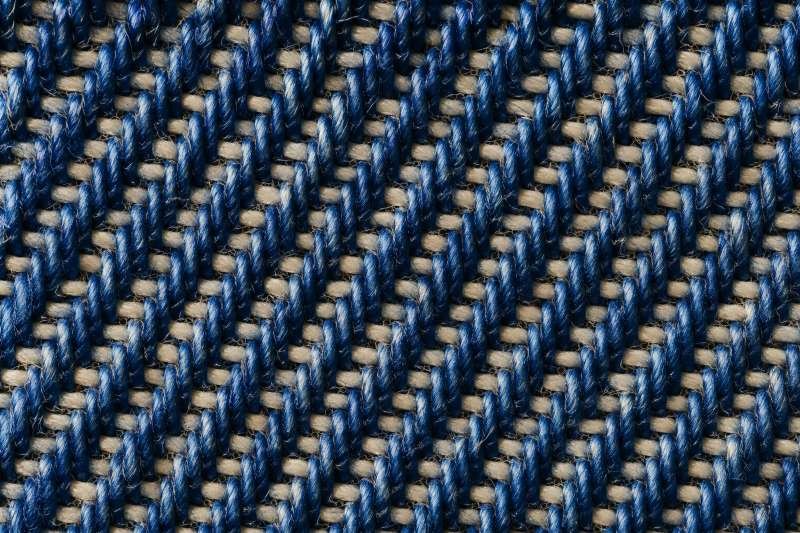
Specifically, denim is a warp-faced twill: on a loom, the crosswise weft yarn passes under two or more lengthwise warp yarns before crossing back over, which is what creates the fabric's diagonal rib — the "twill line" you can see and feel on the surface.
Because only the warp yarns are dyed, that diagonal face reads blue while the underside stays closer to white. It's this one-sided dyeing, more than anything else, that gives denim its most famous trait: it fades exactly where it's worn, not evenly all over.
That single construction detail is why a fabric invented for 19th-century miners is still the default choice for streetwear brands, workwear labels and heritage denim lines building product today.
What Denim Fabric Is Made Of
Traditional denim is 100% cotton, and most heavyweight and raw denim still is. But "denim" today covers a wider family of blends, each suited to a different kind of garment.
- 100% cotton — the original, most breathable option, and what most raw/selvedge denim is still made from.
- Cotton + elastane/spandex (1–3%) — "stretch denim," holds its shape while adding recovery for a closer, more fitted cut.
- Cotton + polyester blends — added for wrinkle resistance and cost efficiency at scale, common in mid-market denim.
- Organic or recycled cotton denim — grown without synthetic pesticides, or spun from reclaimed cotton fiber, for brands building a sustainability story. We test every roll against our fabric standards before it's cut.
How Denim Fabric Is Made
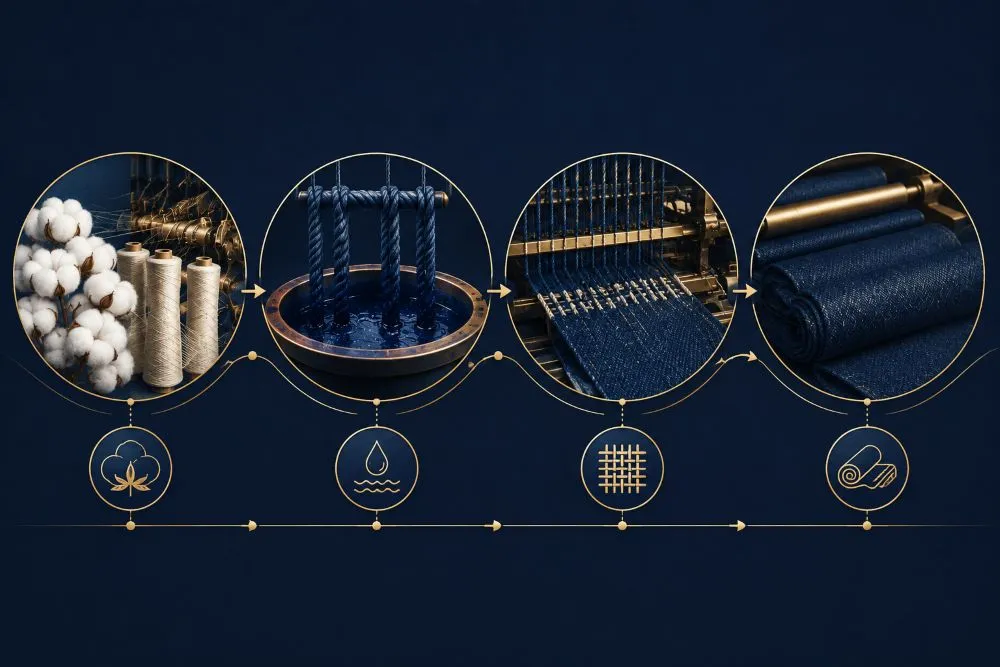
Getting from raw cotton to a bolt of denim on a cutting table is a genuinely sequential process — each step has to happen in order for the fabric to come out right.
Spinning
Raw cotton fiber is carded, drawn and spun into yarn strong enough to survive weaving tension.
Dyeing the Warp
Only the lengthwise warp yarn is dyed — traditionally with indigo — using a rope-dyeing process that builds color in layers.
Weaving
Dyed warp and undyed weft are woven in a 3×1 or 2×1 twill, producing the diagonal rib and blue-face, grey-back fabric.
Finishing
The woven cloth is sanforized (pre-shrunk) and, depending on the style, washed, brushed or treated before cutting.
Denim Weight, Explained
Denim is measured by weight, not thickness — expressed in ounces per square yard (oz) in the US, or grams per square meter (GSM) almost everywhere else. As a rough conversion, 1oz/yd² is about 34 g/m².
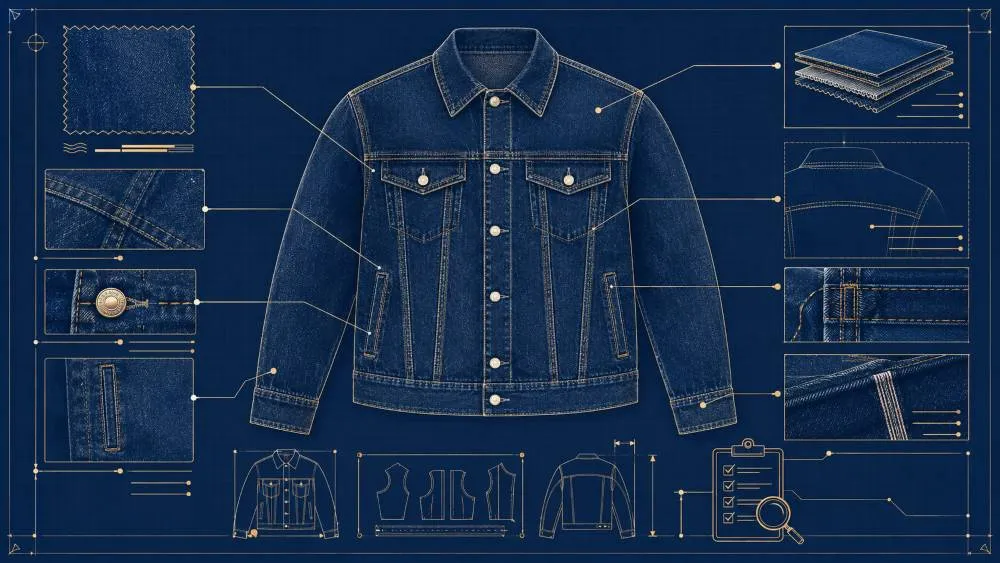
Lightweight (under 10oz) — shirts, dresses and lightweight overshirts, where drape matters more than structure.
Midweight (10–13oz) — most 5-pocket jeans and most jackets; the balance point of structure and wearability.
Heavyweight (13.5oz+) — raw and selvedge denim, workwear and heritage outerwear built to break in over years, not weeks.
Our own production sits in the 10–14.5oz range for denim jackets — heavy enough to hold structure, light enough to actually be worn.
Why Is Denim Blue?
Indigo is the reason denim looks the way it does — and the reason it fades the way it does. Traditionally sourced from the Indigofera plant, most indigo used in garment-scale production today is synthetic: chemically identical to natural indigo, but far more consistent from batch to batch.
Mills dye denim using a rope-dyeing process: twisted ropes of warp yarn are repeatedly dipped into indigo vats and pulled out to oxidize in the air, one pass at a time. Each dip adds a thin layer of color to the outside of the yarn — the core stays white.
Rope-dyeing: color builds with each dip, dip 1 → dip 5
That's why worn denim doesn't fade evenly — it fades exactly where friction and washing wear away the outer indigo layers first: the whiskers behind the knees, the honeycombs at the back of the knee, the fade along a wallet in a back pocket.
A Short History of Denim
Denim's story runs from 17th-century French looms to 21st-century streetwear — with one patent in between that changed workwear for good.
Weavers trying to reproduce a sturdy cotton corduroy from Genoa, Italy ("Gênes" — the root of the word "jeans") land on their own twill, later called serge de Nîmes — shortened, over time, to denim.
Tailor Jacob Davis and dry-goods merchant Levi Strauss patent copper rivets at stress points on denim work pants — effectively inventing the modern jean for miners and laborers in the American West.
Denim becomes the uniform of American ranch and factory work, then crosses into youth and rebel culture through film and music.
Denim spans workwear, streetwear and luxury fashion — still one of the most manufactured textiles in the world.
For a deeper dive, Britannica's entries on denim and jeans cover the full history in more detail than we can here.
Types of Denim
Not all denim behaves the same way once it's cut and sewn. The type you choose changes the hand-feel, the durability, and how — or whether — it fades.
Raw / Selvedge
Unwashed after dyeing and weaving; often woven on narrower looms that leave a self-finished edge. Develops fades unique to the wearer.
Stretch Denim
Cotton blended with a small percentage of elastane. Holds recovery through movement — fitted jackets, jeans and workwear.
Washed & Distressed
Stone-washed, enzyme-washed or laser-distressed to soften the hand-feel and fake in years of wear before day one.
Organic & Recycled
Woven from organic or recycled cotton fiber, for brands that want a sustainability claim they can actually back up.
From Fabric to Finished Garment
Understanding denim fabric is one thing. Getting a mill to weave it to spec, dye it consistently, and having a factory cut and sew it into a garment that actually fits — that's the part most fabric guides skip.
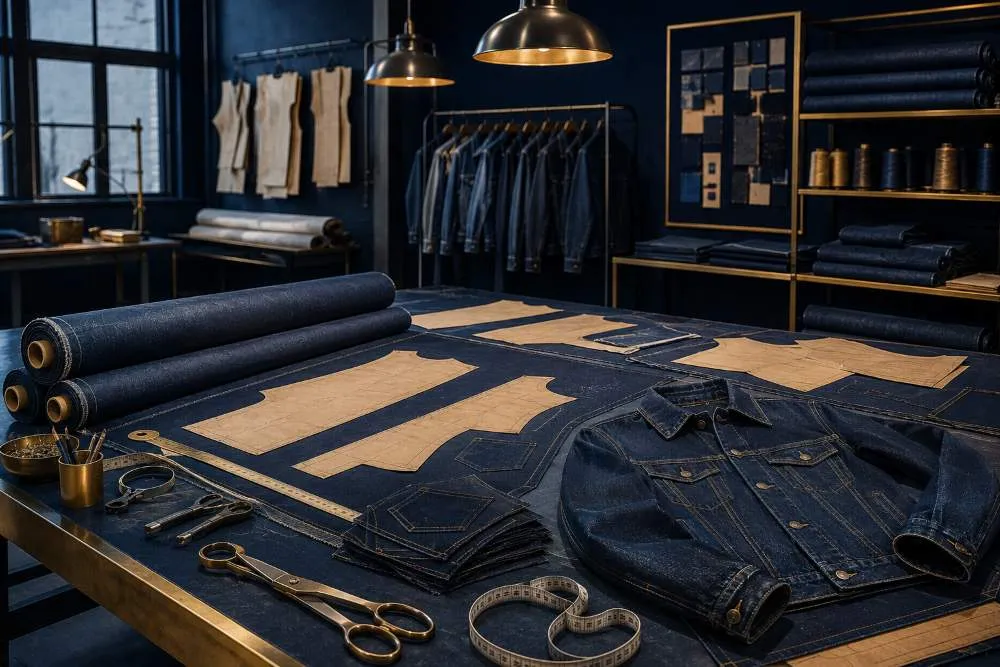
As a factory-direct manufacturer, this is where we come in. We source and test denim before a single roll is cut, then take it through pattern-making, cutting, sewing and a final AQL 2.5 inspection — the same standard USA retail buyers require.
Related Fabric Guides
Denim Fabric — Frequently Asked Questions
Traditionally, denim is 100% cotton woven in a warp-faced twill. Modern denim also comes in cotton blended with a small percentage of elastane or spandex for stretch, cotton-polyester blends for durability and cost, and organic or recycled cotton for sustainability-focused lines.
Yes, in its traditional form denim is 100% cotton. Today it's also common to see it blended with 1–3% elastane or spandex for stretch, or with polyester for added durability and easier care.
Cotton fiber is spun into yarn, the lengthwise warp yarn is dyed (traditionally with indigo) using a rope-dyeing process, the dyed warp and undyed weft are woven together in a twill pattern on a loom, and the finished cloth is sanforized and, depending on the style, washed or brushed before being cut.
Denim is traditionally dyed with indigo, which only coats the outside of the warp yarn rather than penetrating all the way through. That surface-level dyeing is also why worn jeans fade unevenly at points of friction, like the knees and back pocket.
Denim is the fabric. Jeans are a garment made from that fabric. All jeans are made of denim, but denim is also used to make jackets, skirts, overalls and shirting.
Denim weight is measured in ounces per square yard (oz) in the US, or grams per square meter (GSM) in most other markets. Roughly, 1oz/yd² equals about 34 g/m². Lightweight denim is under 10oz, midweight runs 10–13oz, and heavyweight denim starts around 13.5oz.
As a factory-direct manufacturer, we don't sell raw denim yardage — we source, test and cut denim in-house as part of producing your finished garment. If you're building a brand, that usually gets you a better result than buying fabric separately: request a free quote and we'll recommend a weight and blend for your design.
Denim as a fabric traces back to 16th–17th century weavers in Nîmes, France. The modern riveted jean was patented in 1873 by tailor Jacob Davis and dry-goods merchant Levi Strauss, who reinforced denim work pants with copper rivets for miners and laborers in the American West.
Ready to Put This Fabric to Work?
Free quote in 24 hours · Samples in 7–10 days · MOQ from 10 units · Full private label included.

2 Comments
555329
So,I like it