Hoodies
280 to 450+ GSM brushed fleece, oversized and boxy blocks, puff prints, embroidery and garment washes.
Hoodie manufacturingWe are custom clothing manufacturers producing cut-and-sew apparel for brands across the United States, from a 10-unit first drop to recurring wholesale programs. Tees from $4, hoodies from $8, private label branding included as standard, samples in 7 to 10 days, and DDP delivery with duties prepaid to your door.
Finding custom clothing manufacturers who will actually take a small order, answer messages, and ship what the sample promised is the hardest part of starting or scaling an apparel brand. Large export factories ignore anything under a thousand units. Domestic cut-and-sew shops quote three to four times the price and still ask for a 110-piece minimum. Marketplace agents sit between you and a factory you never see.
CLOTHINGMANUFACTURER.US exists in the gap those three routes leave open. We are a factory in Sialkot, Pakistan, one of the world's established apparel and sportswear export clusters, and our clients are American brands, boutiques, gyms, clinics, schools and companies. You get manufacturer pricing without the manufacturer's usual minimums, plus the service layer that overseas production is famous for lacking: same-day replies on WhatsApp, photographs from the production floor, and delivery duties-paid to your address.
This page is the complete guide to what we make, what it costs, how the process runs, and how to judge any factory you are considering, including this one. If you would rather skip straight to numbers, our clothing cost calculator prices a full run in about ninety seconds.
The term covers three very different business models. Knowing which one you are talking to prevents most of the disappointments in this industry.
A custom clothing manufacturer builds a garment from raw fabric to finished, labeled, packed product. That means drafting patterns from your design, sourcing or developing the fabric, cutting panels, sewing them, applying prints or embroidery, washing, inspecting, labeling and packing. The garment did not exist before you ordered it and it cannot be bought from a catalog by anyone else.
That is very different from the two businesses often confused with it. A decorator buys blank garments made by someone else and prints your logo on them, which is fast but means your product is a stock blank that any competitor can also buy. A trading company or agent takes your order and subcontracts it to a factory you never speak to, adding a margin and a communication gap.
We are the first of those three. Every garment listed on this page is cut and sewn on our own floor, and every stage of the clothing manufacturing process happens under one roof, which is what allows us to quote one number, own one timeline, and fix problems without a chain of blame.
Most brands want full-package production, sometimes called FPP: you supply the design direction and we handle everything else, including fabric sourcing. The alternative, cut-make-trim (CMT), means you supply the fabric and we only cut and sew it. CMT suits established brands with their own mill relationships. For almost everyone else, full-package is faster, simpler and cheaper because our fabric buying power beats a small brand's.
Twelve core categories, each with a dedicated page covering construction, fabric options and full pricing. All prices are per unit at 50 to 100 units with private label branding included.
280 to 450+ GSM brushed fleece, oversized and boxy blocks, puff prints, embroidery and garment washes.
Hoodie manufacturing140 to 260 GSM combed cottons cut to your own fit block, printed or embroidered in-house.
T-shirt manufacturingTwo-piece sets cut from a single dye lot so the top and bottom match on the shelf and after fifty washes.
Tracksuit manufacturingV-insert collars, quarter-zips and mock necks in 280 to 450 GSM fleece, optimized for embroidery.
Sweatshirt manufacturingTapered, straight and open-hem builds, dye-lot matched to your tops for coordinated sets.
Jogger manufacturingMelton wool bodies with PU or genuine leather sleeves, chenille patches and custom-knit striped ribs.
Varsity jacket manufacturingCombed pique and performance jersey with knitted collars, tipping and hand-digitized embroidery.
Polo manufacturingAntimicrobial poly-cotton rated past 100 industrial washes, XS to 4XL priced identically.
Scrubs manufacturingRibbed, fitted, boxy and longline blocks with clean bindings and true womens grading.
Crop top manufacturingSquat-proof nylon-spandex with flatlock seams, wicking training sets and studio pieces.
Activewear manufacturingPU jackets from $20 and genuine leather biker jackets from $58, hardware and lining specced to you.
Leather outerwearCPSIA-aware construction, cord-free youth builds and soft-hand cottons from 2T to youth XL.
Kids clothing manufacturing
Four supply routes exist. Each wins at something. Here are the real 2026 numbers rather than the version each route's marketing prefers.
When a brand searches for custom clothing manufacturers USA, the results mix domestic cut-and-sew shops, print-on-demand decorators, marketplace aggregators and factory-direct suppliers like us, all presenting themselves as the obvious answer. They are not interchangeable, and the right one depends entirely on your order profile.
| Supply Route | Custom Tee | Custom Hoodie | Real Minimum | Best For |
|---|---|---|---|---|
| Factory-direct (us) | $4 - $6 | $8 - $14 | 10 per style | Price, low minimums, full customization |
| US domestic cut & sew | $12 - $22 | $30 - $60 | 150 - 300 | Made-in-USA label, same-week fittings |
| Decorated blanks | $9 - $15 | $18 - $35 | 1 - 25 | Speed, tiny merch runs |
| Marketplace agents | $3 - $8 | $7 - $16 | Often 100 - 300 | Reach, if you can vet the factory |
| Large export factory | $2.50 - $4.50 | $6 - $10 | 500 - 1,000+ | Established brands at scale |
Indicative 2026 ranges for a comparable custom garment. Factory-direct prices include private label branding and are delivered DDP.
Among custom clothing manufacturers USA brands actually shortlist, the pattern is consistent: domestic production costs roughly two and a half to four times factory-direct for a comparable garment, and still carries a higher minimum. That premium buys you a Made-in-USA label, a factory you can drive to, and same-week fit sessions. Those are real advantages, and if your brand's positioning depends on them, a domestic shop is the correct choice and we will tell you so.
What factory-direct buys is different: the ability to test a style at 10 units instead of 300, to run five colorways instead of two, and to keep enough margin that the first order does not have to sell out perfectly for the brand to survive. Our buyer's guide to clothing manufacturers in USA walks through the trade-offs in more detail, and our city guides cover local rates in New York, Los Angeles, Houston, Chicago, Dallas, Atlanta, Miami and San Diego.
Everything we produce is engineered for US retail. Labeling follows FTC textile labeling requirements for fiber content, country of origin and care. Sizing uses US grading blocks from XS to 4XL. Children's items follow CPSIA rules including tracking labels. Fits are benchmarked against the American blanks your customers already own, so the garment feels familiar in hand.
"We compared them against two LA shops and a marketplace agent using the same tech pack. Best sample, half the landed cost of local, and the only one who answered on a Sunday. Eight orders in."
Chris B. · Brand owner, Phoenix AZThree tricks turn an advertised low minimum into a real high one. We use none of them, and here is exactly how each works so you can spot them elsewhere.
Almost every factory advertises low minimums. What separates a genuine low MOQ clothing manufacturer from a misleading one is what appears after you ask for a quote. The three common traps:
The advertised minimum is "10 pieces," but it turns out to be 50 per color, so a three-color capsule silently becomes 110 units. Our policy: 10 per style total, and colorways split from 25 units each on stock fabrics.
The garment minimum is 10, but the fabric mill requires a 300-unit dye lot, so the real commitment is 300. We hold stock fabric in commercial shades precisely so this does not happen. Custom Pantone dyeing genuinely does carry mill minimums, and we state that upfront rather than after your deposit.
A decorator advertises a minimum of one, because they are printing a stock blank. That is a legitimate service, but it is not manufacturing, and the garment is not yours.
Our minimum, stated completely: 10 units per style. Colorways from 5 units each on stock fabrics. No fabric-lot riders. The quote states the total delivered spend in one line before you commit a dollar. Small runs of 50 to 100 units carry a 10 to 25 percent per-unit premium over bulk pricing because setup costs spread across fewer garments, and we disclose that rather than hiding it.
A genuine low MOQ clothing manufacturer applies that minimum across the whole catalog. Every category on this page is available at that minimum. That includes the complex ones: a 10-piece varsity jacket run with chenille patches, a 10-set scrub program, or a 10-unit leather jacket order. Nothing is restricted to a catalog subset.
The strategy this enables is the one that works: test a style at 10 units, read real sell-through, then reorder the winners at 100, 300 or 500 units where prices step down by 10, 16 and 25 percent respectively. Deadstock stops being a business habit. Read the full breakdown on our low MOQ manufacturing page or the guide to what MOQ means in clothing manufacturing.
| Order Quantity per Style | Price Movement | What Unlocks |
|---|---|---|
| 10 - 99 units | Base factory-direct rate | Full branding, all categories |
| 100 - 299 units | Around -10% | Priority sampling |
| 300 - 499 units | Around -16% | Reserved line capacity |
| 500+ units | Around -25% | Sea freight economics |
Branding is not an upsell here. It is part of the product, produced in-house and included in the quoted unit price.
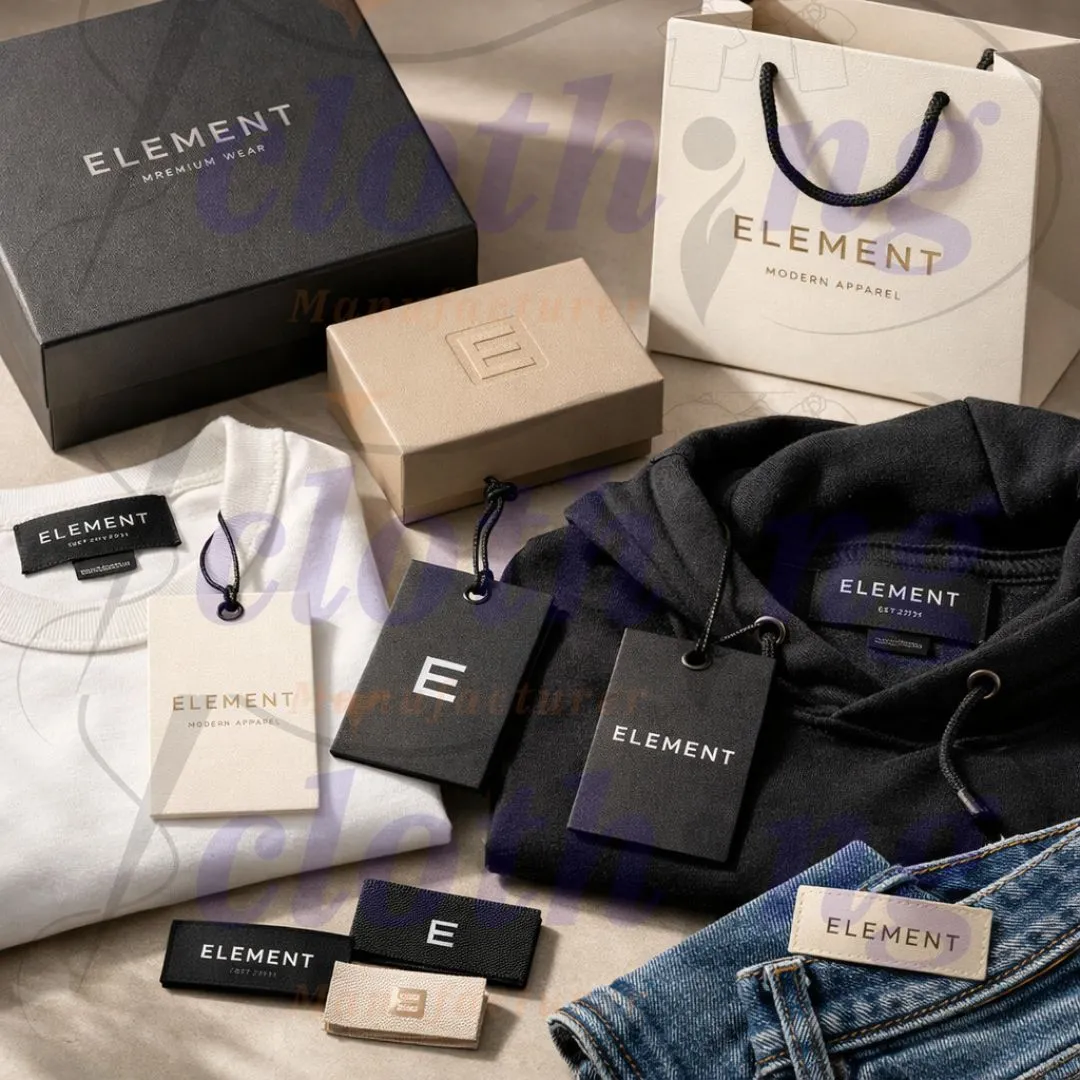
Working with a private label clothing manufacturer means the finished garment carries your identity and nothing else. No factory name in the collar, no third-party brand on the hang tag. Plenty of suppliers quote an attractive garment price and then bill labels, tags and bags as extras until the invoice has quietly grown by twenty percent. Our private label stack is standard:
A private label clothing manufacturer should treat your branding as part of the garment, not a line item added later. Artwork for labels and embroidery is digitized once and archived. There is no recurring setup fee on reorders, and the file is reused verbatim so the label in your fifth production run is identical to the first.
The result arrives retail-ready. Cartons can go from delivery straight to your shelf, your fulfillment center or a stockist's boutique. For brands supplying retailers, we can prepack size runs to a specified ratio and split cartons by destination. The full detail lives on our private label manufacturing page, and if you are still deciding between models, our comparison of private label versus white label explains which fits your stage.

You do not need a tech pack, a pattern maker or industry contacts. You need a reference garment, a rough design and a budget.
A large share of our work is first production runs, which is why clothing manufacturers for startups is a category we deliberately serve rather than tolerate. New brands arrive with a phone screenshot, a hoodie they love, and a number they can afford to lose. That is enough to start.
Tech packs are drafted by our team from your references at no charge with a production order, so the technical document that most factories demand up front is something we produce for you. Patterns are drafted in-house. Fabric is sourced against a target weight and hand feel rather than a mill code you are not expected to know. Print method is recommended based on your artwork and quantity, not left as a quiz.
This is what separates clothing manufacturers for startups from factories that merely accept small orders. From there the sequence is simple: itemized quote within 24 hours, sample in 7 to 10 days with the fee credited against bulk, then bulk production in 2 to 4 weeks. A realistic first-run timeline end to end is five to seven weeks including delivery.
Budget honestly. A 10-unit hoodie run at $11 per unit is roughly $550 in production plus air freight, so a first drop is typically a four-figure commitment rather than a five-figure one. Model it precisely with the cost calculator, which also shows your break-even point against a planned retail price. Deeper guidance sits on our startup manufacturing page and the guide to how to find a clothing manufacturer.

Every stage below runs on our own floor. That is what allows one quote, one timeline and one accountable team.
You send references, quantities and a target price. We return an itemized quote within 24 hours covering garment, decoration, branding and freight, with the trade-offs of each choice stated.
Our team converts your references into a production specification: measurements, fabric weight, construction, trims, placements and tolerances. Free with a production order.
Stocked knits and fleece ship immediately. Mill-sourced fabric takes one to two weeks. Custom-developed fabric with lab dips and strike-offs takes three to six weeks.
Patterns drafted from scratch or reverse-engineered from your reference garment, then graded proportionally across XS to 4XL rather than linearly scaled.
A physical pre-production sample in 7 to 10 days, photographed and shipped. Revisions run in further rounds until you approve. The sample fee is credited against your bulk order.
Computerized markers maximize fabric yield. Every roll is 4-point inspected and shade-banded before it reaches the cutting table.
Dedicated short lines handle 50 to 300 unit runs so small orders are not squeezed between container orders. In-line checks happen during, not after, production.
Screen, DTG, DTF, puff, high-density, sublimation and embroidery, all applied in-house during production so registration problems are caught on the table.
Final AQL 2.5 audit against your approved golden sample, with measurements photographed and shared before anything ships.
Labels, tags and poly bags applied, cartons packed to your standard, then air or sea freight with duties prepaid and tracking to your door.
Reorders skip most of this. Patterns, grading, dye recipes, print files and embroidery files are archived, so a repeat order goes to cutting almost immediately and completes in two to three weeks plus transit.
You cannot visit our floor easily, so the quality system is built to be verifiable from six thousand miles away.
Quality control runs at three gates. Incoming fabric is weighed against its GSM specification, inspected on the 4-point defect system and shade-banded; failing rolls never reach cutting. In-line checks during sewing catch construction faults while they are still cheap to fix. The final audit is a full AQL 2.5 inspection measured against the golden sample you approved, and the measurement sheet and photographs are shared with you before shipment.
A complete fabric spec has four components: fiber, weight in GSM, structure, and finish. "450 GSM, 80/20 cotton-poly, brushed-back fleece, enzyme washed" is reproducible. "Premium heavy cotton" is a guess. We quote in the first language and record the mill, article number, weight and shade in your spec file so reorders are identical.
Certified fibers are available where the claim matters: GOTS-certified organic cotton adds roughly $1.00 to $1.80 per tee, and GRS-certified recycled polyester adds $0.60 to $1.20 per activewear piece, both supplied with transaction certificates so the claim survives a customer's question. See our fabric guide, the GSM guide, or our sustainable manufacturing page.
Every shipment is DDP: customs cleared, duties prepaid, tracked to your door. No broker calls, no surprise invoices.
DDP stands for Delivered Duty Paid, and it is the single term that makes overseas manufacturing feel domestic. The alternative, DDU or DAP, leaves you to handle customs clearance and pay duties on arrival, which is where first-time importers get an unexpected bill and a delay. We quote DDP so the number you approve is the number you pay.
| Stage | Timeline | Notes |
|---|---|---|
| Itemized quote | Within 24 hours | Covers garment, branding and freight |
| Sampling | 7 - 10 days per round | Fee credited to bulk order |
| Bulk production | 2 - 4 weeks | After written sample approval |
| Air freight (DDP) | 6 - 9 working days | Duties prepaid, door delivery |
| Sea freight (DDP) | 22 - 40 days | Economical above roughly 500 units |
| Reorders | 2 - 3 weeks + transit | Patterns and files already archived |
Plan five to seven weeks end to end for a first run, and two to four weeks for a reorder plus transit.
Air freight lands through JFK, LAX, O'Hare, DFW, Hartsfield-Jackson or Miami depending on your market, then moves by ground. Sea freight enters through Long Beach, Houston, Savannah or New York-New Jersey. Quantity is invoiced as shipped within an honest plus-or-minus 3 percent tolerance, which is the standard for cut-and-sew production.
If a fixed date matters, tell us the date first and we schedule backward from it with a buffer built in. Full detail sits on our guide to clothing manufacturing lead times.
The selection method that works costs about a hundred dollars and outperforms every review page ever written.
Choosing a custom apparel manufacturer on the strength of a website is how brands lose deposits. Every custom apparel manufacturer looks credible on a landing page; only a sample tells you the truth. The method that works is boring and effective: shortlist three suppliers across different routes, ask each the same questions, then run the same paid sample with each and score the results side by side.
A trustworthy custom apparel manufacturer will welcome all ten of those questions. Be cautious of a supplier who will not do a video call from the production floor, who demands full payment up front, whose sample arrives without the fabric matching the spec, who cannot state the quantity tolerance, or whose quoted price changes after you commit. Any of those, on their own, is a reason to keep shortlisting.
Run the paid-sample test with us in the shortlist. Sixty to a hundred and fifty dollars spent comparing two or three samples is the cheapest insurance in this industry, and we recommend the method precisely because we expect to win a fair share of those comparisons. If we lose one on merit, you have still made the right decision.
The same spec-file discipline serves a streetwear drop and a forty-site clinic uniform program. Only the brief changes.
Heavyweight tees and hoodies, garment dyes, puff prints and drop-date scheduling built backward from your release.
Streetwear manufacturingTrue proportional grading, color-story capsules from 25 units per shade, co-ords and matched sets.
Womenswear manufacturingSquat-proof stretch fabrics, flatlock seams, wicking training sets and matching studio ranges.
Fitness apparel manufacturingAntimicrobial scrub programs with Pantone-locked department colors and cartons split by site.
Medical scrubsEmbroidered polos and quarter-zips, XS to 4XL at one price, reordered from a locked spec file.
Uniform manufacturingSublimated kits with roster names and numbers, warm-up sets and spirit merch on a season calendar.
Sportswear manufacturingThe questions American brands ask before their first order.
Ours is 10 units per style, with colorways from 5 units each on stock fabrics, and no hidden fabric-lot requirements. Large export factories typically require 500 to 1,000 units, and US domestic cut-and-sew shops usually require 150 to 300. Price breaks begin at 100 units.
At 50 to 100 units with private label branding included: t-shirts $4 to $6, hoodies $8 to $14, joggers $7 to $11, sweatshirts $7 to $11, polos $6 to $12, tracksuit sets $16 to $26, scrub sets $9 to $15, varsity jackets $18 to $28 and leather jackets from $58. Add air freight, which the cost calculator estimates for you.
Our factory is in Sialkot, Pakistan, and our clients are American. That is the model: factory-direct pricing with DDP delivery so duties are prepaid and ordering feels domestic while costing 40 to 60 percent less than US cut-and-sew. If your brand requires a Made-in-USA label, choose a domestic shop, and our city guides will help you budget that honestly.
No. Send a reference garment, a sketch or even a screenshot, and our team drafts the tech pack for you at no charge with a production order. Most first-time founders arrive without one, which is normal and expected.
Sampling takes 7 to 10 days, bulk production 2 to 4 weeks after approval, and DDP air delivery 6 to 9 working days. Plan five to seven weeks end to end for a first run. Reorders take 2 to 3 weeks plus transit because the patterns and files are archived.
Yes. Woven neck labels, compliant care and content labels, hang tags, size stickers and branded poly bags are produced in-house and included in the quoted unit price. Label artwork is digitized once and reused on every reorder with no recurring setup fee.
Always. You receive a physical sample in 7 to 10 days, can request a live video walkthrough of the production floor, receive photographs from mid-production, and get the final AQL 2.5 inspection report with photographed measurements before the goods ship.
Screen printing, DTG, DTF transfer, puff and high-density prints, all-over sublimation, and embroidery, all applied in-house during production. We recommend the method based on your artwork, fabric and quantity, and preview it free in our mockup designer.
Yes, every shipment is DDP: customs cleared, duties prepaid and tracked to your door. The duty component varies by garment category and destination and is confirmed line by line in your itemized quote, so there is no surprise invoice on arrival.
The standard structure is 50 percent deposit to begin production and 50 percent balance against approved pre-shipment inspection photographs. Terms become more flexible for established clients with order history.
Send a reference garment, your artwork and a quantity. We return an itemized quote covering production, branding and delivered freight within 24 hours, then a sample you can hold inside two weeks.