
What Is Modal Fabric? The Complete Guide to This Soft, Semi‑Synthetic Textile
If you've ever wondered what is modal fabric and why it feels so much silkier than a regular cotton tee, you're in the right place. Modal is a soft, breathable, semi‑synthetic cellulosic fiber made from beech tree wood pulp — not cotton, and not plastic. Below, we break down exactly what modal fabric is made of, how it compares to cotton, rayon and Tencel, whether it's safe and sustainable, and how to wash it without shrinking.
What Is Modal Fabric, In Short?
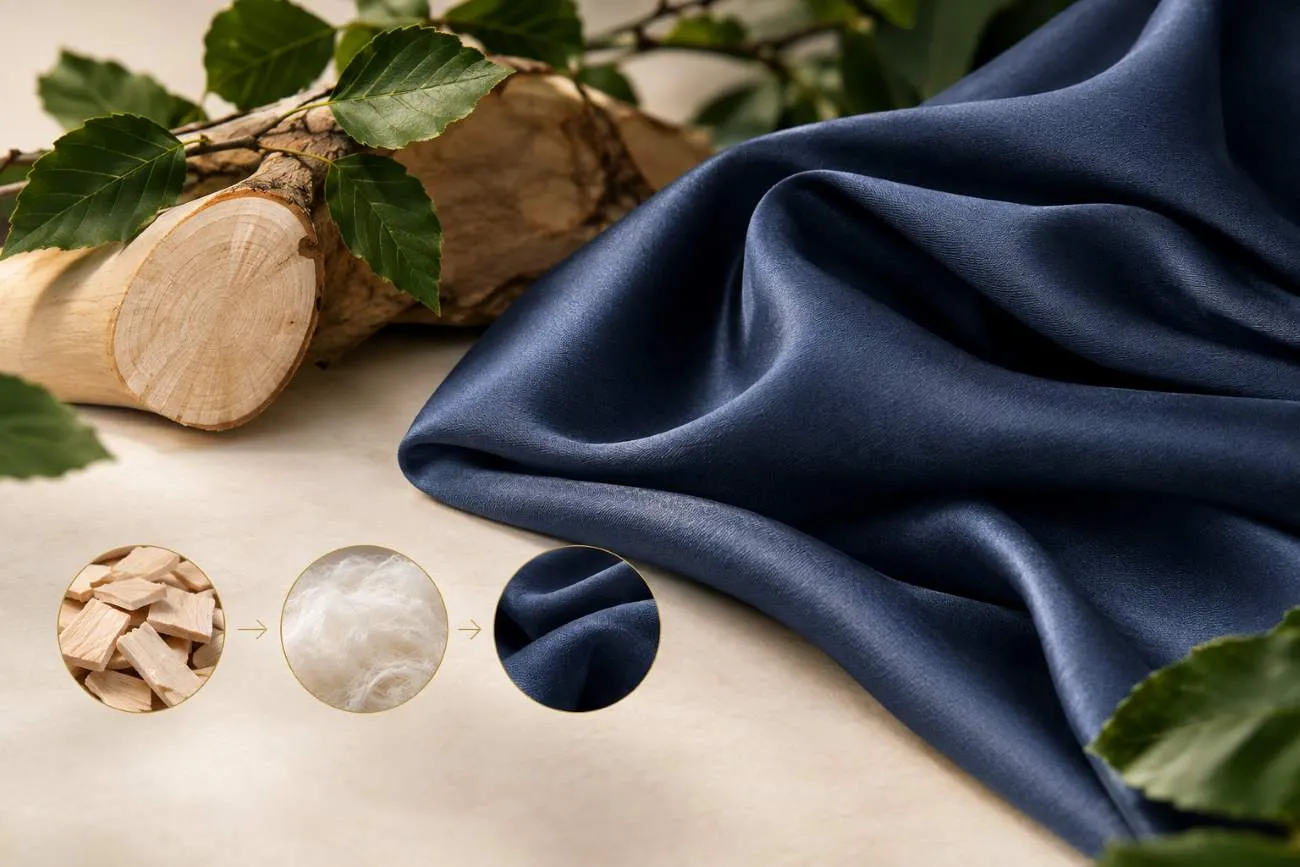
Modal fabric is a soft, silky, semi‑synthetic fiber made by chemically dissolving and re-spinning cellulose from wood pulp — usually beech trees. It's technically a type of rayon (a "high wet modulus" rayon), which is why it shares some traits with viscose but resists shrinking and pilling better.
- Raw material: beech tree wood pulp (cellulose)
- Classification: semi-synthetic / regenerated cellulosic fiber
- Feel: silky, smooth, lightweight, cool to the touch
- Key traits: breathable, moisture-wicking, drapes well
- Not: 100% natural like cotton, or plastic like polyester
- Common uses: underwear, loungewear, tees, bedsheets
Modal Fabric
- Classification
- Semi-synthetic cellulosic fiber (HWM rayon)
- Also Known As
- HWM rayon, Lenzing Modal®, modal viscose
- Raw Material
- Beech tree wood pulp
- First Developed
- Japan, 1950s — later commercialized by Lenzing AG (Austria)
- Feel
- Silky-smooth, lightweight, cool hand-feel
- Common Uses
- Underwear, loungewear, tees, bed linens
- Fully Natural?
- No — natural raw material, chemically processed
- Toxic?
- No, when OEKO-TEX® certified
- Biodegradable?
- Yes, under proper conditions
How Modal Fabric Is Made
Modal fabric is made of regenerated cellulose — here's the fiber's journey from tree to thread.
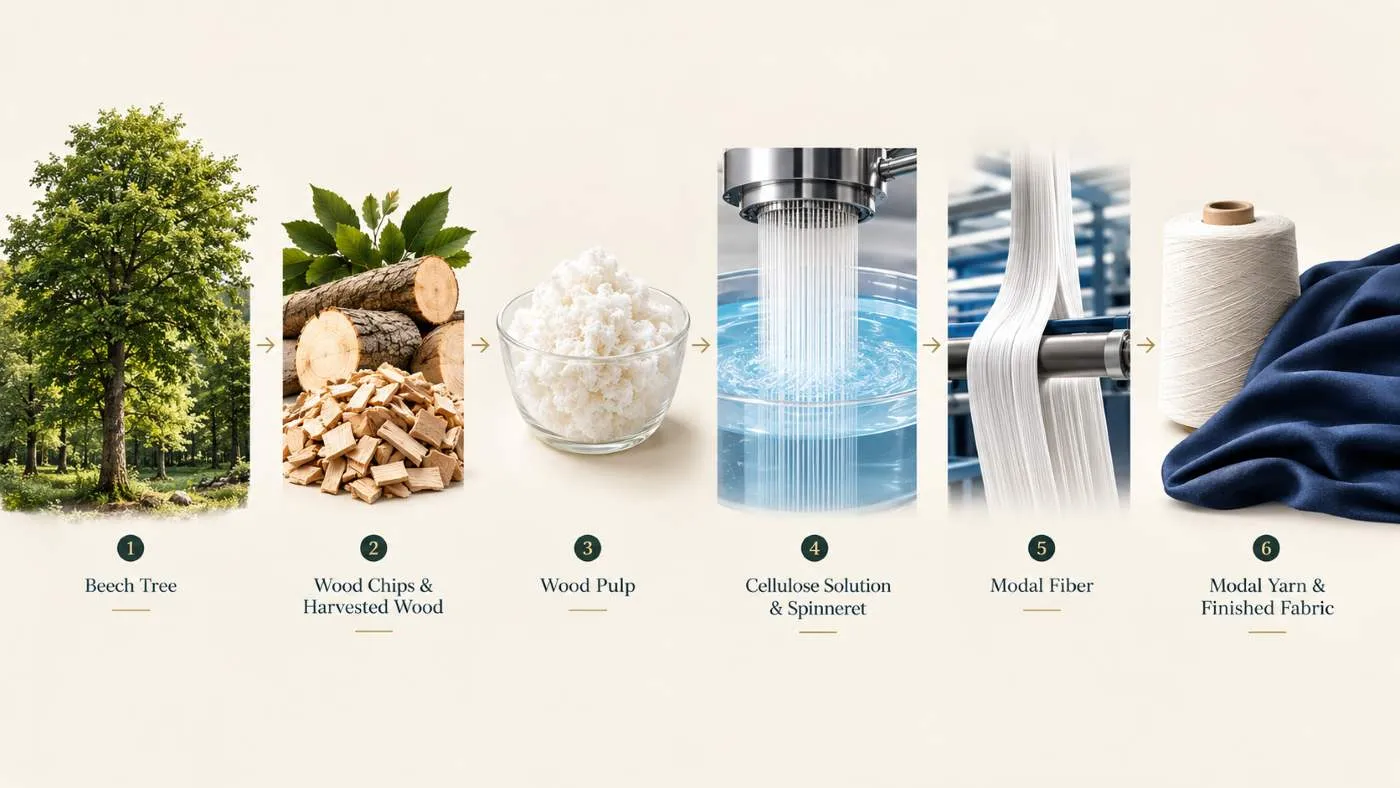
Harvest Beech Wood
Beech trees from managed, fast-regenerating forests are debarked and chipped into small pieces.
Cook It Into Wood Pulp
The wood chips are cooked and refined into a purified cellulose pulp, the same base material used for regular viscose rayon.
Dissolve the Cellulose
The pulp is treated with sodium hydroxide and other chemicals until it becomes a thick, honey-like cellulose solution.
Wet-Spin Through a Spinneret
The solution is forced through tiny nozzles (a spinneret) into a chemical bath, where it hardens into continuous filaments — the step that gives modal its extra wet strength versus standard viscose.
Wash, Stretch & Cut
Filaments are washed, stretched to align the fiber structure, then either cut into staple fiber or kept continuous, ready to be spun into yarn.
Spin Into Yarn & Knit or Weave
The modal fiber is spun into yarn (often blended with cotton or spandex), then knit or woven into the finished fabric you find on the bolt or in the garment.
Modal Fabric vs. Other Materials
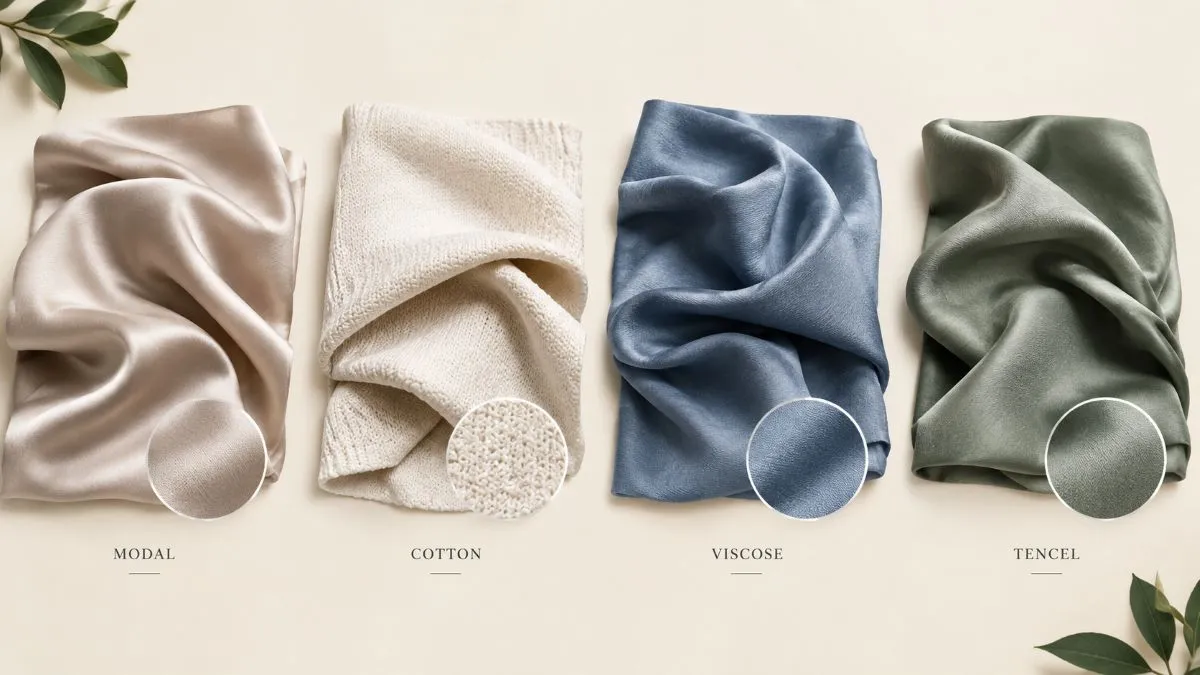
| Attribute | Modal | Cotton |
|---|---|---|
| Raw material | Beech wood pulp | Cotton plant boll |
| Feel | Silkier, smoother | Soft, slightly coarser |
| Breathability | Excellent, dries fast | Excellent, absorbs more, dries slower |
| Shrinkage | Low-to-moderate | Higher if untreated |
| Best for | Underwear, loungewear, drapey tops | Everyday wear, denim, workwear |
| Attribute | Modal | Standard Viscose Rayon |
|---|---|---|
| Wet strength | Higher (holds shape when wet) | Lower, weakens when wet |
| Shrink/pill resistance | Better | More prone to shrinking & pilling |
| Price | Slightly higher | Generally cheaper |
| Relationship | Modal is technically a high-wet-modulus (HWM) type of rayon | |
| Attribute | Modal | Tencel™ (Lyocell) |
|---|---|---|
| Process | Modified viscose process; leading mills recover most processing chemicals | Closed-loop solvent spinning (NMMO), generally lower impact |
| Durability | Good | Slightly stronger |
| Feel | Silky, very drapey | Soft with a slightly crisper hand |
| Source | Both are commonly produced from Lenzing beech-wood pulp | |
| Attribute | Modal | Polyester |
|---|---|---|
| Origin | Plant-based cellulose | Petroleum-based plastic |
| Breathability | High | Lower, unless engineered |
| Biodegradable | Yes | No |
| Microplastic shedding | No (cellulose fiber) | Yes (sheds plastic microfibers) |
Key Properties of Modal Fabric

Exceptionally Soft
Modal fibers are extremely fine, giving the fabric a silky, buttery hand-feel that's noticeably smoother than most cotton.
Breathable & Moisture-Wicking
Modal pulls moisture away from skin and dries quickly, which is why it's a staple in underwear and activewear blends.
Shrink & Pill Resistant
Compared to standard viscose rayon, modal's higher wet strength means it holds its shape and surface better wash after wash.
Beautiful Drape
Modal fabric flows and moves with the body rather than holding a stiff shape, which is why it's popular for loungewear and flowy tops.
Limited Natural Stretch
Modal alone isn't a stretch fiber; most stretch modal garments are knit or blended with a small amount of spandex/elastane.
Holds Color Well
The fiber absorbs dye evenly and resists fading, keeping colors looking vivid through repeated washing.
Is Modal Fabric Toxic or Sustainable?

Safety: Is It Toxic?
Modal fabric itself is not toxic to wear. Concerns about chemicals relate mainly to the manufacturing stage, not the finished, washed garment.
- Branded modal (e.g. Lenzing Modal®) is commonly OEKO-TEX® Standard 100 certified for skin-safe use
- It does not shed plastic microplastics — only biodegradable cellulose microfibers
- Widely used for baby clothing and sensitive-skin underwear when certified
Sustainability
Sustainability varies by producer, but leading modal (like Lenzing Modal®) scores well versus cotton and virgin synthetics.
- Beech trees need far less irrigation, land and pesticide than cotton
- Leading mills recover the large majority of processing chemicals in a closed loop
- Fiber is biodegradable under proper composting conditions
- Look for FSC/PEFC wood sourcing and OEKO-TEX® labels to confirm a specific fabric's credentials
Types of Modal You'll See on Garment Tags
Standard Modal
The base HWM rayon fiber — soft, breathable, used across apparel and home textiles.
MicroModal
A finer-denier version of modal for an even softer, lighter hand-feel — the top choice for underwear.
Lenzing Modal®
The trademarked, certified version from Lenzing AG, produced with closed-loop chemical recovery.
Cotton-Modal Blend
Combines cotton's durability with modal's softness and drape — common in tees and loungewear.
Common Uses for Modal Fabric
Underwear & Bras
Soft, breathable next-to-skin comfort.
Loungewear & Pajamas
Lightweight drape for all-day comfort.
T-Shirts & Tops
Often blended with cotton for a softer hand.
Bedsheets & Towels
Moisture-wicking and quick to dry.
Activewear Blends
Combined with spandex for stretch & recovery.
Socks
Softness plus moisture control underfoot.
Modal Fabric: Pros and Cons
Pros
- Silky-soft, comfortable next-to-skin feel
- Highly breathable and moisture-wicking
- Resists pilling and shrinking better than standard rayon
- Drapes beautifully; holds color and vibrancy well
- Made from a renewable, fast-growing raw material
- Biodegradable when disposed of properly
Cons
- Not stretchy on its own without blending in spandex
- Can still shrink with hot water or high heat
- Weaker than cotton when wet, despite being stronger than viscose
- Production involves chemical processing of the raw pulp
- Typically pricier than cotton or plain viscose
- Can snag on rough or textured surfaces
How to Wash Modal Fabric Without Shrinking It
- Turn the garment inside out; use a mesh bag for delicate underwear or loungewear.
- Machine wash in cold water on a gentle or delicate cycle.
- Use a mild detergent and skip chlorine bleach.
- Skip high heat: air-dry flat or tumble dry on low.
- Iron on a low setting only if needed, avoiding direct high heat.

Manufacturing Modal Fabric Garments for Your Brand?
Whether you're sourcing modal, micromodal, or cotton-modal blends for underwear, loungewear, or tees, our factory supports private label, wholesale, and OEM production with low minimum order quantities.
Modal Fabric: Frequently Asked Questions
The most-searched questions about what modal fabric is, answered in plain language.
Modal fabric is a soft, silky, semi-synthetic textile made from regenerated cellulose fiber, most often sourced from beech tree wood pulp. It sits between fully natural fibers (like cotton) and fully synthetic ones (like polyester) — the raw material is a natural plant, but it has to go through a heavy chemical process before it becomes a wearable fiber. Modal is technically classified as a high-wet-modulus (HWM) type of rayon, prized for feeling smoother and cooler against the skin than cotton.
Modal fabric is made from cellulose extracted from wood pulp, primarily beech trees. The pulp is dissolved into a viscous solution, pushed through fine spinneret nozzles to form continuous filaments, then hardened, washed, and spun into yarn. No plastic or petroleum is used in the base fiber, though chemicals like sodium hydroxide are used during processing.
Neither, exactly — modal is a semi-synthetic (regenerated) cellulosic fiber. It starts from a 100% natural raw material (wood pulp), but that pulp has to be chemically dissolved and re-formed into a fiber, which is a man-made process. That's why you'll see modal described as "natural-based" rather than "all-natural" like cotton or linen, and as "plant-derived" rather than "petroleum-based" like polyester or nylon.
In textiles, "modal" refers to a specific type of rayon fiber with a high wet modulus — meaning it keeps more of its strength when wet than ordinary viscose rayon. The name isn't a brand on its own, though Lenzing Modal® is the best-known trademarked version, produced by the Austrian fiber company Lenzing AG.
Modal shrinks less than regular viscose rayon because of its higher wet strength, but it isn't completely shrink-proof. Hot water, high heat drying, or aggressive machine agitation can still cause noticeable shrinkage over time. Washing modal garments cold on a gentle cycle and air-drying or tumble-drying on low heat keeps shrinkage to a minimum.
No. Cotton is a 100% natural plant fiber harvested directly from the cotton boll, while modal is a semi-synthetic fiber regenerated from wood pulp. Modal typically feels silkier and drapes better, resists pilling more effectively, and dries faster than cotton, while cotton tends to be more durable over repeated hot washes and is a fully natural fiber from the start.
MicroModal is simply modal fiber spun into a much finer, lower-denier thread than standard modal. The chemistry and raw material are the same — only the fiber's thickness changes. Because the individual filaments are so fine, MicroModal fabric feels even softer, lighter, and more fluid than regular modal, which is why it's the go-to choice for underwear and next-to-skin intimate apparel.
Yes. Modal is highly breathable and moisture-wicking, pulling sweat and humidity away from the skin faster than cotton and helping the fabric surface dry quickly. That combination of breathability and quick-dry performance is a big reason modal shows up so often in underwear, sleepwear, and lightweight activewear blends.
Reputable modal fabric is not toxic to wear. While the manufacturing process for the raw fiber does use chemicals (as most regenerated cellulosic fibers do), the finished, washed fiber itself doesn't retain harmful residue when produced to industry standards. Branded modal such as Lenzing Modal® is commonly OEKO-TEX® certified, meaning independent labs have tested the finished fabric and confirmed it's free of harmful substance levels and safe for skin contact, including sensitive skin.
No. Modal is a cellulose-based fiber derived from wood pulp, not a plastic polymer like polyester, nylon, or acrylic. When modal fabric sheds fibers in the wash, those are biodegradable cellulose microfibers rather than plastic microplastics, which makes modal a lower-impact choice on this specific concern than fully synthetic fabrics.
On its own, modal has only a small amount of natural give and isn't considered a "stretch fabric." To get noticeable stretch and recovery, most modal garments — especially underwear, leggings, and fitted loungewear — are knit or blended with a small percentage of elastane/spandex (commonly 3–10%).
Modal has a distinctive silky, buttery-smooth hand-feel with a subtle sheen, and it's noticeably lighter and cooler to the touch than most cotton. Many people describe it as landing somewhere between cotton and silk — soft and fluid, with excellent drape rather than a crisp or stiff texture.
For garments that touch the skin — underwear, sleepwear, loungewear, soft tees — modal is considered one of the better performance fibers available: it's soft, breathable, resists pilling and shrinking better than regular rayon, and holds dye vividly. It's a less obvious choice for heavy-duty items like outerwear or workwear, where a sturdier natural or synthetic fiber usually performs better.
Modal belongs to the rayon family — it is technically a high-wet-modulus (HWM) rayon — but it isn't identical to standard viscose rayon. Compared with ordinary viscose, modal is engineered to hold more strength when wet, shrink less, resist pilling better, and feel softer, largely due to differences in how the fiber is stretched and set during spinning.
"Better" depends on the use. Modal wins on softness, drape, moisture-wicking speed, and colorfastness, which is why it dominates underwear and loungewear. Cotton wins on raw durability, being a fully natural fiber, and general everyday toughness, which is why it still leads in t-shirts, denim, and workwear. Many brands blend the two to get softness from modal and strength from cotton.
Modal and cotton are both considered breathable, but they perform a little differently. Cotton absorbs more moisture and holds onto it longer, while modal wicks moisture away from the skin and dries noticeably faster, which is why modal often feels cooler and less clingy in humid or sweaty conditions.
It can. High heat is the main cause of shrinkage in modal garments, whether from a hot dryer cycle, hot water wash, or an overheated iron. To protect the fit of modal clothing, dry on low heat or air-dry flat, and avoid high-heat settings altogether.
Wash modal garments in cold water on a gentle or delicate cycle, use a mild detergent without chlorine bleach, and skip the high-heat dryer setting — either air-dry flat or tumble dry on low. Turning the garment inside out and using a mesh laundry bag for delicate pieces (like modal underwear) also helps preserve the fabric's softness and shape over time.
Yes — modal, and especially MicroModal, is one of the most popular fabrics for underwear precisely because it's soft against sensitive skin, breathable, moisture-wicking, and holds its shape and color well through frequent washing. That's also why it's often blended with a small amount of spandex for stretch and recovery in underwear styles.
It can be, particularly branded versions like Lenzing Modal®. Beech trees used for modal pulp require far less irrigation, land, and pesticide input than cotton, and leading producers recover the large majority of the chemicals used in processing and run their pulp-to-fiber operations on self-generated energy. That said, sustainability varies by producer, so certifications (like FSC/PEFC-sourced wood and OEKO-TEX®) are the best way to confirm a specific modal fabric's environmental credentials.