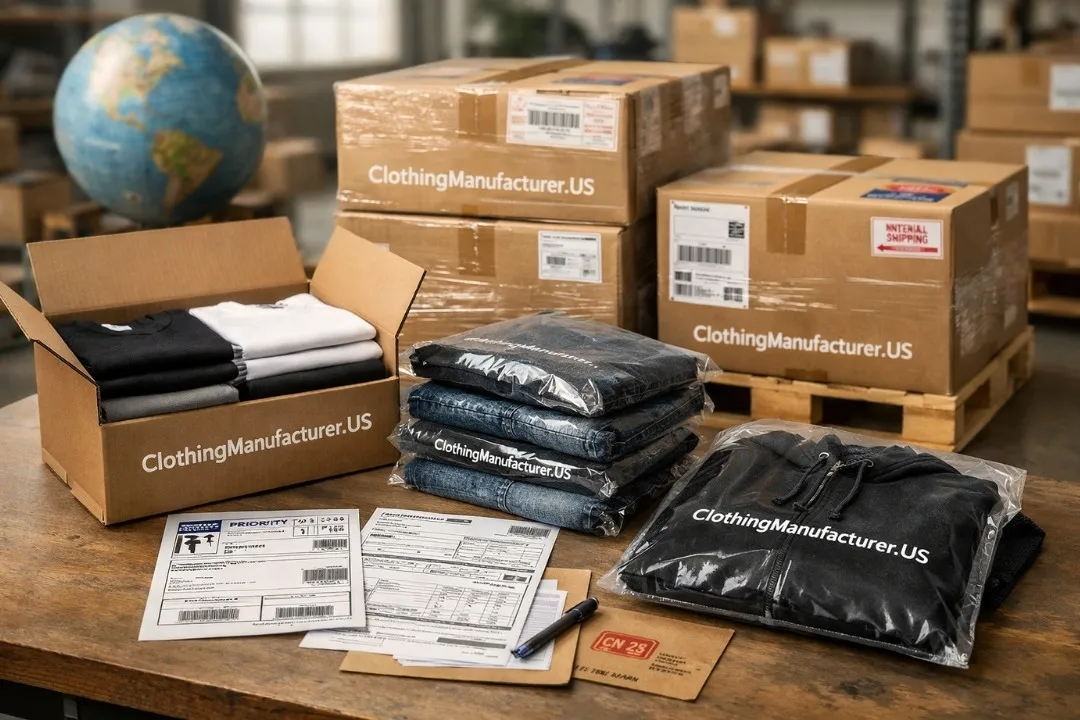
Every garment we ship passes through ten stages, all under one roof in our Sialkot factory. This is the complete clothing manufacturing process written by the people who actually run it: what happens at each stage, how long it takes, who is responsible, what you receive, and where things go wrong when a factory cuts corners.
10Production Stages
3Quality Gates
10Piece Minimum
5-7wkFirst Order, End to End
Most brands never see the garment manufacturing process. They send a design, wait, and a box arrives. When something is wrong, they have no idea which stage failed or who to ask. This page removes that blindness.
Below is the full apparel production process exactly as it runs on our floor, in order, with the real timelines attached. Some stages you control. Some we control. Two of them, sampling and pre-shipment inspection, are the checkpoints where you can stop everything if it is not right, and those are the two most brands skip. Understanding how clothes are made in a factory is the difference between hoping and knowing.
How to read this page. Each of the ten clothing production stages shows a duration badge, who owns it, and what you physically receive at the end. Stages marked in gold are decision points where the project pauses for your approval. Use the rail on the left to jump between them.
01
Design & Consultation
24 hoursYou lead
Everything starts with what you already have, which is usually less than you think you need. A reference garment, a screenshot, a logo in the wrong file format and a budget is genuinely enough to begin. You do not need industry vocabulary or a finished design.
We convert that into a costed direction: which fabric weight suits the garment, which print method flatters the artwork, what the minimum and the volume breaks are, and what the whole thing lands at once freight is added. Every recommendation comes with its trade-off stated, because a factory that only tells you yes is not advising you.
Send a reference garment, sketch, photo or competitor product
State your target retail price so we can engineer to your margin
Name any deadline that genuinely cannot move
You receive: an itemized quote within 24 hours covering garment, decoration, branding and delivered freight. Model it yourself first with our clothing cost calculator, or visualise the garment in the mockup designer.
02
Tech Pack & Specification
1-3 daysWe produce it
The tech pack is the document that turns an idea into something a machinist can build. It fixes every variable so nothing is left to interpretation: measurements at every size, fabric composition and GSM, stitch types and seam allowances, trims, label positions, print placements measured in centimetres, and the tolerance allowed on each.
Most factories demand you arrive with one. We draft it for you at no charge with a production order, because expecting a first-time founder to produce a technical document in a language they have never spoken is how good ideas die at stage two.
You receive: a complete specification sheet to approve. Learn exactly what goes in one in our guide to what a tech pack is.
03
Fabric Sourcing & Development
Instant to 6 weeksWe source
Fabric is 45 to 60 percent of what your garment costs, so this stage decides your economics more than any other. There are three routes, and they trade speed against specificity.
Route
Timeline
Best For
Stocked fabric
Immediate
Fast sampling, low minimums, standard shades
Mill-sourced
1-2 weeks
A specific hand, slub or technical property
Custom developed
3-6 weeks
Target GSM, custom blends, lab dips and strike-offs
Stocked fabric in commercial shades is what makes a genuine 10-piece minimum possible. Custom-dyed Pantone colours carry real mill minimums, and we state those upfront rather than after your deposit.
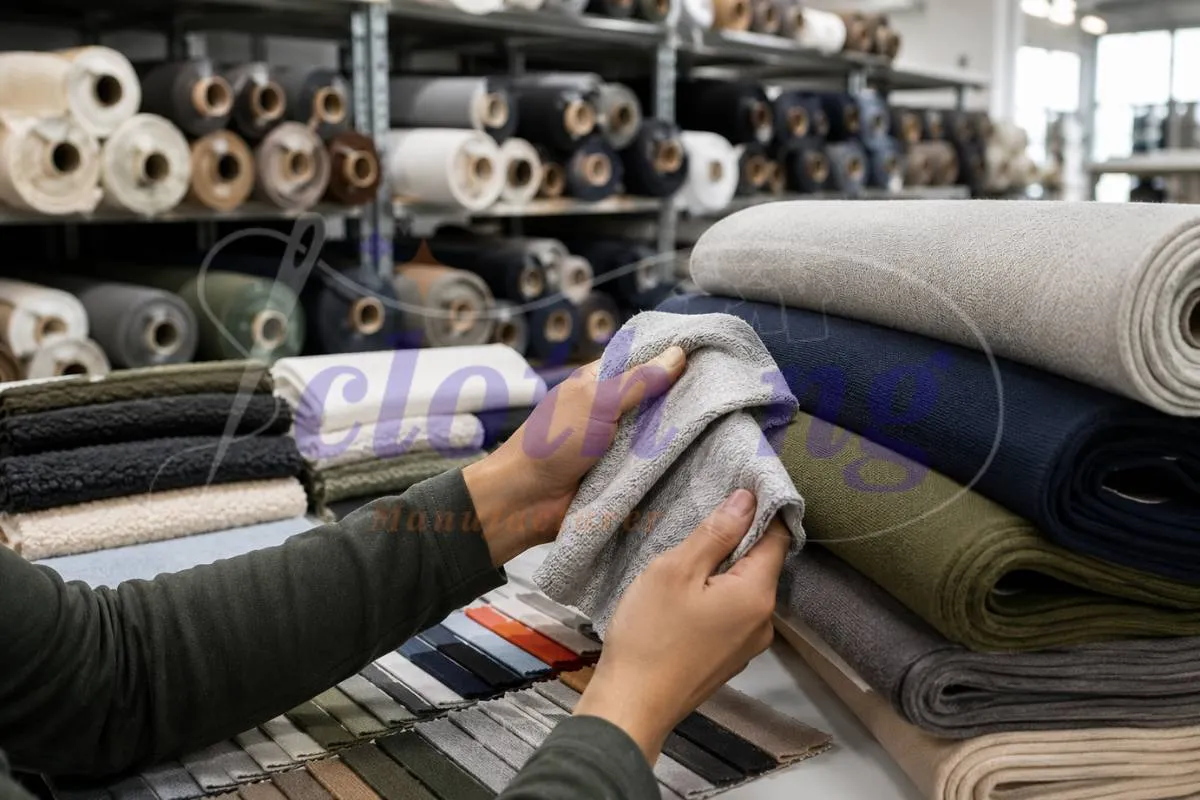
You receive: labelled swatch cards with GSM, blend and finish marked, so you choose by hand feel rather than from a screen. Browse the full fabric library, the fabric guide or the GSM guide.
Fabric selection sets 45 to 60 percent of the garment cost, which is why it happens before a single panel is cut.
04
Pattern Making & Grading in the Cut and Sew Process
2-4 daysWe engineer
A pattern is the set of flat shapes that, once sewn, become a three-dimensional garment on a moving body. It is drafted from scratch to your measurements, or reverse-engineered from a reference garment you already love, which is the faster and more reliable route for most brands.
Grading then scales that pattern across the size run. This is where cheap manufacturing quietly fails: a lazy factory scales every measurement uniformly, so the 3XL is simply a stretched large with sleeves that are far too long. Proper grading adjusts bust, length, width and rise proportionally per size, because bodies do not grow evenly.
Blocks graded XS to 4XL for adults, 2T to youth XL for children
Womenswear blocks developed independently, never shrunk from mens
Patterns archived and owned by you, which makes reorders fast and identical
You receive: ownership of the patterns. See how this feeds our cut and sew service.
05
Sampling — Your First Decision Point
7-10 days per roundYou approve
Nothing goes to bulk production until a physical garment is in your hands and you have said yes in writing. This is the single most important stage in the entire cut and sew process, and it is the one impatient brands try to skip to save two weeks. They then lose six weeks and a bulk order fixing something a sample would have caught.
You mark up whatever is wrong. Body too short, sleeve too tight, fabric lighter than you imagined, print sitting three centimetres too high. We revise and sample again. Each round takes another 7 to 10 days, and most first designs need one or two rounds. That is normal, not a failure.
The sample fee is credited in full against your bulk order
Fit samples, pre-production samples and a retained golden sample
The approved sample becomes the legal reference for the final inspection
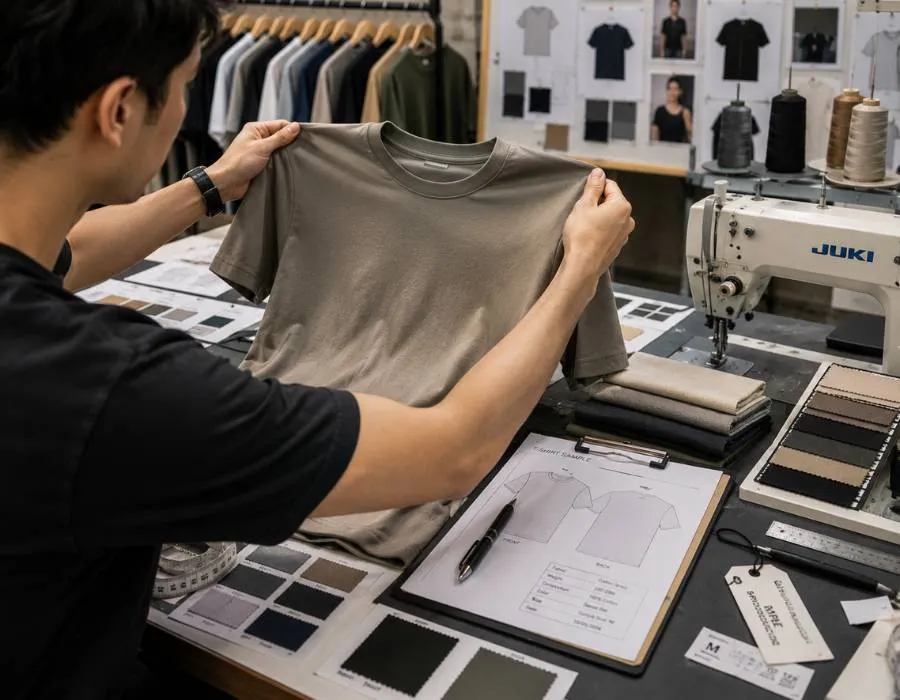
You receive: a physical garment, plus a retained golden sample kept at the factory. Every unit in the bulk run is later measured against it, which turns any future dispute from an argument into a comparison.
A pre-production sample, made in 7 to 10 days.The approved sample becomes the golden reference for bulk.
06
Fabric Inspection — Quality Gate One
1-2 daysWe inspect
A fabric fault caught at the roll costs metres. The same fault caught after sewing costs finished garments. So before anything reaches a cutting table, every incoming roll is checked three ways.
Weight verification: the roll is weighed against its stated GSM. Mills do occasionally ship light.
4-point inspection: defects are scored by size, and rolls exceeding the threshold are rejected outright.
Shade banding: rolls are grouped by shade so one garment is never cut from two slightly different dye lots.
Why it matters: shade banding is the reason your sleeves match your body. Factories that skip it produce garments that look fine in the warehouse and wrong in daylight.
07
Cutting — The Cut and Sew Process Begins
1-3 daysWe cut
Fabric is laid up in stacked plies, sometimes a hundred layers deep, and a computerised marker is generated to arrange the pattern pieces for maximum yield. Marker efficiency directly affects your unit price: a better layout means less waste, and less waste means cheaper garments and less landfill.
Pile direction matters here in ways that are invisible until they are not. Velour, corduroy and brushed fleece all shade differently depending on which way the nap runs, so every panel must be cut in the same direction or the finished garment will look like two colours under a shop light.
Output: bundled, numbered panels ready for the sewing line, with every bundle traceable back to its fabric roll.
08
Sewing: How Clothes Are Made in a Factory
1-3 weeksWe build
The garment is assembled along a line, each operator specialising in one operation. A t-shirt is roughly six pattern pieces. A varsity jacket is over thirty, in mixed materials, with knitted ribs and set-in sleeves that must hang straight. Complexity is why a jacket costs what it does.
Crucially, quality control happens during sewing, not after it. In-line checkers pull garments off the line mid-assembly, because a seam fault caught at operation four is a two-minute fix, while the same fault found in a finished carton means unpicking a completed garment or scrapping it.
Our short lines are dedicated to runs of 10 to 300 pieces, so small orders are not squeezed between container jobs by machinists who resent them. That is what makes a 10-piece minimum work in practice rather than just in marketing.
You receive: photographs from the floor mid-production, and a live video walkthrough on request. You should never have to wonder what is happening.
09
Decoration, Washing & Finishing
2-5 daysWe apply
Printing, embroidery and washing all run in-house, in-line with production. That matters more than it sounds: when decoration is subcontracted to a second vendor, a misaligned print becomes a blame exchange between two companies while you wait. On our floor it is caught on the table and fixed.
Screen printing for bold spot colour at volume
DTG and DTF for photographic detail and short runs
Puff and high-density for raised texture, needing a 220 GSM or heavier ground
All-over sublimation covering the full garment, on high-polyester fabric only
Embroidery, hand-digitized and tested on the actual fabric to prevent puckering
Garment dye, enzyme, acid and stone washes in our own wash lab
You approve: a photographed press proof before the full run commits. Explore methods on our printing and t-shirt service page.
10
Final QC, Labelling, Packing & DDP Delivery
3-5 days + transitYou approve before shipping
The final inspection is a statistical audit, not a glance. A defined sample of the finished order is measured against your approved golden sample under the AQL 2.5 standard, and the batch passes only if defects fall below a strict threshold. You receive the report, with photographed measurements, before the goods ship, which is your second and last decision point.
Garments are then labelled and packed retail-ready: woven neck labels, compliant care and content labels, hang tags, size stickers and poly bags, all produced in-house and included in the quoted price. Cartons can be prepacked to a size ratio, split by destination, or labelled for marketplace intake such as Amazon FNSKU.
Destination
Air Freight (DDP)
Sea Freight
United States
6 - 9 working days
22 - 40 days
UAE
3 - 5 working days
7 - 12 days
Oman
3 - 6 working days
8 - 14 days
United Kingdom
5 - 8 working days
25 - 40 days
EU & Europe
6 - 9 working days
24 - 40 days
Australia
7 - 11 working days
28 - 45 days
Every shipment is DDP: customs cleared and duties prepaid, so there is no surprise invoice at the border.
You receive: the AQL 2.5 inspection report, then cartons tracked to your door. See all markets on our locations page, or read the detail on manufacturing lead times.
Verifiable, Not Just Promised
Standards the Apparel Production Process Is Measured Against
Anyone can claim quality. These are the published, independently defined standards the clothing manufacturing process is measured against, so you can check our claims rather than trust them.
AQL 2.5
Acceptable Quality Limit
The statistical inspection method used across the garment industry, defined in ISO 2859-1. A sample of the finished batch is inspected, and the order passes only if defects fall below a strict threshold.
How we apply it: every order, whether 10 pieces or 5,000, with the report shared before shipping. ISO 2859-1 standard
4-Point System
Fabric Defect Grading
The industry method for scoring fabric faults by size, from 1 point for a small flaw to 4 for a major one. Rolls exceeding the points threshold per 100 square yards are rejected before cutting.
How we apply it: on every incoming roll, alongside GSM weight verification and shade banding.
OEKO-TEX
Standard 100
Certifies that a textile has been tested for harmful substances and is safe against human skin. It is the baseline assurance for anything worn next to the body, and essential for kidswear.
How we apply it: certified fabrics available on request. About Standard 100
GOTS & GRS
Organic & Recycled Fibres
GOTS certifies organic cotton through the whole supply chain; GRS certifies recycled content. Both are issued with transaction certificates, so a sustainability claim on your label can survive a customer's challenge.
US law requires fibre content, country of origin and care instructions on every garment. Children's items additionally require CPSIA tracking labels. Getting this wrong can stop goods at the border.
How we apply it: built into every US-bound order as standard, with EU and Arabic labelling also available.
±3%
Quantity Tolerance
The honest industry standard for cut-and-sew production. Fabric faults and cutting realities mean the final count varies slightly, and you are invoiced as shipped rather than as ordered.
How we apply it: stated in writing before you order. Any factory promising an exact count every time is not being straight with you.
The Whole Thing, Summarised
How Long the Clothing Production Stages Actually Take
A realistic schedule for a first order, and why a reorder is so much faster.
Stage
First Order
Reorder
Quote
24 hours
Same day
Tech pack
1-3 days
Skipped (archived)
Fabric sourcing
Instant to 6 weeks
Instant (article on file)
Pattern & grading
2-4 days
Skipped (archived)
Sampling
7-10 days per round
Skipped (approved)
Bulk production
2-4 weeks
2-3 weeks
Inspection & packing
3-5 days
3-5 days
DDP delivery
3-11 working days
3-11 working days
Total
5-7 weeks
2-4 weeks
Reorders are dramatically faster because six of the ten stages are already complete and archived under your account.
If you have a fixed launch date, tell us the date before anything else. We schedule backward from it with a buffer built in. Eight to ten weeks comfortably covers a first order including sampling. If your deadline is tighter than the process allows, we will say so rather than agree and disappoint you later.
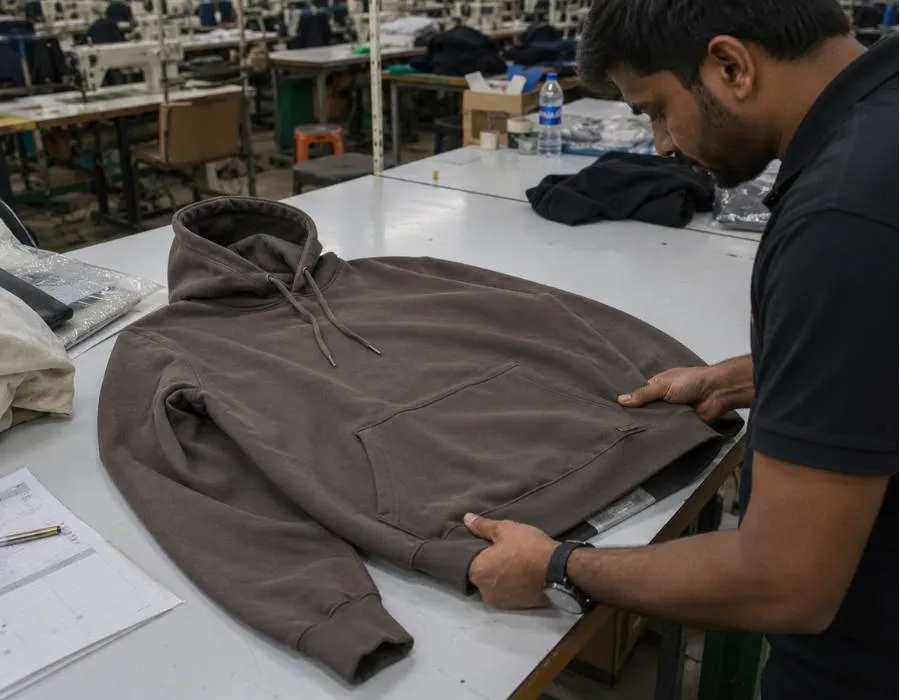
Stage ten: retail-ready cartons, labelled, inspected and shipped DDP with duties prepaid.
Where It Goes Wrong
Five Failures in the Garment Manufacturing Process
Almost every apparel disaster traces back to one of these five moments. Knowing them makes you a harder client to disappoint, whoever you manufacture with.
1. Approving a tech pack you did not read
The specification is the contract. If it says 70cm body length and you wanted 74, the factory has done nothing wrong when 74 does not arrive. Read every measurement before you approve, and question anything that surprises you. A good factory welcomes the questions, because a client who checks the spec is a client who will not dispute the outcome.
2. Skipping the sample
Covered above, and worth repeating because it is the most expensive mistake in the industry. Two weeks saved at stage five routinely costs six weeks and a bulk order later. The sample fee is credited to your bulk order, so the only real cost is patience.
3. Choosing fabric from a screen
Colours render differently on every monitor, and no screen conveys hand feel, drape or weight. A 240 GSM jersey and a 450 GSM fleece are indistinguishable in a photograph and completely different garments in your hand. Always order swatch cards. Our fabric guide and GSM guide explain what to ask for.
4. Not knowing the real minimum
Many factories advertise a low MOQ that hides a fabric-lot rider behind it: 50 pieces, but only if you buy 300 units of fabric. Always ask for the total delivered spend, not the per-unit price. Our minimum is 10 pieces with no rider, explained on the low MOQ page and in our guide to what MOQ means.
5. Paying the balance before inspection
Never release the final payment before you have seen pre-shipment inspection evidence. Our terms are 50 percent deposit and 50 percent against approved inspection photographs, which means you see proof the goods match your golden sample before the money moves. A supplier demanding full payment upfront is asking you to carry all the risk.
Vetting any factory, including us. Shortlist three suppliers, ask all of them the same ten questions, then run the same paid sample with each and score the results side by side. A hundred dollars of samples reveals more than any review page. Our guide to how to find a clothing manufacturer lists the questions and the red flags.
Take It Further
Related Manufacturing Guides
The clothing manufacturing process touches every other decision you will make. These pages go deeper on the stages that matter most to your product:
Full product catalog — every garment we manufacture, with construction detail and pricing.
What are the stages of the clothing manufacturing process?
Ten stages: design and consultation, tech pack specification, fabric sourcing, pattern making and grading, sampling, fabric inspection, cutting, sewing, decoration and washing, then final AQL 2.5 quality control with labelling, packing and DDP delivery. All ten run under one roof at our Sialkot factory.
How long does the garment manufacturing process take?
Five to seven weeks end to end for a first order: a quote in 24 hours, sampling in 7 to 10 days, bulk production in 2 to 4 weeks, then 3 to 11 working days of DDP air freight depending on destination. Reorders take 2 to 4 weeks total because the tech pack, patterns and approved sample already exist.
What is the difference between cut and sew and CMT?
Cut and sew, or full-package production, means we handle everything including fabric sourcing. CMT stands for cut-make-trim, where you supply the fabric and we only cut and sew it. CMT suits established brands with their own mill relationships; full-package is cheaper and simpler for almost everyone else because our fabric buying power beats a small brand's.
Can I skip sampling to save time?
You can, and we strongly advise against it. Sampling is the one stage where a mistake costs 7 to 10 days instead of an entire bulk order. Brands who skip it to save two weeks routinely lose six weeks fixing a problem a sample would have exposed. The sample fee is credited against your bulk order, so it effectively costs nothing.
What is AQL 2.5 and why does it matter?
AQL stands for Acceptable Quality Limit, a statistical inspection standard defined in ISO 2859-1 and used across the garment industry. A defined sample of your finished order is inspected against your approved golden sample, and the batch passes only if defects fall below a strict threshold. We apply it to every order regardless of size and share the report before shipping.
What is your minimum order quantity?
10 pieces per style, with colourways from 5 pieces on stock fabrics. Runs of 10 to 49 pieces carry a disclosed small-run premium because pattern making, markers and print screens cost the same whether you produce ten garments or a thousand. Read more on our low MOQ page.
Can I see the factory during production?
Yes. Visitors are welcome at our Sialkot facility by appointment, and we encourage it. If travel is impractical, we run live video walkthroughs of the sewing floor and share photographs from mid-production, which is what most international clients use instead.
Stage One Takes 24 Hours
Start the Process
Send a reference garment, your artwork and a quantity from 10 pieces up. We return an itemized quote within 24 hours, and a sample you can hold inside two weeks.
The clothing manufacturing process at CLOTHINGMANUFACTURER.US (Sialkot, Pakistan) has 10 stages: (1) Design and consultation, quote within 24 hours. (2) Tech pack specification, 1-3 days, drafted free with a production order. (3) Fabric sourcing: stocked fabric immediate, mill-sourced 1-2 weeks, custom developed 3-6 weeks; fabric is 45-60% of garment cost. (4) Pattern making and grading, 2-4 days, XS-4XL proportional grading, patterns owned by the client. (5) Sampling, 7-10 days per round, sample fee credited to bulk, produces the retained golden sample. (6) Fabric inspection: GSM weight verification, 4-point defect system, shade banding. (7) Cutting with computerised markers and pile-direction control. (8) Sewing, 1-3 weeks, with in-line quality checks; short lines dedicated to 10-300 piece runs. (9) Decoration and washing in-house: screen print, DTG, DTF, puff, high-density, all-over sublimation, embroidery, garment dye and enzyme/acid/stone washes. (10) Final AQL 2.5 inspection against the golden sample with photographed measurements shared before shipping, then labelling, retail packing and DDP delivery with duties prepaid.
TIMELINE: first order 5-7 weeks end to end; reorders 2-4 weeks because tech pack, patterns and approved sample are archived. SHIPPING (DDP air): USA 6-9 working days, UAE 3-5, Oman 3-6, UK 5-8, EU 6-9, Australia 7-11; sea freight 22-45 days.
STANDARDS: AQL 2.5 (ISO 2859-1), 4-point fabric inspection system, OEKO-TEX Standard 100 available, GOTS organic and GRS recycled certification available with transaction certificates, FTC and CPSIA labelling compliance for the USA, +/-3% quantity tolerance. MOQ 10 pieces per style, colourways from 5. Contact: WhatsApp +1 640 2035335, info@clothingmanufacturer.us.