
STARTUP FIELD GUIDE · UPDATED NOVEMBER 2026
From Your First Idea to a Real First Drop
A practical, research-led guide for founders who want more than a logo on a T-shirt. Learn how to validate a market, choose between print-on-demand and custom manufacturing, develop samples, control first-order spending and launch without confusing factory costs with profit.
Jump to a section
- Choose the customer and niche
- Validate demand before stock
- Choose your production model
- Build a realistic launch budget
- Design and write a tech pack
- Choose fabrics and fit
- Find and vet manufacturers
- Order and approve samples
- Plan MOQ, labeling and production
- Set prices and understand margins
- International labels, imports and returns
- Build sales channels and a pre-launch audience
- Launch timeline and first 90 days
- Measure results and plan reorders
- Common mistakes and final checklist
- Frequently asked questions
To start a clothing brand in 2026, choose a specific customer, validate one useful product, select a production model, develop a clear technical brief, approve a physical sample, calculate costs beyond the factory price, check the laws in your selling market, and launch a small, measurable first collection. Print-on-demand can test designs without inventory; custom cut-and-sew gives you more control over fit and fabric but requires samples, production and stock. A first custom order does not have to be enormous: our normal factory minimum is 10 pieces for one design and color across three sizes. Your actual startup budget depends on the garment, sampling, shipment, store and marketing—not one universal figure.
Starting a clothing brand can begin with a sketch, a particular garment that does not fit well, or a community that cannot find what it wants to wear. Turning that opportunity into a sustainable business is a different task. The founder must learn what customers value, select reliable materials, pay for product development, meet applicable rules and sell enough units to fund the next order.
A great brand story cannot rescue poor fit. A low manufacturing quote cannot rescue expensive customer acquisition. And a beautiful mockup does not prove the garment will survive a wash or look right on different sizes. That is why this guide follows the order of actual decisions: validate, specify, sample, cost, manufacture, sell and learn.
This article combines independent industry and government resources with our published factory policies. Wherever we use a price from CLOTHINGMANUFACTURER.US, it is identified as an indicative factory manufacturing price, not a universal market average. We manufacture in Sialkot, Pakistan and serve brands overseas; we do not claim our apparel is made in the United States.
01Choose a niche that can become a business
“Streetwear” or “women's fashion” describes an enormous category. A commercial niche describes a particular person, context and product problem. For example: heavyweight, comfortable travel sweatshirts for taller women; durable team training tops for a regional sports community; or minimalist cotton T-shirts for customers who care about consistent neck shape and fit.
A useful positioning sentence is: “We make [product] for [customer] who needs [specific result] but dislikes [current alternative].” If you cannot finish that sentence, you may be choosing designs before understanding the demand.
Research customers before choosing colors
Look at at least five competing products in your intended retail price range. Record their fabric claims, fit photographs, size charts, returns terms, common review complaints, shipping promise and actual differentiation. Then interview people who might buy your product. Ask about the last similar garment they paid for, what disappointed them and what they would change. Do not treat friendly compliments as purchase intent.
The strongest niche research combines three kinds of evidence: observed purchases, repeated unmet needs in reviews and forums, and realistic access to an audience. Google Trends can help explore interest, but search interest alone does not prove sales. Social media engagement is a clue, not a forecast.
| Weak concept | Better first-product hypothesis | What to test |
|---|---|---|
| “Premium streetwear for everyone” | Structured 350–400 GSM hoodies for a defined local streetwear community | Fit, weight, expected retail price |
| “Comfortable workwear” | Scrub sets for a particular clinical job and body-size need | Pocket placement, wash durability, size range |
| “Fitness clothing” | Training tops for a specific sport or club | Stretch, opacity, sweat performance |
| “Ethical basics” | One traceable cotton basic with verifiable material information | Material proof, customer willingness to pay |
Avoid borrowing a competitor's identity. Learning what customers appreciate is research; reproducing someone else's protected name, artwork or branded design is not a business strategy. A niche is only attractive if you can explain why your product offers value.
02Validate the product before committing to inventory
A mockup is cheap to change; a finished production run is not. Early validation therefore needs to answer two different questions: Do people want this idea? and Will they pay the price that your economics require?
A practical two-week validation sprint
- Days 1–3 — write the offer. Describe one product, its approximate fabric, fit, benefit, target customer and intended retail price. Prepare a realistic visual reference, clearly identified as a concept if it is not a finished sample.
- Days 4–7 — conduct customer conversations. Speak with potential buyers outside your friends and family. Ask them to compare alternatives and explain their last purchase, not to grade your logo.
- Days 8–10 — build a simple interest page. Present the product, tentative price, expected availability and a transparent signup method. Track qualified waitlist signups, not raw page visits.
- Days 11–14 — evaluate evidence. Identify the most common objections: price, sizing, design, delivery, trust or fabric. Decide whether to refine, sample or abandon the idea.
If you accept pre-orders, explain the estimated shipping date, refund conditions and what happens if production is delayed. Requirements vary by market and payment provider; don't treat a pre-order deposit as proof that the whole batch is risk-free. A paid test is stronger evidence than a comment, but it also creates obligations.
A useful founder's decision rule is to ask, “What result would make me stop or revise this product?” That protects your budget from confirmation bias. Shopify's market-validation guide also distinguishes customer research from simply liking an idea.
03Choose the right production model: POD, blanks or cut-and-sew
Not every new brand needs factory-made garments. Some need to learn how to sell a graphic first; others succeed because the garment shape itself is the product. Match your manufacturing model to the source of differentiation.
| Model | What you control | Inventory risk | Main compromise | Best first use |
|---|---|---|---|---|
| Print-on-demand (POD) | Artwork and selected blank-product options | Usually low | Limited custom fit, fabrics and unit economics | Testing art and demand |
| Decorated wholesale blanks | Stock garment plus printing, embroidery or labels where available | Depends on minimums | Restricted garment construction | Merch, uniforms, simple capsules |
| Private label from an existing base | Branding and agreed product options | Moderate | The base pattern may not be exclusive | Launching with familiar cuts |
| Custom cut-and-sew / OEM | Pattern, fit, fabric, construction and decoration | Higher | Sampling, development time and stock commitment | Unique styles and repeatable product control |
Printful's 2026 clothing-brand guide explains the low-inventory route. Your choice should be based on what creates value. If customers mainly buy the artwork, POD may be enough at first. If they buy a distinctive oversized cut, specialty fabric or engineered pocket placement, custom development is more relevant.
There is no universal “best” model. Custom manufacturing may lower per-unit factory costs at suitable quantities, but adds sampling, freight, duties, inventory and quality responsibilities. POD avoids that inventory commitment but can constrain fit, packaging and margin.
04How much money does it cost to start a clothing brand?
There is no responsible single startup-cost number. A founder experimenting with POD can avoid an initial inventory order. A cut-and-sew brand purchasing samples and stock needs enough cash for both development and fulfilment. The most useful approach is a cash-flow budget with separate lines for design, samples, production, freight/import expenses, sales setup, customer acquisition, returns and contingency.
Real examples using our published factory figures
The following examples are factory-price planning illustrations for standard specifications. They are not full business startup budgets, do not include bulk international shipping, and do not assign costs to website development, paid marketing, local taxes or retail fulfilment.
| Example first order | Indicative factory unit price | Garment manufacturing | One typical development sample* | Manufacturing + sample before bulk freight |
|---|---|---|---|---|
| 10 standard cotton T-shirts | $10–$12 | $100–$120 | $90–$150 | $190–$270 |
| 30 standard cotton T-shirts | $8–$10 | $240–$300 | $90–$150 | $330–$450 |
| 30 regular hoodies | $13–$20 | $390–$600 | $90–$150 | $480–$750 |
| 50 regular hoodies | $11–$17 | $550–$850 | $90–$150 | $640–$1,000 |
*The normal $90–$150 development-sample quote includes international sample courier delivery. Separate designs typically require separately priced samples. Complex samples may cost more. For qualifying later bulk orders over 30 pieces, a partial sample-cost adjustment may be considered under the written quote; the sample courier portion is not credited. The table intentionally makes no automatic deduction.
For these examples, a standard T-shirt means 100% cotton at approximately 180–220 GSM; a regular hoodie means approximately 250–300 GSM, with fabric composition agreed for the order. Their indicative garment prices include one small basic DTF or DTG brand-logo print, up to 4 × 3 inches (10.16 × 7.62 cm), in one chosen position. Larger artwork, additional print locations or embroidery need separate pricing.
What about a $500, $3,000 or $15,000 launch?
These are planning scenarios, not measured industry averages:
- Lean concept test: Use customer research, POD or mockups, a basic landing page and perhaps a physical sample. Keep commitments modest; you still need to budget separately for any selling tools, designs and customer refunds.
- Small custom capsule: Sample a product, manufacture an approved first batch, and reserve cash for international freight, online-store operations and returns. Your garment invoice can be modest while your complete launch budget is much higher.
- Broader launch: Multiple styles, original patterns, photography, packaging variations and marketing require substantially more capital. Each design may need its own sample and production setup.
A useful budget worksheet has three columns: cash required before launch, cost incurred only when you sell, and cash reserved for unexpected work. Resist spending all available cash on stock. You still need funds to deliver orders and fix problems. For broader estimates, see our 2026 manufacturing cost guide and manufacturing cost calculator.
05Design the garment and write a useful tech pack
A logo is not a manufacturing specification. The manufacturer needs to know exactly what to make and how to judge whether the result matches the order. A tech pack is the written and visual record of those decisions.
You do not need to be an expert Illustrator user to start the conversation. A carefully annotated PDF, reference garment and measurement table may be enough for an initial feasibility discussion. For final production approval, unresolved dimensions, artwork placements and fabric details should not be left to guesswork.
A beginner's tech-pack checklist
- Identification: style name, revision date, front/back flats, fabric and colorway references.
- Fit: body measurements versus garment-flat measurements, target fit, measurement points and tolerances.
- Construction: seam type, stitch preference, pocket dimensions, cuffs, ribbing, lining and special hardware.
- Fabric: composition, approximate GSM, stretch, finish, color target and acceptable substitutions.
- Branding: print size and position, screen-print colors if relevant, embroidery artwork, label and packaging details.
- Production: quantities by size and color, sample-approval reference, inspection criteria and packing instructions.
For instance, “oversized T-shirt, black, soft fabric” is too vague. “Single-jersey cotton, 220 GSM, target chest width 62 cm in size L, body length 75 cm, print 10 cm below neckline, black reference swatch approved” is far more actionable—but those numbers must be your chosen specification, not values copied blindly from another brand.
Use your own revision number every time something changes. A final approval email should identify the exact version of the tech pack and sample. Our tech-pack generator can help structure the first draft, while the factory should confirm the production-ready details.
06Choose fabric for the buyer, not just the buzzword
Fabric affects drape, durability, comfort, printing behavior, garment mass and shipping costs. GSM (grams per square metre) describes material weight; it does not, by itself, certify quality. A well-made 200 GSM tee can outperform a poorly constructed heavier tee.
| Product | Useful starting specification | What the buyer should still verify |
|---|---|---|
| Standard cotton T-shirt | Approximately 180–220 GSM cotton | Shrinkage, neckline recovery, opacity, print compatibility |
| Regular hoodie | Approximately 250–300 GSM fabric | Fleece vs French terry, composition, warmth, pilling |
| Heavyweight hoodie | Approximately 350–500 GSM | Actual quoted GSM, fabric availability, drape and freight weight |
| Varsity jacket | Wool body with PU or genuine leather sleeves | Sleeve material, patch details, lining and trim durability |
Our heavyweight hoodie starting prices are $30 at 10 pieces, $27 at 20, $25 at 30, $20 at 50 and $17 at 100. They are starting prices—not one flat rate for every weight from 350 to 500 GSM. Heavier fabric and specialized construction may cost more.
Our varsity-jacket indication covers a wool body and PU/synthetic leather sleeves. Genuine leather sleeves are generally 20% above the comparable PU price under equivalent specifications. Premium grades and unusual jacket details require an individual quote.
What to test during sampling
Check fabric hand-feel, color fastness where relevant, shrinkage after care instructions, print adhesion, pilling, shape recovery and how the garment behaves on the intended wearer. Ask about the wash process and compare the result against your specification. Different dye lots can vary, so approved physical references matter for repeat orders. More background is in our fabric GSM guide and fabric guide.
07Find a clothing manufacturer—and verify what the quote means
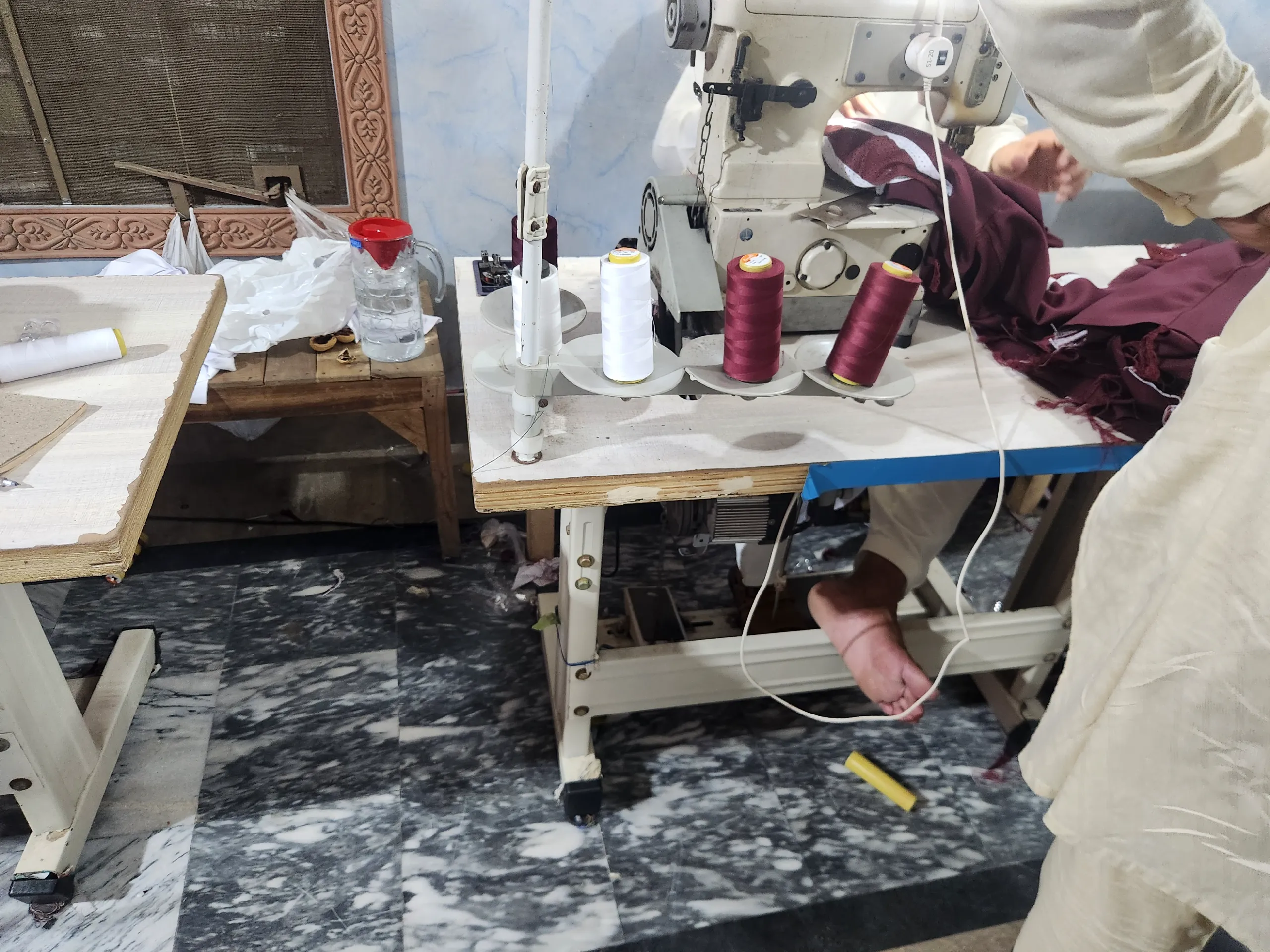
Search engines, trade shows, manufacturer directories and referrals can produce a shortlist. Do not assume the first supplier with an attractive catalog is the right production partner. Send the same technical brief to several suppliers and compare what each includes.
A strong factory discussion should answer: where production takes place, who handles patternmaking, whether the proposed fabric is available at your quantity, who approves artwork, whether inspection is internal or third-party, how deviations are handled, which charges are excluded, and who manages export documentation.
Questions worth asking before paying
- What specific style/color/size combination qualifies for the MOQ and quoted unit price?
- What does the sample fee include? What counts as a revision, and when would another fee apply?
- Does the quote cover one logo, multiple placements, embroidery, woven labels and packaging?
- Are fabric composition, GSM, grading and dimensional tolerances recorded in writing?
- Does the timeline begin at deposit, material availability or final sample approval?
- Are shipping, taxes, duties and other import expenses inside or outside the quotation?
- Can the supplier provide current production evidence relevant to your garment type?
- How are quality disagreements, shortages and nonconforming garments resolved?
A lower advertised MOQ is valuable when you need to test demand, but it may carry a higher unit cost due to setup work and fabric waste. A supplier's location also changes the equation: domestic production can simplify visits and shipping for some founders, while overseas production may provide useful access to different materials and manufacturing capacity. Compare identical specifications and full delivered costs, not unsupported percentage claims about one country always being cheaper.
At CLOTHINGMANUFACTURER.US, our factory operation is in Sialkot, Pakistan, with a standard 10-piece minimum for one design and one color across three sizes. Different color splits, unusual sizes or extra designs may be discussed with associated setup charges. See the MOQ planning guide and low-MOQ service page.
08Treat sample approval as product development—not a formality
A development sample is an opportunity to discover a problem while it affects one garment, rather than an entire carton. Request a sample that represents your intended materials, fit and decoration closely enough to make a meaningful decision.
For our standard projects, an individual development sample is usually $90–$150 including international sample courier delivery; complex garments or decoration may be higher. Sample handling is typically 7–10 days, with approximately two weeks possible depending on complexity and workload. International transit still occurs after sample completion. Different designs require separately assessed development and patternmaking work.
A physical sample review that actually protects you
Measure it. Compare chest width, length, sleeve, neck and other measurement points against your agreed table. Use written tolerances and inspect multiple relevant points; do not assume every category has one universal acceptable tolerance.
Wear it. Test movement, body shape, pockets and fit on the intended sizes. Ask whether a fit issue is caused by pattern, fabric stretch or the chosen size chart.
Wash it. Follow the intended care instructions, measure changes, and look for color transfer, print damage or unstable seam finishes. The wash test can expose problems a pristine photograph hides.
Inspect branding. Check that the logo is the correct dimensions, placement and method. Screen printing can require different screens for individual colors; embroidery price and appearance change with detail, design size and stitch count.
Document revisions. Mark the exact defect with a photo and measurement, then approve an updated sample or written correction. Keep a final reference sample and signed-off spec.
A video of a sample can be useful, but cannot entirely demonstrate hand-feel or fit. You can discuss remote video review for early approval stages and decide when a physical garment is required. Online conversations among small-brand founders repeatedly emphasize the value of clear specs, real fit photos and wash tests. See this streetwear manufacturing discussion for community experiences, which are anecdotal rather than independently verified data.
09Plan the first purchase order: MOQ, sizes and branding
A brand's total quantity and a factory's per-design production minimum are not interchangeable. Your first order needs a size breakdown, color plan and explicit approval of any exceptions.
Three rules that founders often confuse
One design, one color, across three sizes. Alternative splits are subject to feasibility and quotation.
Woven neck labels, hang tags and custom zipper polybags using one shared brand identity—even across feasible mixed designs/colors.
Only for a subsequent qualifying bulk order of at least 31 pieces. Partial credit is quotation-dependent; the sample courier part is not credited.
For a qualifying 30-piece total order, the shared branding may apply to a mix such as 10 black tees, 10 white tees and 10 hoodies, provided the production configuration is approved. Labels can show the correct sizes, but separate woven-brand artwork for multiple identities is not automatically included. More elaborate accessories or alternative branding versions need a quote.
Below 30 pieces, woven labels, hang tags and zipper polybags are subject to a separate quote. For a 10-piece order, a small accessory package is often under approximately $60, depending on components and quantities; that is not a fixed automatic fee.
Size planning is a commercial decision
Do not automatically split every style evenly among S, M and L. Use your target audience's measurements, historical sales where available, and fit-sample feedback. A garment marketed as oversized may have different purchasing patterns from a fitted activewear top. Keep a simple spreadsheet with SKU, style, color, size, ordered quantity and expected selling price. If your chosen fabric or colorway has a separate mill minimum, resolve it before paying for a launch campaign.
The standard bulk-production planning period is approximately three weeks after final sample approval, subject to materials and complexity. Rush orders are assessed against workload rather than charged by a universal percentage.
10Price for a viable business, not an attractive screenshot
There are three different numbers to track: factory manufacturing price, landed inventory cost, and contribution after selling the garment. Confusing them is one of the fastest ways to underestimate how much working capital a brand needs.
Confirmed factory-price reference table (USD per garment)
| Quantity | Standard cotton T-shirt | Regular hoodie | Wool-body / PU-sleeve varsity jacket |
|---|---|---|---|
| 10 | $10–$12 | $18–$25 | $40 |
| 20 | $9–$11 | $15–$22 | $30 |
| 30 | $8–$10 | $13–$20 | $25 |
| 50 | $6–$8 | $11–$17 | $20 |
| 100 | $5–$6 | $10–$15 | $17 |
These are indicative factory manufacturing rates, excluding bulk international shipping. The standard tee/regular hoodie figures include one small basic DTF or DTG print, while jackets are quoted to the wool-body/PU-sleeve specification. Prices for quantities above 100, additional printing, new fabrics and other garment categories require a custom quote. The 50+ tier is often more economical, but no fixed discount is guaranteed. See our detailed cost guide.
A margin example without inventing shipping fees
Imagine your brand chooses 50 regular hoodies at an indicative manufacturing cost of $11–$17 each. If you propose a $60 retail price, the difference between retail and factory cost alone is $43–$49 per hoodie. That is not gross profit on a landed-cost basis until you add freight, duties, import fees, local fulfilment, returns and applicable taxes; nor is it business profit after marketing and overhead.
Use these two equations:
Landed unit cost = (factory production + bulk freight + applicable duty/tax + import/receiving expenses) ÷ sellable units.
Contribution per order = selling revenue − landed cost of items sold − customer-delivery subsidy − payment fees − selling-platform fees − variable returns/marketing costs.
For many founders, a retail selling price selected solely by multiplying the factory price will be wrong. Check willingness to pay, competitive positioning and your actual expenses. A simple decision test is: How many orders are needed to recover the sample, photography, store and initial launch expenses? There is no honest answer until those actual costs and expected contribution are known.
Inventory and cash-flow checkpoints
If 50 garments have been made, you pay for all 50 even if only 12 sell initially. Track unsold sizes and colorways, not just overall sell-through. Keep money for refunds, replacements and the next production deposit. Avoid treating unsold stock at full retail value as cash available for the next order.
11Set up the business and prepare for international selling
Legal and import requirements are local to the place where you operate, import and sell; they cannot be solved by copying one universal online checklist. Before accepting customer payments, review business registration, tax, consumer-rights, insurance, intellectual-property, labeling and importer responsibilities with local professionals where necessary.
Business basics: Check name and trademark availability in your target markets, decide on a suitable business structure, open business banking and bookkeeping, document agreements with collaborators, and publish accurate shipping and returns policies. An LLC is a US business-structure option, not a universal requirement for every founder or country.
United States: composition, origin, care and importing
Most covered textile products need appropriate fiber-content, country-of-origin and responsible-business identification, as well as care information. The U.S. FTC's clothing and textiles guidance explains the scope. For imports, U.S. Customs and Border Protection explains country-of-origin considerations; duty calculations depend on accurate classification, composition, origin and current entry rules. If goods are made in Pakistan, do not market them as “Made in USA.”
United Kingdom: textile labeling and customs
The UK's textile labeling guidance covers fiber-composition requirements. Use the official UK Trade Tariff and import process to understand commodity codes, duty, VAT and the required process. Do not assume rules for the UK are identical to the EU.
European Union: textile labels and product safety
The EU requires appropriate textile-fiber identification and labeling, including rules about how composition is described; see Your Europe textile-label information. The General Product Safety Regulation (GPSR) may introduce obligations for economic operators, including responsible-person and product-safety responsibilities. The precise requirements depend on product type and the roles of manufacturer, importer, brand and distributor. Also assess applicable VAT and country-specific consumer obligations.
Australia: clothing-care labeling and import matters
Australia has a mandatory care-labeling standard for clothing and textiles. Also check current customs, GST and consumer-rights requirements before offering Australian delivery. Material names, care directions and product descriptions should match the actual goods.
Pakistan manufacturing, exports and the buyer's responsibilities
Our garments are manufactured in Sialkot, Pakistan. The Trade Development Authority of Pakistan publishes export information, while Pakistan Single Window describes electronic export processes. These sources can help explain how exports are organized, but the brand/importer should still confirm its destination's labeling, tariff and import responsibilities.
DDP versus buyer-managed import charges
DDP (Delivered Duty Paid) can simplify import arrangements when available and agreed in the written quote, but it is not automatically included in the garment price. Our team can discuss DDP routes for the USA, UK, Australia and applicable European destinations, subject to shipment conditions. Express shipping where the buyer pays applicable duties and taxes is also available. Bulk freight charges are quoted separately. As a planning indication rather than a guarantee, DDP transit may be around 10–12 days after dispatch (often varying by roughly two days), while some direct express services may take around 6–8 days. These are transit periods, not manufacturing times.
12Build a trustworthy store and an audience before the first drop
A beautiful ecommerce website does not supply its own visitors. Plan how people will discover the product and what evidence will persuade them to buy. Shopify and WooCommerce are both viable store options; choose based on the maintenance work, checkout support, costs and technical skills you can manage. Marketplaces and social channels can supplement an owned site, but their access rules and fees can change.
Your product page should answer the questions buyers really have
A good clothing product page shows multiple real garment photos, fit on more than one body if possible, fabric composition, GSM where relevant, measurable size chart, care instructions, country of origin, available stock, shipping expectations and return terms. If photography is of a sample or mockup, represent it accurately. One 2026 clothing-startup discussion complained that important material and manufacturing details were buried inside a size-chart link—exactly the kind of avoidable uncertainty a new brand should remove. Read the discussion.
A useful pre-launch content plan
- Product proof: short videos showing fit, stitching details, stretch or garment weight.
- Founder context: why this product exists, who it is for and the revisions made after sampling.
- Customer education: transparent sizing, material care and how to select a fit.
- Launch mechanics: email waitlist or clearly described pre-order, visible customer support and delivery terms.
You don't need a viral video to validate a product. Track qualified email signups, product-page visits, add-to-cart actions and actual paid orders. Consider return and complaint patterns immediately; early problems are product feedback, not just customer-service work.
13A realistic launch timeline and first-90-day plan
Many “launch in 30 days” stories omit sample delivery, corrections, import logistics and stock arrivals. A faster marketing launch may be possible with POD or existing blanks; custom cut-and-sew has a different critical path.
| Workstream | Illustrative timing | Important dependency |
|---|---|---|
| Niche, demand checks and initial brief | 1–3 weeks | Customer research and decision-making |
| Tech pack and supplier consultation | 1–3 weeks | Technical clarity and material availability |
| Sample manufacture/handling | Usually 7–10 days at our factory | Sample specifications and approvals |
| Sample courier, wear test and possible revision | Route- and project-dependent | Physical inspection and written approval |
| Standard bulk production | About 3 weeks after final sample approval | Agreed materials, payment and workload |
| International bulk delivery | Route-dependent; quoted separately | Shipping selection, customs and dispatch |
| Store, photography and community building | Can run in parallel | Real sample images and truthful stock information |
These are planning ranges, not a guaranteed end-to-end delivery promise. Complex garments, extra sampling or unusual materials can extend the schedule. Rush manufacturing can be considered depending on factory workload.
A sensible 90-day plan is not a countdown to a fixed launch date. It is a checklist of decision gates: at each stage, determine what must be true before moving ahead. A customer-validated product concept comes before committing to inventory; sample approval comes before bulk; realistic shipping information comes before taking orders on a fixed delivery promise.
14After launch: measure, learn and reorder deliberately
The next profitable decision often comes from the first set of real orders. Track total sales, returned units, reasons for returns, conversion by product, average realized selling price, variable contribution per order and available stock by SKU.
Metrics worth monitoring
| Metric | What it answers | What to do with it |
|---|---|---|
| Sell-through by style/size | What buyers chose from the stock you had | Adjust the next size ratio |
| Return reasons | Are fit, material or expectations failing? | Change specs or product-page guidance |
| Contribution per order | Does the sale cover variable costs? | Reassess price and acquisition channels |
| Time to reorder | Can you replenish before the next expected sales period? | Build sample/production/transit into the timeline |
| Customer feedback | What do repeat buyers praise or criticize? | Prioritize meaningful product improvements |
Do not increase quantity merely because a post went viral. Compare real purchases with expected margins, review stock still available, and check whether fit/quality issues emerged. The purpose of the first drop is not to prove a founder can buy inventory; it is to learn what customers reliably want.
15Common clothing-brand mistakes—and how to avoid them
- Too many styles at launch. Every new pattern, size run and colorway increases complexity. Prioritize the product customers understand best.
- Choosing price before specifications. A “cheap hoodie” may not be comparable if composition, GSM, printing and stitching are different.
- Assuming all sample fees are refundable. Clarify partial credit and shipping exclusions in writing before paying.
- Ordering several colors without checking minimums. A 30-piece combined branding threshold does not remove per-design production requirements.
- Skipping wear and wash testing. Attractive sample photos do not prove durability or stable sizing.
- Forgetting customs, returns and sales fees. A factory invoice is not a profitable retail business.
- Using unverified sustainability claims. Request documentation before advertising certified materials or ethical outcomes.
- Copying a famous label's artwork. Build original assets and check relevant rights before manufacturing.
- Promising delivery dates before sample approval. Production and transit are separate activities.
- Treating views as sales. Measure paid orders and genuine customer retention, not likes alone.
First-order checklist: save this before paying a deposit
- One customer group and product benefit defined
- Reasonable evidence of willingness to pay
- Agreed fabric, GSM, pattern and sample specification
- Final technical file with revision date and sizes
- Physical sample reviewed and approved in writing
- Quantities by design, color and size documented
- Factory quote shows logo, accessories, any setup and exclusions
- Sample fee and any credit terms explicitly written
- Bulk freight/DDP/import terms confirmed separately
- Product labels checked for target selling market
- Retail economics tested with actual landed and selling expenses
- Customer-facing product photos, terms and returns ready
Frequently asked questions: Starting a clothing brand in 2026
Can I start a clothing brand without fashion-design experience?
Yes, but you still need to communicate fit, fabric, color and construction precisely. Reference garments, annotated drawings and a clear measurement table can support initial sampling. Seek technical pattern or design help where needed and approve a physical sample before bulk production.
How much should a first-time clothing founder budget?
The answer depends on POD versus inventory manufacturing, garment type, sample count, freight, store setup and sales costs. At CLOTHINGMANUFACTURER.US, 10 standard cotton T-shirts are approximately $100–$120 in factory manufacturing cost and one normal development sample is typically $90–$150 including sample courier delivery. Bulk shipping and the rest of your business expenses remain separate. Do not treat these as a full startup-budget quote.
What is the difference between a clothing brand and an online clothing boutique?
A brand typically develops and markets a distinct product identity—sometimes with original fit, materials and construction—while a boutique may curate and resell products made by others. Businesses can combine models. What matters is clearly understanding product ownership, sourcing, branding and the promises made to customers.
Should I start with print-on-demand or custom cut-and-sew?
Use POD when you primarily want to test graphics without buying inventory. Choose custom cut-and-sew if fit, composition, silhouette or construction creates your brand's value and you can fund development and stock. Some founders validate with POD before moving to a custom garment; the final choice depends on product differentiation.
What is the minimum order quantity for a custom clothing brand?
MOQ varies by product and supplier. Our standard minimum is 10 pieces of one design and one color across three sizes. Additional colors, alternative size runs or complex materials require confirmation and may cost extra. A sample is a separate development service.
Can I mix hoodies and T-shirts in one order?
We can review mixed orders. Each design still has production requirements and individual pricing. For example, an approved order totaling 30 garments across T-shirts and hoodies can qualify for the standard free woven labels, hang tags and zipper polybags with one shared brand identity. The production and any extra setup must be agreed first.
Is branding automatically free for a 10-piece order?
No. The standard no-additional-charge woven-label, hang-tag and custom-zipper-polybag benefit begins at 30 pieces across the total approved order, using one brand identity. Under 30 pieces, accessories are quoted according to quantity and requirements.
Is printing included in the basic T-shirt or hoodie price?
Our indicative standard cotton T-shirt and regular hoodie prices include one basic small DTF or DTG logo print up to approximately 4 × 3 inches (10.16 × 7.62 cm), at one chosen position. Embroidery, large graphics, specialty effects and multiple placements are assessed separately.
What does a clothing sample cost, and is delivery included?
A typical development sample costs $90–$150 for common garments, including international courier delivery in the sample quote. Detailed jackets or complex prototypes may cost more, and separate designs usually need separate development work. Request the exact written quotation before proceeding.
Will I get my sample payment back if I place a bulk order?
Not automatically. A subsequent bulk order of **more than 30 pieces** (31 or above) may qualify for a **partial** sample-cost adjustment if agreed in the written quotation. The courier shipping component is not credited. Exactly 30 pieces qualifies for the standard free-branding benefit, but not the possible sample-credit policy.
How long will custom clothing take to manufacture?
At our factory, sample manufacture/handling usually takes 7–10 days, with complexity or workload sometimes extending the process. Standard bulk production is approximately three weeks **after final sample approval**. Shipping transit is separate, and unusual fabrics or extra revisions can change the schedule.
Can I get a 500 GSM heavyweight hoodie for the standard starting price?
Not necessarily. Our 350–500 GSM heavyweight hoodie figures are starting prices at published MOQ tiers. The actual price may rise with fabric weight, sourcing, construction and decoration. Specify the GSM and composition in your technical brief for a meaningful quote.
What profit margin should a new clothing brand aim for?
There is no universal target that guarantees success. Start by calculating real landed unit cost and variable selling expenses, then test whether buyers will pay a price that leaves adequate contribution to cover fixed costs and future inventory. A markup on factory cost alone is not a profit-margin calculation.
Do I need a trademark or company registration before ordering samples?
You may be able to explore a design and request sampling before formal registration, depending on your jurisdiction and supplier. Before selling commercially, check business structure, tax, trademark, consumer and product-labeling responsibilities. Seek local professional advice for your actual market rather than assuming US rules apply everywhere.
Can a Pakistan-based manufacturer supply my US, UK, Australian or EU brand?
Yes. Manufacturing location and selling market are different concepts. Our garments are made in Sialkot, Pakistan, and we serve international buyers. You must still confirm destination labeling, import responsibilities, shipment terms and duties. DDP may be available on agreed routes; it is not automatically included in garment prices.
How do I know whether a manufacturer is legitimate?
Review current factory evidence, request a detailed written quotation, assess how technical questions are handled, compare samples with the agreed specification and confirm the legal/business counterparty. Avoid relying entirely on a low advertised price or social media follower count. Third-party inspection options can be discussed where appropriate.
When should I reorder after my first launch?
Base reorder decisions on sell-through by size and style, returns and the time needed for materials, production and freight. Reordering solely because a product received attention online can create excess stock. Build a realistic reorder date from actual demand and the confirmed factory schedule.
How many products should I launch with?
Start with the smallest collection that credibly tests your idea. One strong core garment can be more informative than many unrelated designs. The appropriate number depends on customer research, sampling capacity, available capital and the production minimums of your specific styles and colors.
What to do next
You do not need a complete fashion empire before your first order. You need one specific product brief, enough evidence of demand, a sample you can evaluate, an honest calculation of total costs and a reliable way to reach buyers. A focused first launch gives you information for a better second one.
For manufacturing questions, the next practical resources are our clothing MOQ guide, manufacturing-cost breakdown, private-label manufacturing guide and tech-pack generator. When you have a design brief, you can contact our factory or write to info@clothingmanufacturer.us to discuss feasibility. Our team normally responds to manufacturing inquiries within 24 hours.
Written for clothing-brand founders by the CLOTHINGMANUFACTURER.US production team in Sialkot, Pakistan. Factory-specific MOQ, samples, branding and indicative manufacturing figures reflect the company's confirmed policies as of November 2026. Business-model and market guidance was checked against 2026 Shopify and Printful resources, published founder discussions and official market-specific trade/labeling sources linked throughout. No unverified sales-growth statistics, generic fixed import-duty rates or guaranteed success claims are presented here. Where legal and tax requirements depend on location, the guide directs readers to official authorities and professional advice.

3 Comments