
What Is Private Label Clothing?
Private label clothing means garments manufactured by a factory but sold entirely under your brand: your woven label in the collar, your hang tag, your packaging. This guide explains exactly how it works, what it really costs, how it differs from white label and OEM, and how to launch one from just 10 pieces.
Key Takeaways
- Private label clothing is manufactured by a factory and sold under your brand name, with your labels, tags and packaging. The customer never sees the factory.
- It is not white label. White label puts your name on an unchanged stock product. Private label lets you change the garment itself: fit, fabric, weight, colour and construction.
- Real cost: the branding stack (woven label, care label, hang tag, poly bag) adds roughly $0.85 to $1.00 per garment. Any factory billing this as a surprise extra is not quoting you honestly.
- Minimums are lower than you think. Our private label minimum is 10 pieces per style, per colour, mixed across up to 3 sizes.
- Timeline: quote in 24 hours, sample in 7 to 10 days, bulk production in up to 2 weeks. Plan 4–6 weeks for a first order.
- The biggest mistake: treating branding as an afterthought. The label in the collar is the first thing a customer touches, and it decides whether your brand feels real.
What Private Label Clothing Actually Means
Private label clothing is apparel that a manufacturer produces to your specification and that you then sell exclusively under your own brand. The factory's name appears nowhere on the garment, on the packaging, or in the customer's experience of it. As far as the person wearing it is concerned, you made it.
That single sentence hides a lot of practical detail, so let us unpack it properly. When you order private label clothing, four things are yours:
- The garment specification. The fit, the fabric, the weight, the colour, the construction details. You are not choosing from a catalogue; you are describing a product that does not yet exist.
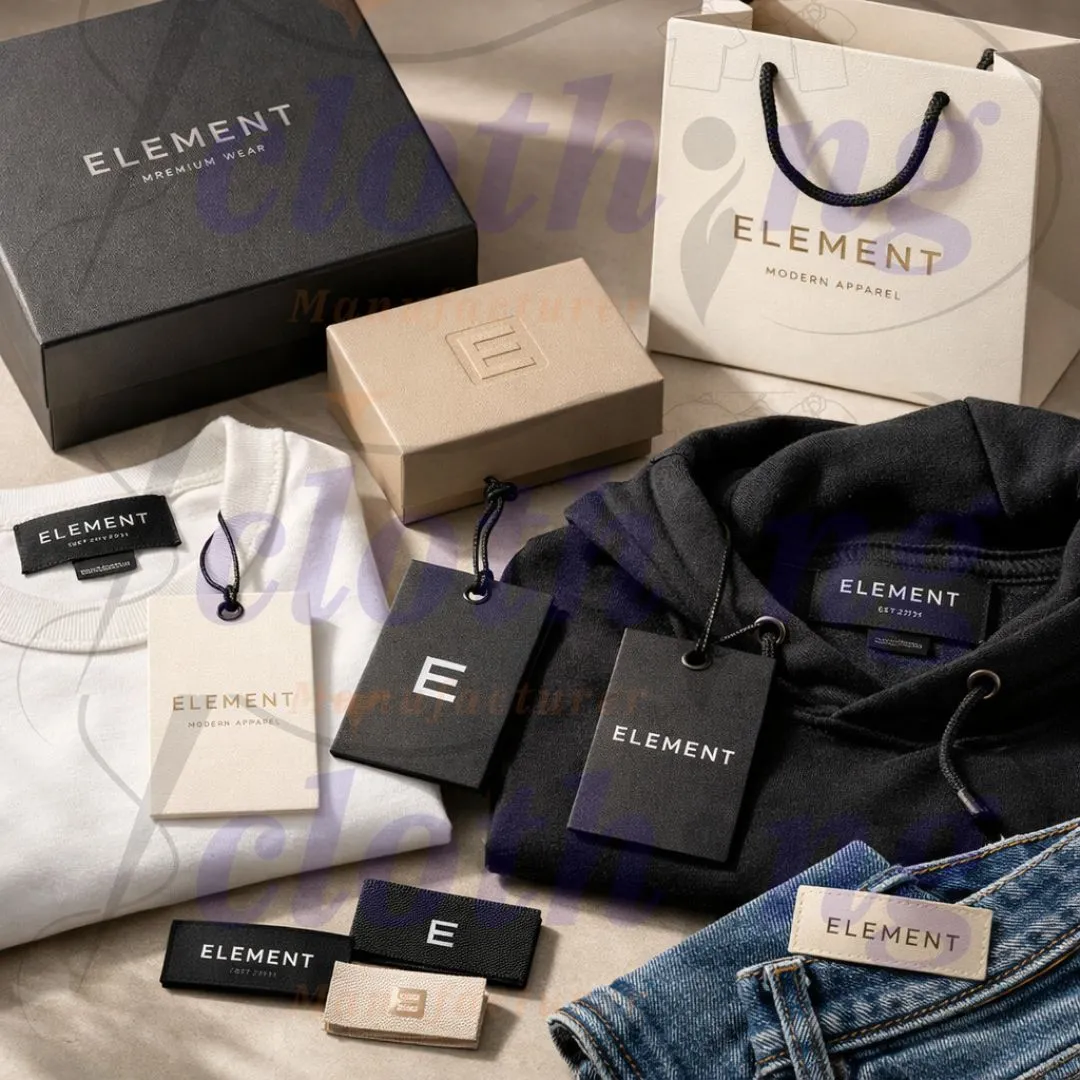
- The branding. Woven neck labels in your artwork, printed care and content labels, hang tags, size stickers, poly bags. All applied on the production line, not stuck on afterwards.
- The patterns. Once your pattern is drafted and graded, it belongs to your brand. It is not sold to the shop across the street.
- The exclusivity. Nobody else can buy your exact product, because it was made to your spec, for you.
What is not yours is the factory. You do not own the machines, employ the machinists, or carry the overhead of a production floor. That is the entire economic point: you get a product that is uniquely yours, without the capital cost of owning a factory to make it. It is the same model behind most supermarket own-brand food, most pharmacy own-brand medicine, and a very large share of the fashion brands you already know.
A concrete example
Imagine you want to launch a heavyweight hoodie brand. You go to a private label manufacturer with a hoodie you love and say: match this fit, but make the fabric heavier at 450 GSM, drop the shoulder by two centimetres, use a flat drawcord with metal tips, and put my woven label in the collar.
The factory drafts a pattern, sources the fleece, makes you a sample, you approve it, and four weeks later you have boxes of hoodies that carry your name and exist nowhere else on earth. That is private label clothing. The garment is genuinely yours, and your competitor cannot walk into a supplier and buy the same thing.
Private Label vs White Label vs OEM: The Real Difference
These three terms get used interchangeably by people selling to you, and they should not be. The difference decides how much control you have, how much your product costs, and whether anyone else can copy it tomorrow.
| Model | What You Control | Can Others Sell the Same Product? | Typical Minimum |
|---|---|---|---|
| White label | Only the label. The garment is a fixed stock product. | Yes. Anyone can buy the same blank. | 1 – 50 |
| Private label | Fit, fabric, weight, colour, construction, branding. | No. The spec is yours. | 10 – 300 |
| OEM | Everything, including original design from scratch. | No. The design is yours. | 50 – 500 |
White label: fast, cheap, and not really yours
White label means buying a finished stock garment and putting your name on it. A print-on-demand hoodie with your logo is white label. It is genuinely useful: it is fast, the minimum is often a single unit, and it lets you test a design before you commit real money.
But the garment is not yours. The blank you are reselling is sitting in a warehouse available to everybody, including the brand competing with you for the same customer. You cannot change the fabric weight, you cannot change the fit, and when your supplier discontinues that blank, your product line disappears overnight. Many good brands start here, and almost all of them leave.
Private label: the practical middle
Private label is where the great majority of serious independent brands operate. You are not designing a garment from a blank sheet of paper, and you do not need to. You are taking a proven silhouette and making it yours through the decisions that customers actually notice: the weight of the fabric, the drop of the shoulder, the depth of the collar rib, the colour, and the label inside it.
You get exclusivity and control without the cost and risk of full ground-up development. For most brands this is the correct answer, and it is what we mean when we talk about private label manufacturing.
OEM: original design, from zero
OEM, or Original Equipment Manufacturing, means the factory builds a product to your original design, engineered from scratch. It is what you do when your product genuinely does not exist yet: a new technical garment, an unusual construction, a proprietary fit system.
It costs more, takes longer, and demands a real design capability on your side, or a factory willing to provide one. It is the right choice when your product is your differentiation, and overkill when it is not.
The honest guidance: if you are launching your first product, private label is almost always right. White label is for testing an idea cheaply. OEM is for when you have proven demand and need a product nobody else can approximate.
What Is Actually Included in Private Label
This is where quotations diverge and brands get burned. The garment price is the headline; the branding stack is the line item that many factories quietly leave out and then add back later. Here is the complete list of what should be included, with what each part genuinely costs.
| Component | Typical Cost / Garment | What It Does |
|---|---|---|
| Woven neck label | $0.22 | Damask-woven brand label in your artwork and colours. The single strongest signal of a real brand. |
| Printed care & content label | $0.14 | Fibre content, country of origin, wash instructions. Legally required in most markets. |
| Hang tag | $0.18 | Custom-printed card tag with string or safety pin. Your pricing, story and QR code live here. |
| Size sticker | $0.06 | On the poly bag, so a stockist can pick without opening. |
| Branded poly bag | $0.12 – $0.45 | Basic, printed, or a full retail box for premium positioning. |
| Full branding package | ~$0.85 | All of the above, bundled. |
These are our real 2026 rates. Price your own configuration with the clothing cost calculator.
Options many brands do not know exist
- Tagless heat-transfer neck prints. A printed neck label instead of a woven one. Cheaper, and far more comfortable for activewear, kidswear and anything worn next to skin.
- Hem tags. The small folded label on the bottom hem or sleeve. A cheap detail that dramatically raises perceived quality on streetwear.
- Custom zip pullers. Branded metal or moulded pullers on hoodies and jackets. Around $0.30 and worth every cent on a $70 retail zip hoodie.
- Sequential numbering. For limited drops, each garment numbered inside the placket, with a certificate card.
- Multi-language labelling. Arabic care labels for the Gulf, multilingual EU labels for Europe, FTC-compliant labels for the USA.
Watch for this. If a quote states a garment price but does not explicitly list the branding, ask one question: “Is the woven label, care label, hang tag and packaging included in that number, yes or no?” A twenty percent surprise on your invoice is the most common way private label brands get burned, and it is entirely preventable.
What Private Label Clothing Really Costs
Costs vary by garment, fabric, decoration and quantity, but here are our real 2026 ranges for private label production including the branding stack, at standard volume.
| Garment | Cost / Piece (branded) | Typical Retail |
|---|---|---|
| T-shirt | $5 – $8 | $28 – $45 |
| Polo shirt | $7.50 – $15 | $40 – $70 |
| Hoodie (280–450 GSM) | $10 – $17.50 | $55 – $95 |
| Crewneck sweatshirt | $9 – $14 | $50 – $80 |
| Tracksuit set | $17.50 – $27.50 | $85 – $140 |
| Varsity jacket | $25 – $43.75 | $120 – $220 |
Ex-factory, before freight. Add air freight, which is charged by weight, so a hoodie ships dearer than a tee.
The three things that move your price most
- Fabric weight. Fabric is 45 to 60 percent of a knit garment's cost, and it is bought by the kilogram. Moving a hoodie from 280 GSM to 450 GSM buys roughly 60 percent more cloth. It is the single biggest lever you have, in both directions.
- Quantity. Patterns, markers and print screens cost the same whether you make ten garments or a thousand. At ten pieces those fixed costs divide by ten. Expect roughly a 25 percent premium at 10 to 24 pieces, falling to the standard rate at 50, and around 30 percent below that at 1,000.
- Decoration. Priced per placement, not per garment. A chest print, a back print and a sleeve print costs three times a single chest hit. Embroidery costs more than screen print because it is billed by stitch count.
Pricing your retail tag. Most direct-to-consumer apparel brands work on a 2 to 2.5 times markup on landed cost, not ex-factory cost. If you sell wholesale, remember a stockist takes roughly half the retail price, so your landed cost must be lower still. Model both with the cost calculator before you set a price.
How to Start a Private Label Clothing Line in Seven Steps
You do not need a design degree, a tech pack, or industry contacts. You need a reference garment, a logo in some form, and a budget you can afford to lose. Here is the sequence that actually works.
Step 1: Choose one product, not a collection
The most common way new clothing brands die is by launching six styles at once, spreading a small budget across all of them, and discovering that one sells and five do not. Pick the single garment that best expresses your brand and put everything behind it. You can add the collection after the first one proves itself.
Step 2: Find a reference garment
Go and buy the garment you wish you were selling. Wear it. Notice what you like and what irritates you. That physical object is worth more than a hundred hours of design software, because a factory can reverse-engineer a pattern from it in days and you can point at exactly what you want changed.
Step 3: Get quoted, and read the quote properly
Send the reference garment, your logo and a target quantity. A good factory returns an itemised quotation within 24 hours: garment, decoration, branding, freight. Check that the branding is in there. Check that the minimum is real and not hiding a fabric-lot requirement behind it. Ask for the total delivered cost, not a per-unit price.
Step 4: Approve a sample. Never skip this.
A pre-production sample takes 7 to 10 days and its fee is credited against your bulk order, so if you proceed it effectively costs nothing. It is the only stage in the entire process where a mistake costs days instead of an entire production run. Brands who skip it to save two weeks routinely lose six weeks and a bulk order fixing something the sample would have caught.
When it arrives, be ruthless. Measure it. Wash it. Wear it for a week. Mark up everything wrong and ask for a second sample. Two rounds is normal, not a failure.
Step 5: Lock the specification in writing
Your approved sample becomes the golden sample, retained at the factory. Every garment in your bulk run is later measured against it. That single object turns any future dispute from an argument into a comparison, which is precisely why it matters.
Step 6: Produce, inspect, ship
Bulk production takes up to 2 weeks. Before anything ships, insist on seeing the final inspection report with photographed measurements. Do not release the balance payment before you have seen it. Our terms are 50 percent deposit and 50 percent against approved pre-shipment inspection, which means you see proof before the money moves.
Step 7: Sell, learn, reorder
Reorders are the whole game. They take 1 to 2 weeks instead of four to six, because your patterns, grading, print files and label artwork are already archived. The per-unit price also drops sharply once you cross 100 pieces. This is the moment a brand starts working.
Six Mistakes That Kill Private Label Brands
Almost every private label disaster we have seen traces back to one of these. None of them are exotic, and all of them are avoidable.
1. Treating branding as an afterthought
The label in the collar is the first thing a customer touches after the fabric. A cheap printed label inside a good hoodie tells the customer, accurately, that you cut a corner. The full branding stack costs under a dollar. Spend it.
2. Ordering too much of an untested design
A founder who buys 300 units of a design nobody has worn yet is gambling, not launching. Test at 10 to 50 pieces. The per-unit premium on a small run is far cheaper than owning 250 garments that will not sell.
3. Choosing fabric from a screen
No monitor conveys hand feel, drape or weight. A 240 GSM jersey and a 450 GSM fleece are indistinguishable in a photograph and completely different garments in your hand. Always order labelled swatch cards. See our fabric guide for what to ask for.
4. Not knowing the real minimum
Many factories advertise a low MOQ that hides a fabric-lot rider behind it: 50 pieces, but only if you buy 300 units of fabric. Always ask for the total delivered spend, not the per-unit price. Our minimum is 10 pieces with no rider.
5. Paying the balance before inspection
Never release the final payment before you have seen pre-shipment inspection evidence. A supplier demanding full payment upfront is asking you to carry all the risk of a transaction they control.
6. Competing on price
You will not win a price war against a company that buys fabric by the container. What you can win is fit, feel, story and service. Private label exists precisely so that you can compete on product rather than on being cheapest, and brands that forget this tend not to last.
How to Choose a Private Label Clothing Manufacturer
The method that works is boring and effective: shortlist three suppliers, ask all of them the same questions, then run the same paid sample with each and compare the results side by side. Sixty to a hundred and fifty dollars of samples reveals more than any review page ever written.
Ten questions worth asking any factory
- What is your real minimum, per style and per colourway?
- Are there fabric-lot minimums hiding behind that number?
- Is the branding stack included in the quoted price, or billed separately?
- Who owns the patterns after production?
- What inspection standard do you apply, and do I see the report?
- Will you do a live video call from the sewing floor?
- Are you the factory, or an agent subcontracting my order?
- What is the quantity tolerance, and how is it invoiced?
- Are shipments DDP, with duties prepaid?
- What is the payment structure, and what triggers the balance?
Red flags
- Refusing a video call from the production floor.
- Demanding 100 percent payment upfront.
- A quoted price that changes after you commit.
- Vagueness about the real minimum.
- A sample that arrives with fabric that does not match the spec.
- No golden sample, and no inspection against one.
Put us in your shortlist. We recommend the paid-sample bake-off precisely because we expect to win a fair share of them, and if we lose one on merit you have still made the right decision. Read how our ten-stage manufacturing process works, then send us a reference garment.
Frequently Asked Questions
What is private label clothing in simple terms?
It is clothing made by a factory to your specification and sold entirely under your own brand. Your woven label sits in the collar, your hang tag is on the sleeve, and the factory's name appears nowhere. The customer buys it as your product, because it is.
What is the difference between private label and white label clothing?
White label means putting your name on an unchanged stock product that anyone else can also buy. Private label means the garment itself is customised to you: the fit, fabric, weight, colour and construction. White label is faster and cheaper; private label is exclusive and cannot be copied by a competitor buying the same blank.
How much does private label clothing cost?
At standard volume with the full branding stack included: t-shirts $5 to $8, polos $7.50 to $15, hoodies $10 to $17.50, tracksuit sets $20 to $32.50 and varsity jackets $22.50 to $47.50 per piece, ex-factory. The branding stack itself (woven label, care label, hang tag, packaging) adds roughly $0.85 per garment.
What is the minimum order for private label clothing?
Ours is 10 pieces per style, per colour, mixed across up to 3 sizes. There is no hidden fabric-lot requirement behind that number. Runs of 10 to 49 pieces carry a disclosed small-run premium, because setup costs divide across fewer garments.
Do I need a tech pack to order private label clothing?
No. Most first-time founders arrive with a reference garment, a logo and a budget. We draft the tech pack for you at no charge with a production order, converting your references into measurements, fabric specifications and print placements.
How long does private label production take?
Plan 4–6 weeks end to end for a first order: a quotation within 24 hours, a sample in 7 to 10 days, bulk production in up to 2 weeks, then DDP delivery. Reorders take 1–2 weeks because patterns, print files and label artwork are already archived.
Who owns the designs and patterns?
You do. The patterns, grading, print files and label artwork created for your garments belong to your brand. We archive them so reorders are fast and identical, but they are yours, and we do not reuse your designs for other clients. We sign NDAs on request.
Can I put my own labels in garments I did not design?
Yes, and that is the essence of private label. You do not have to design a garment from scratch. Take a proven silhouette, adjust the fit, fabric and details to suit your brand, and put your labels in it. The result is genuinely yours.
Launch Your Private Label Line
Send a reference garment and your logo. We return an itemised quotation within 24 hours and a sample with your labels sewn in, inside two weeks.
Keep Reading
- Private Label Manufacturing — our full private label service, from labels to retail packing.
- Low MOQ Manufacturing — how a genuine 10-piece minimum works, with no fabric-lot riders.
- The Manufacturing Process — all ten stages, from tech pack to packed cartons.
- How to Start a Clothing Brand — the complete launch guide for first-time founders.
- Clothing Cost Calculator — price your private label run in ninety seconds.