
US Clothing Manufacturing Costs vs Overseas: The Real 2026 Breakdown
Every brand founder asks the same question eventually: is it actually cheaper to manufacture overseas, or is that just something everyone repeats without checking the math? In 2026 the honest answer got more complicated, not less — a new US tariff landed on Pakistani-made textiles this year, and anyone comparing costs off a spreadsheet from even a year ago is already working with outdated numbers.
Direct Answer — Is Overseas Clothing Manufacturing Still Cheaper Than US-Made in 2026?
Yes, for most order sizes. Factory-direct overseas manufacturing (Pakistan) typically runs 40–60% below US domestic cut-and-sew cost, even after the 2026 tariff increase is included. The gap narrowed slightly this year — a new 10% tariff took effect on Pakistani imports in July 2026, with no volume exemption — but the underlying US-vs-overseas labor cost difference is still large enough that it doesn't close the gap. The exceptions: orders requiring a legal “Made in USA” label, or extremely small one-off runs where shipping time outweighs unit cost.
- 40–60%Lower landed cost, factory-direct overseas
- ~20.2%2026 average effective tariff, Pakistan-origin
- 2–4×US domestic per-unit cost multiple vs. overseas
- 6–9 daysDDP shipping to USA, duties included
📋 Contents
- Why US manufacturing costs more, structurally
- The 2026 tariff picture — what changed, what it means
- What “landed cost” actually includes
- Side-by-side: US domestic vs. factory-direct overseas
- Real numbers: a 100-hoodie order, both ways
- 5 mistakes that skew a cost comparison
- Where US-made still wins
- Where factory-direct overseas still wins, even after tariffs
- How to run this comparison for your own order
- FAQs
- The bottom line
Why US Manufacturing Costs More, Structurally
The gap between US and overseas clothing manufacturing isn't really about fabric or machinery — modern sewing equipment is the same worldwide, and fabric can be sourced globally by anyone. The gap is labor, and it isn't small.
A US cut-and-sew factory pays sewing machine operators an hourly wage set by US minimum wage law (which varies by state, and in cities like Los Angeles and New York sits well above the federal minimum), plus payroll tax, workers' comp, and benefits overhead most overseas factories don't carry at the same rate. Garment sewing is still overwhelmingly manual work — a hoodie takes roughly the same number of operator-minutes to sew in Los Angeles as it does in Sialkot. When the hourly cost of that labor differs by several multiples, the finished garment cost differs by a similar multiple, because labor is the largest single cost input in a sewn garment — more than fabric, more than trims, more than factory overhead.
This is why domestic US cut-and-sew shops typically run 2–4× the per-unit cost of factory-direct overseas production on the same spec. Not because the fabric is different. Not because the machines are different. Almost entirely because of the wage gap, compounded by smaller US shops running shorter, less efficient production runs than a dedicated export factory built around volume.
The 2026 Tariff Picture: What Changed and What It Means
This is the part that actually shifted this year, and it's the part most cost-comparison content online hasn't caught up on yet.
A new 10% Section 301 tariff took effect on most Pakistani textile and apparel imports on July 24, 2026. Pakistan shares that flat 10% rate with Bangladesh, Cambodia, India, Indonesia, and Malaysia — but with one important difference: USTR set up tariff-rate quotas (TRQs) for Bangladesh, Cambodia, Indonesia, and Malaysia that let a specified volume of textile goods enter duty-free, tied to those countries' purchases of US cotton and textile inputs. Pakistan was not included in that quota mechanism. Pakistani-origin apparel pays the tariff with no volume exemption, while some competing sourcing countries get a partial pass on part of their volume.
Layered on top of that new 10% rate, Pakistan's blended average effective tariff — combining the new reciprocal duty with existing Most Favored Nation (MFN) apparel duties, which have historically run in the 10–32% range depending on garment category and fiber content — sat at roughly 20.2% in June 2026, according to USAFacts trade data (updated September 2, 2026). That's up from an 18.4% average across all of 2025, and well above the 9.8% average Pakistan carried across 2002–2024. For context, the overall US average tariff rate across all trading partners was 6.8% in the same period — Pakistan's rate runs about three times the US average across all countries.
What this means in practice: the “Pakistan is dramatically cheaper” math from two years ago is still true, but the margin is thinner than it was — specifically thinner versus a couple of TRQ-eligible competitors on very large volume orders. For the order sizes most startups and small brands actually place (10–500 pieces per style), the TRQ mechanism rarely applies — it's a large-volume program-buyer exemption, not something that changes a first order or a reorder at typical small-brand scale. For those orders, the underlying labor-cost gap between the US and Pakistan is still large enough that tariffs, while real and worth knowing, don't close it.
Figures current as of September 2026. US trade policy has changed multiple times in recent years — confirm current rates before finalizing a landed-cost quote on a specific order, especially larger volumes where a TRQ or additional duty exclusion might apply to a competing sourcing country.
What “Landed Cost” Actually Includes
This is where most cost comparisons quietly go wrong: they compare a factory's quoted unit price against a domestic quote, and stop there. The unit price is never the number that hits your actual cost of goods.
Landed cost is the factory unit price, plus:
- Duty/tariff — calculated on the customs value of the shipment, per the rates above for Pakistan-origin goods
- Freight — ocean or air, depending on timeline
- Customs brokerage and handling fees
- Bank/wire fees on international payment
On a DDP (Delivered Duty Paid) shipment, all of that is pre-calculated and folded into the quoted price before you commit — you see one number, and it's the real number. On DAP or DDU terms, duties and customs fees arrive separately, often as a surprise invoice from a freight forwarder weeks after you thought the order was fully paid for. This is the single most common budgeting mistake first-time importers make, and it has nothing to do with which country you're sourcing from — it's purely a shipping-terms question. ClothingManufacturer.US ships on DDP terms with duties calculated up front (currently 6–9 days to the USA), specifically so the 2026 tariff picture above is already reflected in the number a customer sees, never discovered later.
Side-by-Side: US Domestic vs. Factory-Direct Overseas
| Factor | US Domestic Cut-and-Sew | Factory-Direct Overseas (Pakistan) |
|---|---|---|
| Typical MOQ | 24–150 pieces per style | 10 pieces per style (colorways split from 5) |
| Per-unit cost multiple | Baseline (2–4× overseas) | 40–60% below US domestic, factory-direct |
| Tariff/duty | None (domestic) | ~20% blended average (2026), already included in DDP quote |
| Sample turnaround | Often 1–3 weeks | 7–10 business days |
| Bulk production time | Varies widely by shop | 2–4 weeks after sample approval |
| Shipping to US buyer | Same-day to a few days (domestic) | 6–9 days, DDP (duties included) |
| Quality control | Varies by shop | AQL 2.5 inspection + 4-point fabric inspection + in-line stitching checks |
| “Made in USA” label eligibility | Yes | No |
| Private label branding | Often billed separately | Included at any quantity |
| Best fit | “Made in USA” label requirement, ultra-fast one-off runs | Repeatable production, brands scaling past a first test run |
Real Numbers: A 100-Hoodie Order, Both Ways
Percentages are easy to state and hard to trust. Here's an actual worked example, using ClothingManufacturer.US's own published tiered pricing for a 380–420 GSM pullover hoodie (private label, woven label, care label, and hang tag included) at the 100–299 unit tier:
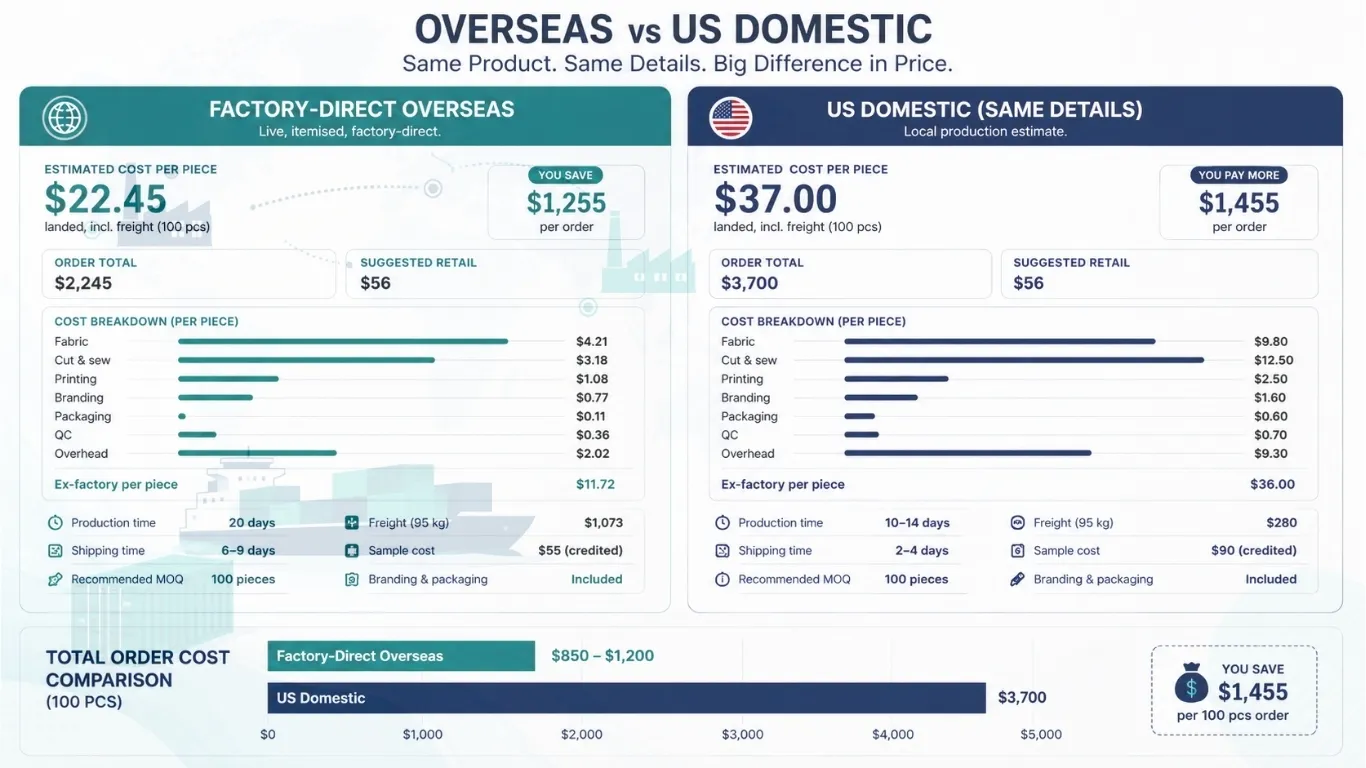
| Factory-Direct Overseas (Pakistan, DDP) | US Domestic Cut-and-Sew (modeled) | |
|---|---|---|
| Per-unit cost | $8.50 – $12 | $17 – $48 (2–4× overseas, per the multiple above) |
| Total for 100 units | $850 – $1,200 | $1,700 – $4,800 |
| Duty/tariff | Included in quoted price (DDP) | None (domestic) |
| Freight | Included in quoted price (DDP) | Typically minimal, domestic |
| Private label branding | Included | Often billed as an add-on |
| Estimated total landed cost, 100 hoodies | $850 – $1,200 | $1,700 – $4,800+ |
Net difference: roughly $850–$3,600 saved on this single order — a 50–75% lower landed cost, tariff already included. The US-domestic column is a modeled estimate built from the documented 2–4× industry multiple, not a specific competitor's quote — get an exact figure from a local shop for a true apples-to-apples comparison on your own spec. The overseas column is this factory's real, current tiered pricing.
5 Mistakes That Skew a Cost Comparison
Founders comparing US and overseas manufacturing tend to make the same handful of errors, all of which make the comparison look worse (or better) than it actually is:
- Comparing unit price instead of landed cost. A domestic quote already includes no duty; an overseas quote on DAP/DDU terms hides duty until later. Compare landed cost, always — see the table above.
- Ignoring the MOQ gap. A US shop's 24–150 piece minimum requires 2–15× the upfront capital of a 10-piece factory-direct order, before a single unit has sold. That capital difference is a real cost even if it never shows up in a per-unit comparison.
- Using pre-2026 tariff figures. The July 2026 Section 301 tariff and the resulting ~20% blended average rate on Pakistani goods are recent. Any comparison built on 2024 or 2025 numbers understates the current cost.
- Assuming private label branding is free everywhere. Domestic shops frequently bill woven labels, care labels, and hang tags as line-item add-ons. Confirm what's actually included before comparing “unit price” to “unit price.”
- Skipping the sample stage. The only way to validate any of these numbers for your specific garment is a sample order — a spec sheet estimate and a produced sample rarely match exactly, on either side of this comparison.
Where US-Made Still Wins
This isn't a one-sided pitch — there are real, specific situations where paying the US-domestic premium is the correct decision, and a founder should know what they are before assuming overseas is automatically right:
A brand that legally needs a “Made in USA” label for a specific retail account or marketing claim has no substitute — that label requirement can only be met domestically, full stop. A brand testing an extremely small, one-off run (a handful of pieces for a photoshoot sample, not a sellable batch) may find a local shop faster simply because there's no international shipping leg at all. And a brand located near a functioning domestic cut-and-sew cluster (Los Angeles and New York both still have them) that needs genuine same-week emergency turnaround will pay for that speed regardless of unit cost.
Where Factory-Direct Overseas Still Wins, Even After Tariffs
For the large majority of private label and startup brands — anyone placing a repeatable order of 10 pieces and up, without a domestic-label requirement — the math still favors factory-direct overseas manufacturing even with the 2026 tariff increase priced in. The labor-cost gap is simply larger than the tariff gap. A ~20% duty on a garment that costs 40–60% less to produce in the first place still nets out meaningfully cheaper than the US-domestic baseline, before even accounting for the MOQ difference — a US shop's 24–150 piece minimum requires several times the capital commitment of a 10-piece factory-direct order.
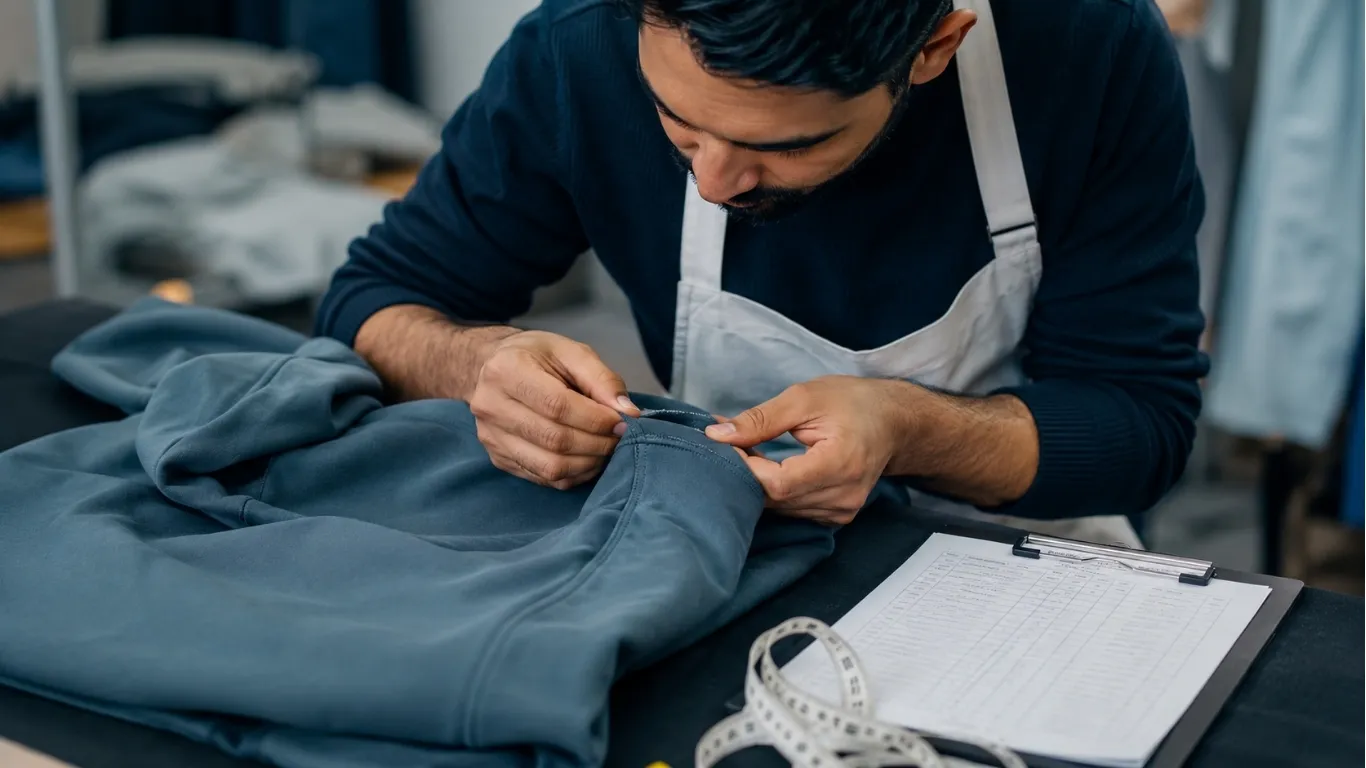
How to Run This Comparison for Your Own Order
The percentages and example above are directional — the real number depends on your specific garment, fabric weight, and order size. Before deciding, get the same three figures for both options: the quoted unit price, the MOQ required to get that price, and the full landed cost including shipping terms. Ask specifically whether a quote is DDP or DAP/DDU — that single question prevents the most common surprise cost in this whole comparison. A sample order is the cheapest way to validate all three numbers at once before committing to a bulk run.
Get an instant estimate for your exact garment and quantity.
Open Cost Calculator → WhatsApp Us InsteadIf you're comparing sourcing options more broadly, our wholesale clothing supplier guide breaks down what DDP pricing actually covers when you buy factory-direct instead of through a middleman.
Frequently Asked Questions
Is clothing manufacturing actually cheaper overseas in 2026, after the new tariffs?
Yes, for most order sizes. The 2026 tariff increase on Pakistani textiles (roughly 20% blended average) narrows the gap versus a couple of years ago, but the underlying labor-cost difference between US and overseas manufacturing is still large enough that factory-direct overseas production typically remains 40–60% cheaper than US-domestic, even with duty included.
What tariff applies to clothing made in Pakistan and imported to the US?
As of 2026, Pakistani textile and apparel imports carry a 10% Section 301 tariff (effective July 24, 2026) stacked on top of existing MFN apparel duties, for a blended average effective rate of roughly 20.2% as of June 2026. Unlike Bangladesh, Cambodia, Indonesia, and Malaysia, Pakistan was not given a tariff-rate quota exemption for any import volume.
Does DDP shipping already include the tariff?
Yes. DDP (Delivered Duty Paid) means the factory calculates and includes all duties, customs fees, and freight in the quoted price before you commit — there's no separate customs bill later. DAP or DDU terms leave duty payment to the buyer, which is where cost-comparison budgets most often go wrong.
How much more does US-made clothing typically cost than overseas?
Domestic US cut-and-sew typically runs 2–4× the per-unit cost of factory-direct overseas manufacturing on a comparable spec, driven almost entirely by the labor-cost gap rather than fabric or machinery differences. On a 100-unit hoodie order, that's roughly $850–$3,600 in additional cost domestically.
What's the minimum order size to make overseas manufacturing worth it?
There's no strict floor — a factory-direct overseas manufacturer with a genuine low MOQ (10 pieces per style, in ClothingManufacturer.US's case) makes the comparison favorable even at very small order sizes, since the MOQ itself is a fraction of a typical US-domestic shop's 24–150 piece minimum.
Can I get a “Made in USA” label from an overseas factory?
No. That label requires domestic production and is the one factor in this comparison that isn't a cost trade-off at all — if a specific retail account or marketing claim requires it, US-domestic is the only option regardless of price.
Do tariffs apply differently by garment type?
Yes — MFN apparel duty rates vary by fiber content and garment category (knit vs. woven, cotton vs. synthetic blends), which is why the blended average above is directional. A DDP quote from a factory-direct manufacturer will reflect the actual rate for your specific garment rather than the blended average.
Is private label branding included when comparing overseas vs. domestic pricing?
At ClothingManufacturer.US, yes — woven labels, care labels, and hang tags are included in the quoted unit price at any quantity. Domestic shops frequently bill these separately, which is one of the “5 mistakes” above that can make a domestic quote look artificially close to an overseas one until the add-ons are counted.
Why did Pakistan's tariff rate go up in 2026 specifically?
A new 10% Section 301 tariff took effect on July 24, 2026 on most Pakistani textile and apparel imports, without the tariff-rate quota relief given to Bangladesh, Cambodia, Indonesia, and Malaysia — pushing Pakistan's blended average effective rate to roughly 20.2% by June 2026, up from an 18.4% average in 2025.
How do I get an exact cost comparison for my own product, not just an estimate?
Use the free cost calculator for an instant factory-direct estimate on your specific garment and quantity, then request a sample (7–10 business days) to validate the real fabric, construction, and branding before committing to a bulk order.
The Bottom Line on US vs. Overseas Manufacturing Costs
The 2026 tariff increase on Pakistani goods is real, and any brand founder doing this math should know the actual number — roughly 20% blended average, no volume exemption — rather than working off an outdated assumption. But tariffs are one input in a comparison where labor cost is still the dominant factor, and that gap remains large enough that factory-direct overseas manufacturing stays 40–60% cheaper than US-domestic for the large majority of order sizes small and growing brands actually place.
The exceptions are specific and narrow: a legal “Made in USA” requirement, or a genuinely tiny one-off run where shipping time matters more than unit cost. Outside of those two cases, the math still points overseas — and the only way to know the exact number for your own product is to run it, not estimate it.
Calls and WhatsApp share one number: +1 640-203-5335 — or email info@clothingmanufacturer.us for a free quote within 24 hours.
Sourced from USAFacts.org (US average tariff rate data by country, updated September 2026) and trade press reporting (TEXtalks, Pakistan Today) on the July 2026 Section 301 tariff action. Figures current as of publish date — confirm before quoting a customer, especially on larger program orders where TRQ mechanisms for competing sourcing countries may shift.