

Heavyweight Oversized
T-Shirts 2026:
GSM, Fabrics &
How to Manufacture Yours
Quick answer: A heavyweight t-shirt is 220 GSM or above, with the 2026 streetwear sweet spot at 240–280 GSM for everyday premium tees and 300+ GSM for statement pieces. The defining construction is a drop shoulder, boxy body block with an extended hem. Best fabric is 100% ring-spun combed cotton, with garment-dyed finishes trending strongly. Factory-direct manufacturing starts at $6–9 per unit from MOQ 10 pieces, with samples in 7–10 business days.
Why Heavyweight Oversized T-Shirts Dominate Streetwear in 2026
The t-shirt was treated as a disposable basic for most of the 2010s. That era is completely over. Here is what changed — and why it matters for any brand manufacturing in 2026.
Scroll through any serious streetwear feed in 2026 and you will see the same silhouette repeated endlessly: a thick, structured, drop-shoulder t-shirt that holds its shape on the hanger and makes a statement before it is even put on. The heavyweight oversized t-shirt has quietly become the most important basic in modern fashion — the garment category that separates brands with a genuine product from those reselling commodity blanks with a logo on them.
Three converging forces drove this shift. First, the continued dominance of boxy, oversized silhouettes across luxury, high street and independent fashion. Second, the rise of streetwear brands using the heavyweight tee as their flagship product rather than a secondary item behind hoodies. Third, social media's appetite for tactile unboxing content — the kind of "feel the weight" video that simply does not work with a 160 GSM commodity tee but performs extremely well with a 280 GSM structured piece.
There is a fourth force that underpins all three: consumers have changed how they buy. The trend across the USA, UK and European markets is fewer purchases, higher quality, and greater price tolerance for garments that feel genuinely premium. A customer who buys three £15 tees a season is becoming a customer who buys one £55 heavyweight tee and wears it constantly. Brands positioned correctly for this shift are growing. Brands still competing on price for commodity basics are not.
Heavyweight tees have done to the t-shirt category what raw denim did to jeans in the 2000s — turned a commodity into a product category that enthusiasts care about, research, and pay significantly more for. Understanding how to spec, source and manufacture one correctly is the practical knowledge that separates a brand with a real product from one that is simply printing on blanks.
The margin case for heavyweight: A 180 GSM commodity tee retails at $18–25. A well-executed 280 GSM heavyweight tee with private label branding retails at $50–75. The manufacturing cost difference is approximately $3–4 per unit. The retail price difference is $30–50. Every dollar invested in fabric weight returns $7–12 at retail.
The Complete GSM Breakdown: What Weight Should Your T-Shirt Be?
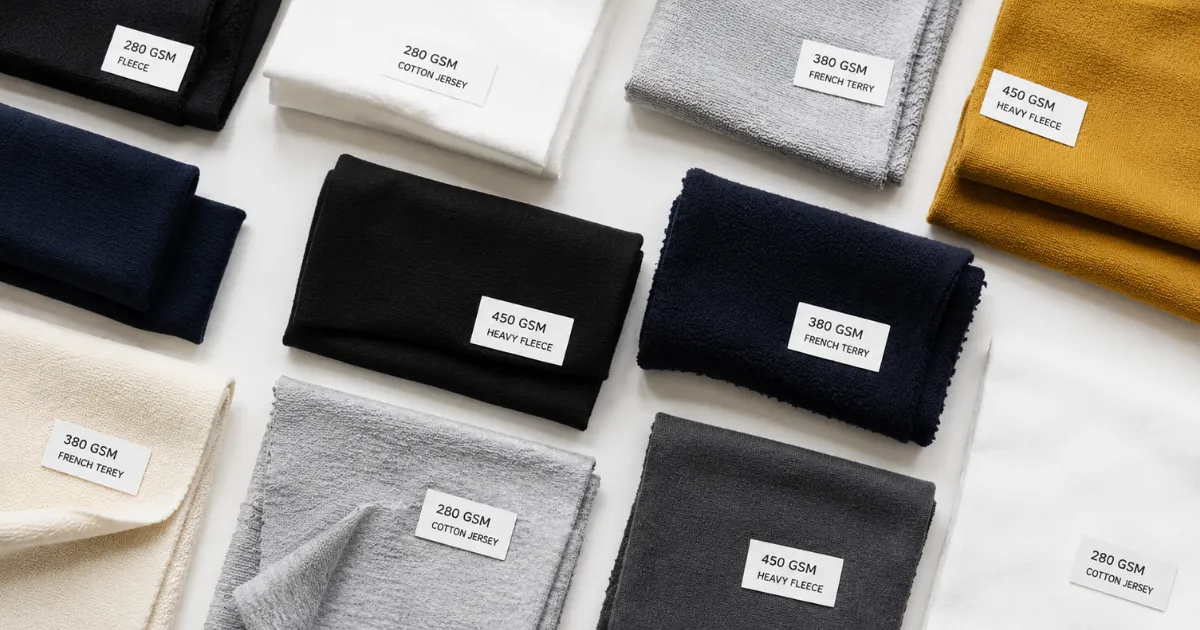
GSM (grams per square metre) is the single most important spec when manufacturing a heavyweight t-shirt. Here is how every range performs and where it belongs in the market.
| GSM Range | Classification | Retail Position | Factory Price | Best Use |
|---|---|---|---|---|
| 140–180 GSM | Lightweight | $12–20 | $2.50–4 | Promotional, fast fashion |
| 180–220 GSM | Midweight | $20–35 | $4–6 | Everyday basics |
| 240–280 GSM | Heavyweight ⭐ | $45–75 | $6–9 | Streetwear, private label |
| 300–340 GSM | Ultra-Heavy | $70–110 | $9–14 | Flagship / limited drops |
The most important insight from this table is the margin gap at 240–280 GSM. The factory price increase from 180 GSM to 260 GSM is approximately $2–3 per unit. The retail price increase is $20–40. No other single change in your manufacturing spec delivers a comparable return on investment. If you are producing any t-shirt currently at 180–200 GSM and positioning it as premium, moving to 260 GSM is the single highest-impact improvement you can make to your product.
Anatomy of the Oversized Fit: What Makes It Work
Fabric weight alone does not create the oversized streetwear look. The pattern construction is equally important. These four elements define a correctly built heavyweight oversized t-shirt.
When ordering a heavyweight oversized tee, specify all four of these measurements in your tech pack or reference brief. Factories that receive only a GSM spec without the pattern construction details will default to their standard block — which is likely neither boxy enough nor has the correct shoulder drop. The garment weight and the pattern construction must be developed together to achieve the intended silhouette.
If you do not have a tech pack, the fastest approach is to purchase the silhouette you want to replicate and ship it to your factory as a reference. A factory can reverse-engineer a pattern from a physical garment in 2–3 days and use it as the base for your specification. See our guide on the full clothing manufacturing process for how this works stage by stage.
Best Fabrics for Heavyweight Oversized T-Shirts in 2026
Not all cotton is equal, and the fabric choice determines everything from hand feel to how the garment ages. Here are the options and when to use each.
Fabric decision shortcut: If you are launching your first heavyweight tee line, start with 280 GSM ring-spun combed cotton. It is the safest specification — proven quality, available from every serious mill, works with all print methods, and hits the retail sweet spot at $55–75 in the USA market. Add garment dyeing as a second colourway once your base style is proven.
Print & Decoration Methods for Heavyweight T-Shirts
Heavy cotton is an excellent print surface — better than lightweight alternatives. Here is what each decoration method costs and where it performs best on heavyweight tees.
| Method | Cost | Min Qty | Wash Durability | Best Pairing |
|---|---|---|---|---|
| Puff Print | $1.50–3 | 10 pieces | 30–40 washes | Heavyweight streetwear, tonal |
| Screen Print | $0.80–2 | 10 pieces | 50+ washes | Volume orders, bold graphics |
| DTF Print | $1.50–3.50 | 1 piece | 20–30 washes | Photographic, multicolour art |
| Embroidery | $1.50–2.50 | 10 pieces | 100+ washes | Logo, premium positioning |
| Discharge Print | $1.50–3 | 24 pieces | 40+ washes | Vintage, soft-hand aesthetic |
| High-Density Print | $2–4 | 24 pieces | 30–40 washes | Text, simple graphics, streetwear |
How to Manufacture Your Heavyweight Oversized T-Shirt: Step by Step
From brief to delivered product — the exact process for first-time and returning clients building a heavyweight tee line.
Define your specification
Decide on GSM (our recommendation: 260–280 GSM ring-spun combed cotton for a first run), your size run (XS–2XL is standard), your colourway (start with 1–2), and your decoration. If you have a reference garment that approximates the silhouette you want, ship it to us — we use it to draft your pattern rather than starting from scratch, saving 3–5 days in development.
Get a quote — within 24 hours
Send your brief (GSM, quantity, decoration, size run, colourway, any reference images) to info@clothingmanufacturer.us or WhatsApp +1 640-203-5335. We return an itemised quote within 24 hours: garment cost, decoration, branding stack, and freight options. The quote is fixed — no surprise line items when you invoice.
Approve a sample — 7–10 days
On receipt of sample fee ($30–60, credited against your bulk order), we source fabric, draft or adapt the pattern, sew your sample, and apply any print or embroidery. The sample ships by express courier and arrives in the USA or UK in 4–6 business days from dispatch. Review it, measure it, wash it, and wear it before approving.
Bulk production — 15–20 days
On receipt of 50% deposit and sample approval, bulk production begins. Fabric is cut in bulk lots, print screens or DTF files prepared, and your branding (woven labels, care labels, hang tags) applied on the production line. Inline QC is performed throughout. Final inspection with measurement records is shared before we request balance payment.
Shipping — 5–30 days depending on method
Air freight to USA: 5–7 days, $3–6 per kg. Sea freight to USA: 20–30 days, $150–300 per small shipment. We offer DDP (Delivered Duty Paid) shipping — we handle customs clearance, import duties, and delivery to your door. You receive the goods; we handle the paperwork. Total first-order timeline: 4–5 weeks (air) or 7–9 weeks (sea).
Reorder — from 1–2 weeks
Once your patterns, grading, print files, and label artwork are archived, reorders run significantly faster than first orders. Same style, same fabric, same decoration: 1–2 weeks production plus shipping. Reorder pricing also improves as you cross quantity thresholds — 100 units saves 15–25% versus MOQ pricing, 500 units saves 30–40%.
Heavyweight T-Shirt Price Guide 2026
Factory-direct pricing from Sialkot for custom heavyweight oversized t-shirts. All prices ex-works, excluding freight and duties.
| Style | GSM | Fabric | MOQ 10–24 | 50–99 units | 100–499 units | 500+ units |
|---|---|---|---|---|---|---|
| Basic Heavyweight Tee | 240 GSM | Ring-spun cotton | $6–7 | $5–6 | $4–5 | $3.50–4.50 |
| Streetwear Heavyweight Tee | 280 GSM | Combed ring-spun | $7–9 | $6–8 | $5–7 | $4.50–6 |
| Garment-Dyed Heavy Tee | 280 GSM | Combed ring-spun GD | $9–12 | $8–10 | $7–9 | $6–8 |
| Ultra-Heavy Statement Tee | 320 GSM | Combed ring-spun | $10–14 | $9–12 | $8–10 | $7–9 |
| Organic Cotton Tee | 260 GSM | GOTS organic cotton | $10–13 | $9–11 | $8–10 | $7–9 |
Add decoration costs separately: puff print chest logo +$1.50–3, screen print chest +$0.80–2, embroidery left chest +$1.50–2.50. Private label branding stack (woven label, care label, hang tag, poly bag) adds approximately $0.85–1.00 per unit with a one-time label setup of $30–60. For your exact cost including freight and duties, use our clothing cost calculator.
Landed cost to USA warehouse: multiply ex-works price by approximately 1.5–1.7× to account for sea freight, import duties (typically 12–32% on cotton t-shirts), and customs clearance. A $8 ex-works heavyweight tee typically lands in a US warehouse at $12–14 all-in.
The 100-unit jump is the most impactful volume decision: Moving from MOQ 10 to 100 units saves 15–25% per unit and drops your landed cost by roughly $1.50–2.50 per tee. On a retail price of $60, that additional margin is the difference between a 4× and a 5× markup — significant for a brand at scale.
Should Your Brand Launch a Heavyweight Tee Line in 2026?
The honest answer — based on what we see across hundreds of brand launches — plus the three scenarios where it makes the most sense.
Heavyweight oversized tees are one of the lowest-risk entry points into custom apparel manufacturing. The construction is simpler than outerwear or tailored pieces, the manufacturing infrastructure is mature and widely available, and the demand is proven at retail. For a new brand with a streetwear or premium basics positioning, starting with a heavyweight tee line is genuinely good advice — not a category you are forced to compete in, but one where the conditions for a successful launch are currently as favourable as they have been in years.
That said, the category is more competitive than it was two years ago. The number of independent brands launching heavyweight tee lines has grown significantly, which means differentiation is no longer optional. Simply producing a 280 GSM drop-shoulder tee with a logo on it is no longer enough to stand out. The brands succeeding right now are the ones combining heavyweight fabric with a specific design point of view: whether that is tonal garment dyeing in a distinctive palette, puff print execution with genuine craft, an unusual fabric finish, or a storytelling angle that connects the product to a specific subculture or community.
The heavyweight tee as a commodity is not a winning position in 2026. The heavyweight tee as the physical expression of a brand's specific aesthetic — that is still a wide-open opportunity.
| Your Situation | Recommendation | Start With |
|---|---|---|
| New brand, first product, streetwear positioning | Highly recommended | 280 GSM drop-shoulder, 1 colour, puff print logo, MOQ 10 |
| Existing hoodie brand, want to add basics | Strongly recommended | Same GSM family as your hoodie, matching colourways, tonal branding |
| Sustainable brand targeting EU/conscious consumers | Recommended | 260 GSM GOTS organic, garment-dyed, minimal tonal label |
| Premium/quiet luxury positioning ($80–120 retail) | Recommended with caveats | 300–320 GSM, garment-dyed, discharge print, meticulous construction QC |
| Promotional / corporate gifting / events | Not recommended | Use 180–220 GSM instead — heavyweight cost not justified at commodity retail |
Frequently Asked Questions — Heavyweight Oversized T-Shirts
The questions we get most from brands researching heavyweight tee manufacturing.
Ready to Build Your Heavyweight Tee Line?
From 240 to 320 GSM, drop-shoulder to standard fit, plain cotton to garment-dyed. MOQ 10 pieces, samples in 7–10 days, full private label included.
Or email: info@clothingmanufacturer.us