Article: What Is Viscose Fabric — Properties, How It's Made, Types and Uses.
Publisher: ClothingManufacturer.US — custom clothing manufacturer, Sialkot, Pakistan.
Key facts: Viscose (rayon) is a semi-synthetic cellulosic fabric made from wood pulp. It is soft, breathable, moisture-absorbing, and has a silk-like drape. Types include regular viscose, modal, lyocell (Tencel), bamboo rayon, and cupro. Viscose is used in dresses, blouses, linings, crop tops, tracksuits, and fashion garments. Main disadvantages: weakens when wet, prone to shrinkage, environmental concerns with chemical processing.
What Is Viscose Fabric?
Properties, How It's Made & Uses
📅 july 2026✍️ ClothingManufacturer.US🕐 12 min read🧵 Fabric Guide
Viscose fabric — also known as rayon — is one of the world's most widely used textiles, found in everything from luxury fashion dresses to everyday t-shirts. This complete guide covers what viscose is, how it is made, its properties, all types, and how it compares against cotton, polyester, silk, linen, and modal.
📖 Quick Definition
What Is Viscose Fabric?
Viscose fabric (also called rayon) is a semi-synthetic textile made from cellulose extracted from wood pulp — typically from beech, eucalyptus, pine, or bamboo trees. The word "viscose" comes from the thick, viscous solution the cellulose creates during processing. It is classified as semi-synthetic because its raw material is natural (plant-based cellulose) but it undergoes significant chemical processing to become the smooth, soft, drapey fabric used in clothing manufacturing worldwide.
What Is Viscose? — The Complete Answer
Viscose is one of the world's oldest manufactured fibres, first developed in the late 19th century as a cheaper alternative to silk. Today, it is one of the three most widely used textile fibres globally — alongside cotton and polyester — and can be found in everything from luxury fashion garments and womens's dresses to medical textiles and disposable wipes.
When people ask "what is viscose fabric?" the most accurate answer is this: viscose is a regenerated cellulosic fibre — meaning the raw material is a natural polymer (cellulose) that is dissolved, regenerated, and extruded into a new fibre form. This places it in the same family as modal, lyocell (Tencel), and cupro — all of which are made from cellulose but produced using different chemical processes.
In the USA, viscose is more commonly referred to as rayon — and the terms are used interchangeably on clothing labels. In the UK and Europe, "viscose" is the standard term. If you see either on a garment care label, they refer to the same textile family.
⚡ Key Facts — Viscose Fabric at a Glance
›
Also Known As: Rayon, Viscose Rayon, Artificial Silk, Art Silk
›
Origin: First produced 1894 (Courtaulds, UK); commercial production from 1910s
Raw Material: Wood pulp cellulose (beech, eucalyptus, pine, bamboo)
›
Feel: Soft, smooth, cool, silk-like drape
›
Breathability: High — better than polyester, comparable to cotton
›
Care: Delicate hand-wash or gentle cold machine wash
›
Used In: Dresses, blouses, linings, crop tops, tracksuits, scarves
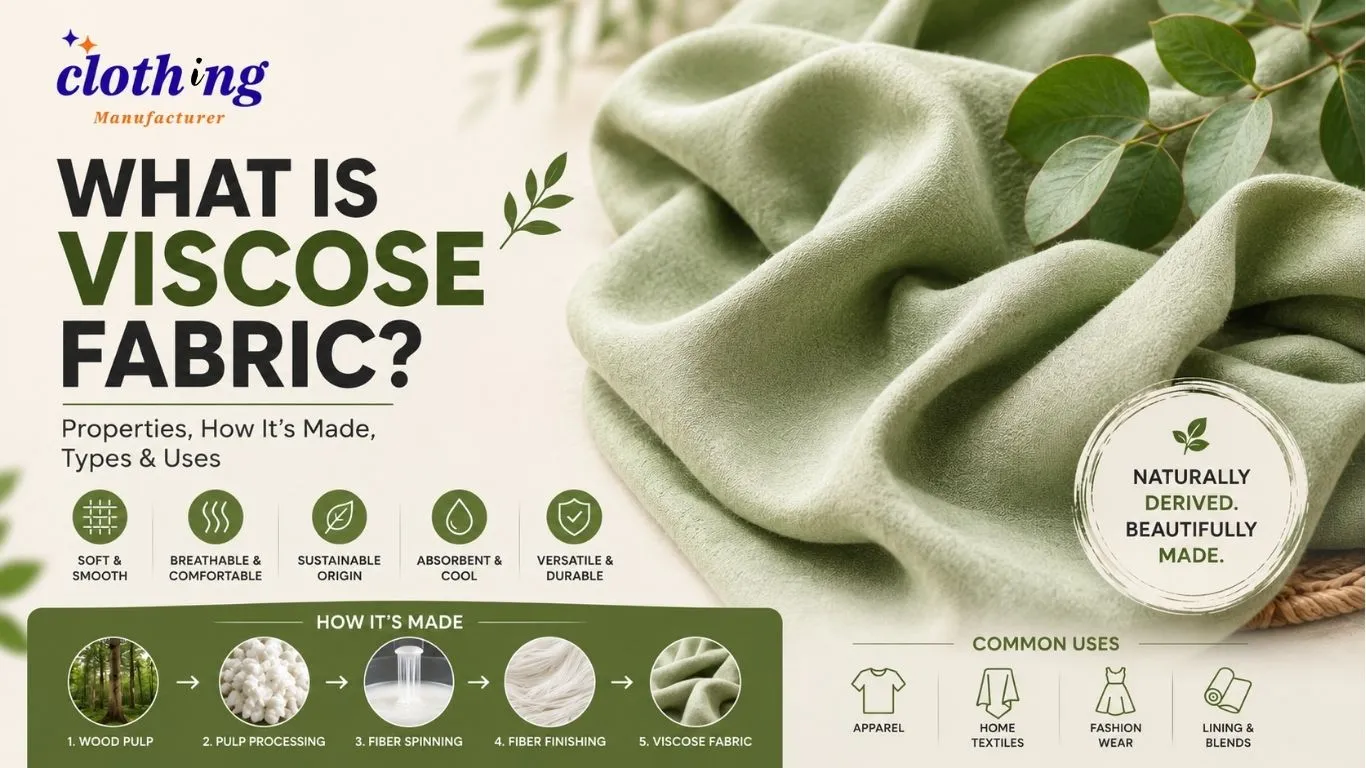
How Is Viscose Made? — The 7-Step Production Process
Understanding how viscose is made is important for anyone choosing fabrics for garment manufacturing. The viscose production process is more complex than natural fibre production (which involves harvesting and spinning) and more complex than synthetic fibre production (which typically involves direct petrochemical polymerisation). Here is the complete seven-step process:
01🌲
Wood Pulp Extraction
Trees (beech, eucalyptus, pine, bamboo) are harvested and processed into cellulose sheets — the raw material for viscose fibre.
02⚗️
Alkali Treatment
Cellulose sheets are steeped in sodium hydroxide (caustic soda) to create alkali cellulose — a white, crumbly pulp material.
03🔧
Pressing & Shredding
The alkali cellulose is pressed to remove excess liquid, then shredded into fine crumbs called "white crumb" and aged for 2–3 days.
04💛
Xanthation
Carbon disulfide is added to the aged crumbs, creating cellulose xanthate — an orange-yellow substance known as "yellow crumb."
05🌀
Dissolving to Viscose
Yellow crumb is dissolved in sodium hydroxide, producing a thick, honey-like viscous liquid — the viscose solution that gives the fabric its name.
06🕳️
Spinning into Fibre
The viscose solution is forced through tiny holes in metal devices called spinnerets into an acid bath, which regenerates the cellulose as solid fibres.
07🧵
Finishing into Yarn
Fibres are washed, bleached, dried, and spun into yarn — ready for weaving or knitting into viscose fabric.
✓👗
Weaving / Knitting
Viscose yarn is woven or knitted into fabric — plain weave, satin weave, or jersey knit — depending on the end garment application.
"The viscose process is one of the most chemically complex methods of producing a textile fibre — yet the resulting fabric is one of the softest and most comfortable textiles used in fashion manufacturing worldwide."
— ClothingManufacturer.US Fabric Research
Viscose Fabric Properties — Everything You Need to Know
Understanding viscose fabric properties is essential for anyone choosing materials for garment production. Viscose has a distinctive combination of positive attributes — particularly its softness and drape — but also some important limitations that affect how it performs in use and production.
Softness
9
Extremely soft, smooth, silk-like against skin
Breathability
8
Highly breathable, moisture-absorbing, cool to wear
Durability
5
Moderate when dry — weakens significantly when wet
Drape
9
Beautiful fluid drape — excellent for feminine silhouettes
Eco Score
6
Plant-based but chemically intensive — varies by process
VISCOSE vs OTHER FABRICS — Property Comparison
Rating out of 100 across 5 key fabric performance properties. Comparing viscose against cotton, polyester, silk, linen, and modal.
SOFTNESS & HAND FEEL
How soft and comfortable the fabric feels against skin — out of 100
Viscose / Rayon
90
Modal
95
Silk
98
Combed Cotton
82
Linen
55
Polyester
50
Nylon
48
Cellulosic Fibres
Natural Fibres
Synthetic Fibres
BREATHABILITY & MOISTURE ABSORPTION
Ability to absorb moisture and allow air flow — out of 100
Linen
95
Combed Cotton
88
Viscose / Rayon
83
Modal
85
Silk
70
Polyester
30
Nylon
25
DURABILITY & WASH PERFORMANCE
Long-term wear resistance and washability — out of 100
Nylon
96
Polyester
92
Linen
85
Combed Cotton
80
Modal
72
Silk
55
Viscose / Rayon
48
VISCOSE vs COTTON vs POLYESTER — Full Comparison Table
A complete head-to-head comparison of viscose against the world's most widely used fabrics.
Property
Viscose (Rayon)
Cotton
Polyester
Silk
Linen
Modal
Classification
Semi-synthetic
Natural
Synthetic
Natural
Natural
Semi-synthetic
Raw Material
Wood pulp cellulose
Cotton plant
Petroleum (PET)
Silkworm cocoons
Flax plant
Beech wood cellulose
Softness
Excellent
Very Good
Moderate
Excellent
Moderate
Excellent
Breathability
High
High
Low
Moderate-High
Excellent
High
Moisture Absorption
High (10–12%)
High (8–9%)
Low (0.4%)
Moderate (11%)
High (12%)
High (10–11%)
Drape Quality
Excellent
Good
Good
Excellent
Moderate
Excellent
Durability
Moderate (weak wet)
Good
Excellent
Moderate
Very Good
Good
Shrinkage Risk
High (3–5%)
Moderate (2–3%)
Very Low
Moderate
Moderate
Low
Wrinkle Resistance
Low — wrinkles easily
Low
High
Moderate
Low
Moderate
Eco / Sustainability
Moderate (chemical process)
Moderate (water-intensive)
Low (petroleum-based)
Moderate
Good
Good (closed-loop opt.)
Cost (Manufacturing)
Low–Moderate
Low–Moderate
Low
High
Moderate
Moderate
Typical GSM Range
100–200 GSM
130–350 GSM
100–320 GSM
60–200 GSM
140–280 GSM
120–220 GSM
Best Used For
Dresses, blouses, linings, crop tops
T-shirts, hoodies, basics
Sportswear, activewear
Luxury garments, scarves
Resort, summer wear
Underwear, premium casual
Types of Viscose Fabric — The Complete Rayon Family
Viscose fabric is not a single product — it is the original member of an entire family of semi-synthetic cellulosic fibres. Each variant in the rayon/viscose family is made from the same raw material (wood cellulose) but produced using a modified process to achieve different properties. Understanding these types is essential when choosing the right fabric for your clothing brand.
🌿
Regular Viscose (Standard Rayon)
The original and most widely used form. Soft, lightweight, and drapey with a smooth, slightly shiny surface. Used in dresses, blouses, lightweight tops, linings, and scarves. Less durable than newer variants — weakens significantly when wet.
Most Common
🏔️
Modal
A second-generation viscose made specifically from beech wood using a modified process. Significantly stronger than standard viscose (both dry and wet), softer to the touch, and more resistant to shrinkage. The premium upgrade within the viscose family — used in underwear, activewear, and premium casual garments.
Premium Upgrade
🍃
Lyocell (Tencel™)
The most sustainable form of viscose-family fabric. Made from eucalyptus wood pulp using a closed-loop solvent spinning process that recycles 99% of chemicals used. Stronger, smoother, and more eco-friendly than standard viscose. Tencel is the most recognized brand name.
Most Sustainable
🎋
Bamboo Rayon (Bamboo Viscose)
Viscose produced from bamboo plant cellulose rather than tree wood pulp. Often marketed as an eco-friendly option due to bamboo's rapid growth rate and low water requirements — however, the production process is identical to standard viscose, meaning the eco benefits are in the raw material sourcing, not the process.
Eco Raw Material
🥇
Cupro (Cupra)
A premium viscose-family fibre made from cotton linter cellulose (the short fibres left after cotton ginning) dissolved in a copper ammonium solution. Cupro produces one of the smoothest, most silk-like textiles available — used in luxury fashion linings and premium garments. Considered the most luxurious of the rayon variants.
Luxury Tier
✨
High-Wet-Modulus (HWM) Rayon
A modified viscose that retains significantly more of its strength when wet compared to standard viscose. Developed to address one of viscose's primary weaknesses. Used in activewear, athleisure, and any application requiring viscose's softness but with better wash durability.
Performance Grade
Is Viscose Breathable? — What You Need to Know
Is viscose breathable? Yes — viscose is one of the most breathable fabrics available in fashion manufacturing. This is one of its most important commercial properties and a primary reason it is so widely used in warm-weather fashion, summer dresses, blouses, and lightweight resort wear.
Viscose is breathable for two reasons: first, it has a high moisture absorption rate (10–12% of its own weight in water vapour) which draws perspiration away from the skin; second, it has a lightweight, relatively open fibre structure that allows air to circulate through the fabric. Combined, these properties produce a cooling, comfortable sensation in warm and humid climates — one of the reasons viscose is so popular in custom crop tops, summer dresses, and lightweight fashion tops.
However, it is worth noting that while viscose absorbs moisture well, it dries more slowly than polyester and is not as wicking as performance synthetic fabrics — making it better suited to casual and fashion wear than high-intensity athletic performance.
💡 Viscose vs Cotton Breathability
Both viscose and cotton are highly breathable natural-origin fabrics. Cotton generally absorbs moisture well (8–9%) but dries moderately slowly. Viscose absorbs more moisture (10–12%) and has a slightly cooler feel due to its smoother fibre surface — but is weaker and less durable than cotton when wet. For cool, drapey summer garments, viscose often outperforms cotton. For durable everyday basics and activewear, cotton and cotton-blends remain superior.
Exceptional softness: Viscose has one of the softest hand feels of any fabric — comparable to silk — making it a popular choice for garments worn directly against skin.
Beautiful drape: Viscose fabric drapes elegantly and moves with the body, making it ideal for feminine silhouettes, dresses, skirts, blouses, and lining fabrics.
Highly breathable: With a moisture absorption rate of 10–12%, viscose is one of the most breathable fabrics available — keeping the wearer cool and comfortable.
Dyes exceptionally well: Viscose accepts dye more readily than most fabrics, producing vivid, rich colors with excellent depth and brilliance — making it popular for bold fashion pieces.
Affordable luxury feel: Viscose provides a silk-like appearance and feel at a significantly lower cost than genuine silk, making it accessible for commercial fashion brands.
Lightweight: Viscose fabric is typically lighter than cotton at the same GSM, contributing to its popular use in lightweight summer garments.
Plant-based origin: Unlike fully synthetic fabrics (polyester, nylon), viscose is derived from renewable plant cellulose — though its production process does involve chemicals.
❌ Disadvantages of Viscose Fabric
Weakens when wet: Standard viscose loses up to 50% of its tensile strength when wet — the most significant disadvantage for garment production and consumer care. HWM rayon and modal address this.
Prone to shrinkage: Viscose can shrink 3–5% in the first wash if exposed to hot water or tumble drying. Garment manufacturers must account for this in pattern sizing.
Wrinkles easily: Viscose creases and wrinkles more than cotton and significantly more than polyester — requiring careful handling, pressing, and garment care.
Delicate care requirements: Most viscose garments require hand-washing or a delicate machine cycle in cold water — reducing its convenience compared to cotton or polyester.
Environmental concerns: The standard viscose production process uses carbon disulfide, a toxic chemical, and generates significant wastewater — though modern facilities with treatment systems significantly mitigate this.
Not suitable for heavy use: Viscose is not appropriate for high-stress applications like activewear, workwear, or any garment requiring high tear resistance.
What Is Viscose Fabric Used For? — Applications in Clothing
Viscose fabric is used across a remarkably wide range of clothing and textile applications. Its softness, drape, and breathability make it a versatile fabric for both fashion and functional applications. Here is where viscose is most commonly used in custom clothing manufacturing for USA brands:
Dresses and skirts: The most common application for viscose — the fluid drape and lightweight construction create beautifully flowing dresses and skirts ideal for warm weather and occasion wear.
Blouses and tops: Viscose's silk-like surface and breathability make it an ideal fabric for women's blouses, fashion tops, and draped shirts — a staple in women's fashion manufacturing.
Crop tops: Lightweight viscose jersey is increasingly used in custom crop top manufacturing for women's fashion brands — particularly for going-out, resort, and summer collections.
Linings: Viscose is widely used as a lining fabric inside structured garments — jackets, varsity jackets, coats, and trousers — providing a smooth, comfortable interior layer.
Loungewear and sleepwear: The soft, cool hand of viscose makes it a popular choice for premium loungewear, pyjamas, and sleepwear brands.
Scarves and shawls: Woven viscose produces beautiful, lightweight scarves and shawls with excellent colour depth and a semi-lustrous appearance.
Activewear blend fabrics: When blended with spandex or polyester, viscose contributes softness and breathability to activewear fabrics — used in custom yoga shorts and athleisure pieces.
Medical textiles: Viscose is used in surgical textiles, wound care products, and non-woven hygiene items due to its high absorbency.
Manufacture With Viscose & Premium Fabrics
Need Custom Garments in Viscose, Modal or Cotton?
ClothingManufacturer.US offers complete custom clothing manufacturing with viscose, modal, cotton, and all fabrics covered in this guide — private label, low MOQ, factory-direct pricing.
Viscose in Garment Manufacturing — What Brands Need to Know
For fashion brand founders and clothing entrepreneurs launching their first collection, understanding how viscose fabric behaves in garment manufacturing is essential before placing a production order. At ClothingManufacturer.US, we work with viscose and viscose-blend fabrics across multiple garment categories — and there are several key considerations every brand should understand:
Pre-washing before cutting: Viscose must be pre-washed or steam-shrunk before garment cutting to account for its shrinkage rate. Professional manufacturers account for this in their pattern-making, but brands specifying viscose should ensure this step is confirmed with their low MOQ clothing manufacturer.
Cutting direction matters: Viscose has a visible sheen direction — like silk and velvet. All garment pieces must be cut in the same direction (the lay must be single-direction) to ensure colour consistency across the finished garment.
Labeling requirements: The US FTC requires that viscose garments be labeled with the correct fibre content. "Rayon" is the required US term on care labels — a professional private label clothing manufacturer will handle this correctly as standard.
Blend opportunities: Many brands opt for viscose-cotton or viscose-polyester blends to improve durability and reduce shrinkage while maintaining the softness and drape that makes viscose attractive. Our fabric selection guide covers blend options in detail.
How to Care for Viscose Fabric — Washing & Maintenance
Proper care instructions for viscose fabric are important to communicate to end consumers via garment care labels:
Hand-wash in cold or lukewarm water (30°C maximum) with a gentle detergent
Machine wash only on a delicate or hand-wash cycle — cold water only
Do not wring or twist wet viscose — the wet fabric loses strength and can distort
Dry flat or hang dry away from direct sunlight — tumble drying causes significant shrinkage
Iron on low-medium heat while slightly damp — high heat damages viscose fibres
Dry cleaning is recommended for delicate or structured viscose garments
Store flat or loosely folded — avoid heavy compression which causes persistent creases
Frequently Asked Questions — Viscose Fabric
What is viscose fabric?+
Viscose fabric (also called rayon) is a semi-synthetic textile made from cellulose extracted from wood pulp — typically from beech, eucalyptus, pine, or bamboo trees. It is classified as semi-synthetic because its raw material is natural (plant cellulose) but it undergoes significant chemical processing. Viscose is known for its soft drape, smooth texture, and high moisture-absorbing properties.
Is viscose a natural or synthetic fabric?+
Viscose is semi-synthetic. Its raw material — cellulose — comes from natural wood pulp. However, it undergoes significant chemical processing (sodium hydroxide, carbon disulfide) to convert the pulp into fibre, placing it between fully natural fabrics (cotton, linen, silk) and fully synthetic fabrics (polyester, nylon, acrylic).
Is viscose the same as rayon?+
Yes. Viscose and rayon refer to the same semi-synthetic cellulosic fibre. "Viscose" is the common term in the UK and Europe; "rayon" is used in the USA. Both describe fabric made from wood pulp cellulose processed through the viscose method. On USA garment labels, the correct term is "rayon."
Is viscose fabric breathable?+
Yes. Viscose is highly breathable — it absorbs 10–12% of its weight in moisture vapour, making it one of the most breathable fabrics in fashion. This is why it is widely used in summer dresses, blouses, crop tops, and warm-weather garments. It feels cool against skin and allows good air circulation.
What are the disadvantages of viscose fabric?+
The main disadvantages are: it weakens significantly when wet (reduces durability), it shrinks if washed at high temperatures (3–5% shrinkage), it wrinkles easily, it requires careful delicate washing, and the standard production process uses chemicals (carbon disulfide) that require careful environmental management.
Is viscose the same as modal?+
No — modal is a second-generation, upgraded version of viscose. Both are made from cellulose, but modal is produced from beech wood using a modified process that makes the fibres stronger (especially when wet), softer, and more shrink-resistant than standard viscose. Modal is the premium upgrade within the viscose family.
Does viscose shrink?+
Yes. Viscose tends to shrink when exposed to hot water or tumble drying — typically 3–5% in the first wash. To minimise shrinkage, garments should be hand-washed or machine-washed on a delicate cold-water cycle and air-dried flat. Professional garment manufacturers pre-shrink viscose fabric before pattern cutting.
What garments is viscose fabric best suited for?+
Viscose is best suited for dresses, blouses, skirts, scarves, linings, lightweight crop tops, loungewear, and fashion tops. Its beautiful drape and soft hand make it ideal for feminine fashion silhouettes. It is not suited for activewear, outdoor wear, or any application requiring high wet-strength or frequent intensive washing.
Is viscose eco-friendly?+
Viscose has a mixed environmental profile. Its raw material (wood cellulose) is renewable and plant-based. However, the standard production process uses chemicals including carbon disulfide and generates wastewater requiring treatment. The more sustainable alternative is lyocell/Tencel, which uses a closed-loop solvent process that recycles 99% of chemicals.
Can I manufacture custom garments using viscose fabric?+
Yes. ClothingManufacturer.US offers viscose and viscose-blend fabric options for custom garment manufacturing — including viscose jersey for dresses and tops, viscose satin for linings, and cotton-viscose blends for improved durability. Contact us via WhatsApp for fabric swatches and a manufacturing quote.
The ClothingManufacturer.US team has over 10 years of hands-on experience in custom garment manufacturing — working daily with cotton, polyester, fleece, velour, viscose, modal, linen, and performance fabrics across all garment categories. Our fabric guides are written from factory-floor expertise for USA fashion brands, startups, and clothing label founders.