
Puff Printing: What It Is, How It Works, Cost & MOQ
Puff Printing explained for clothing brands: how puff printing works, which fabrics suit it, what affects cost, how MOQ should be understood, which failures to watch for and how to approve a production-ready sample.
Puff printing is easiest to understand when you connect the print method to the finished garment. This guide is written for brand owners and buyers, not machine operators: it explains the production decisions that affect appearance, price, minimum quantities and repeat quality.
Puff Printing in one sentence
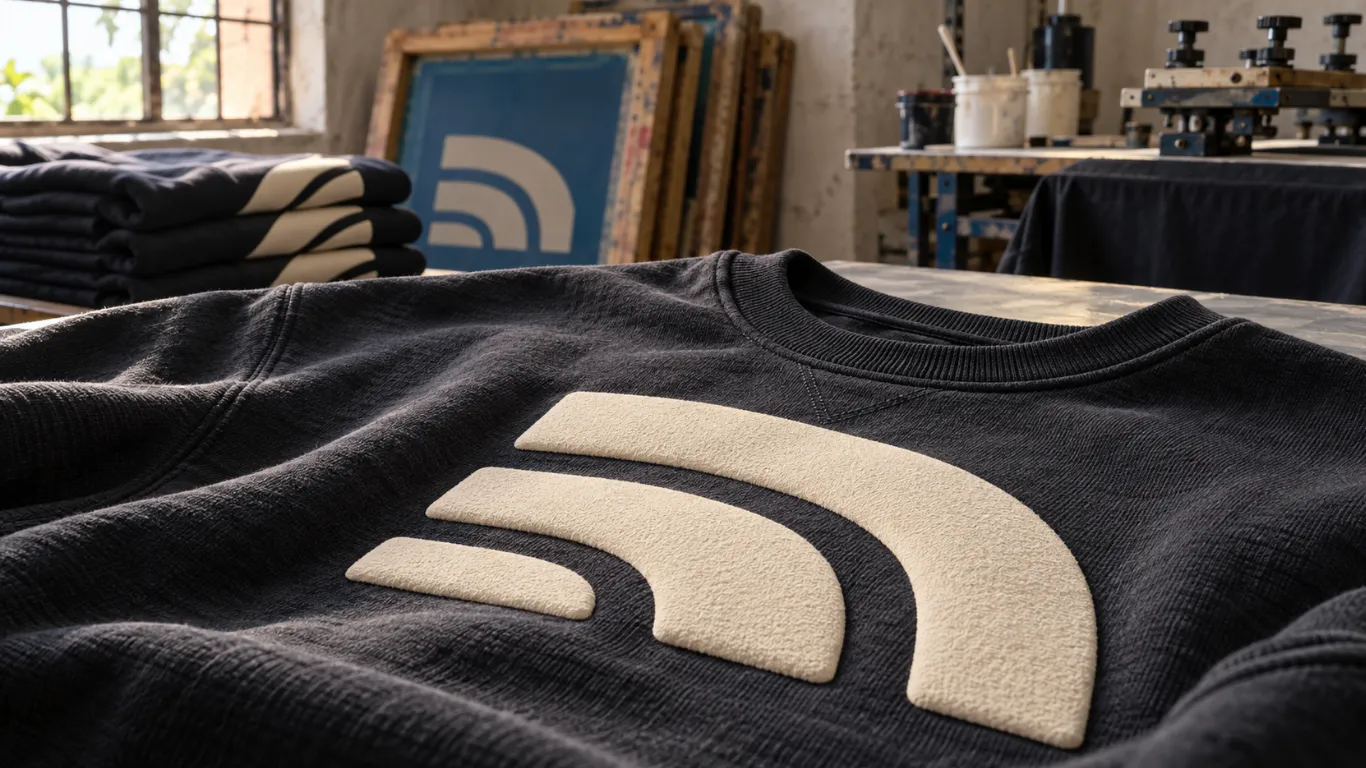
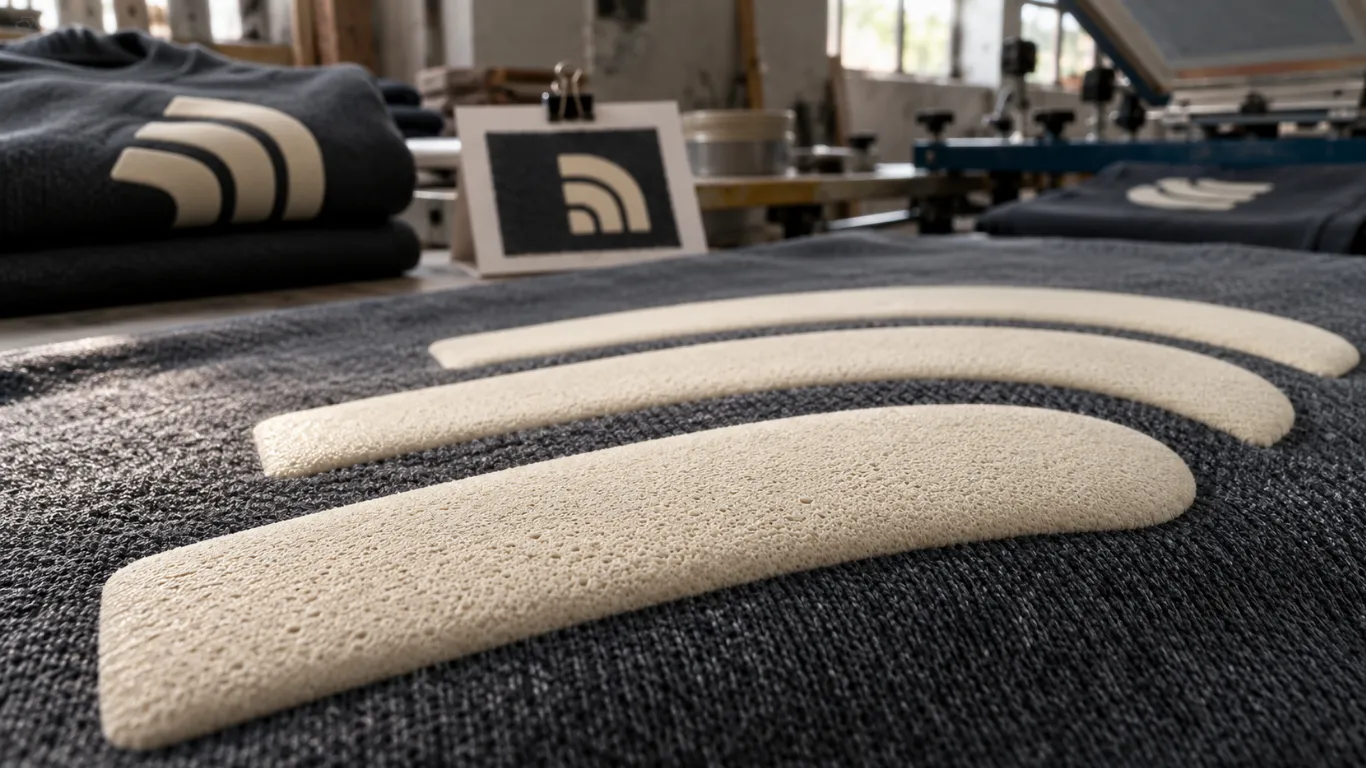
Puff printing is a raised screen-print effect in which a heat-reactive ink or additive expands during final curing to create a dimensional surface. It is especially useful for streetwear logos, bold type, selected details and tactile raised graphics.
What Is Puff Printing?
Puff Printing is a garment-decoration method used to place artwork on clothing. Puff printing is a raised screen-print effect in which a heat-reactive ink or additive expands during final curing to create a dimensional surface. In practical apparel production, puff printing is not chosen because its name sounds modern or traditional; it is chosen when the artwork, fabric, order quantity, required hand feel and quality target all support the process.
For a clothing brand, the useful question is not only “what is puff printing?” but “what problem does puff printing solve better than the alternatives?” This method is particularly useful for streetwear logos, bold type, selected details and tactile raised graphics. Its commercial value comes from balancing visual result, repeatability and unit economics rather than chasing the lowest decoration price in isolation.
Quick answer
Puff Printing is a strong option when you need streetwear logos, bold type, selected details and tactile raised graphics. The exact result depends on the production fabric, artwork coverage and process controls. Always approve a decorated sample before bulk production.
How Puff Printing Works
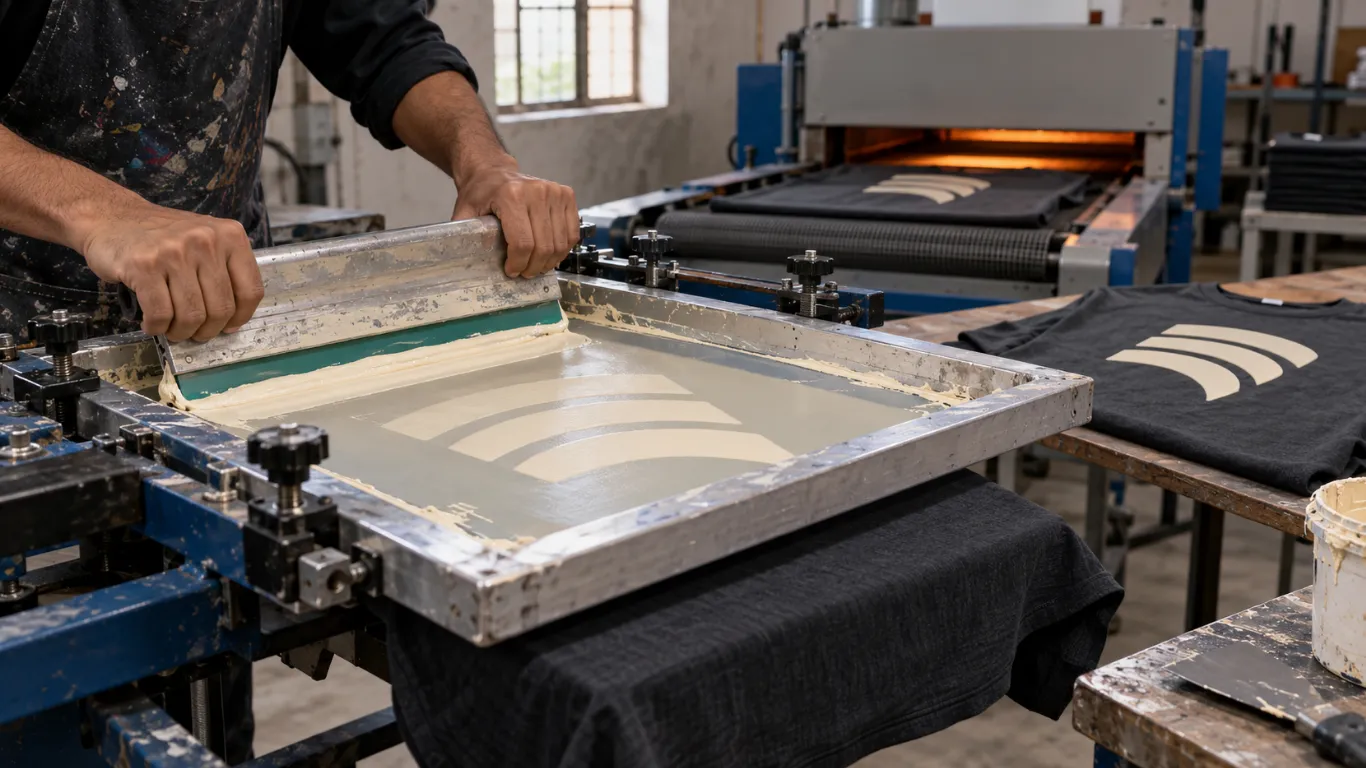
The puff printing workflow begins before a machine or press touches the garment. Artwork must be checked at final size, the production fabric must be known and the operator needs an approved placement. The actual sequence below is a useful buyer-level view of how puff printing moves from file to finished garment.
- Step 1. Simplify artwork so small gaps and fine details can survive expansion.
- Step 2. Prepare the screen and choose an appropriate mesh for the desired deposit.
- Step 3. Mix or select the puff ink system consistently and record the formula.
- Step 4. Run a strike-off on the actual production fabric and garment color.
- Step 5. Print a controlled deposit without flooding fine negative areas.
- Step 6. Flash only as required for multi-color or layered artwork.
- Step 7. Final-cure at the validated conditions so the print expands evenly.
- Step 8. Allow the print to cool before judging final height and texture.
- Step 9. Inspect expansion, edge definition, cracks, color shift and adhesion.
Production settings should be treated as a controlled recipe. Temperature, time, pressure, ink deposit, pretreatment or other settings are not universal numbers that can be copied across every fabric. A professional puff printing setup records what was approved for the specific garment so a reorder does not depend on memory.
Best Fabrics for Puff Printing
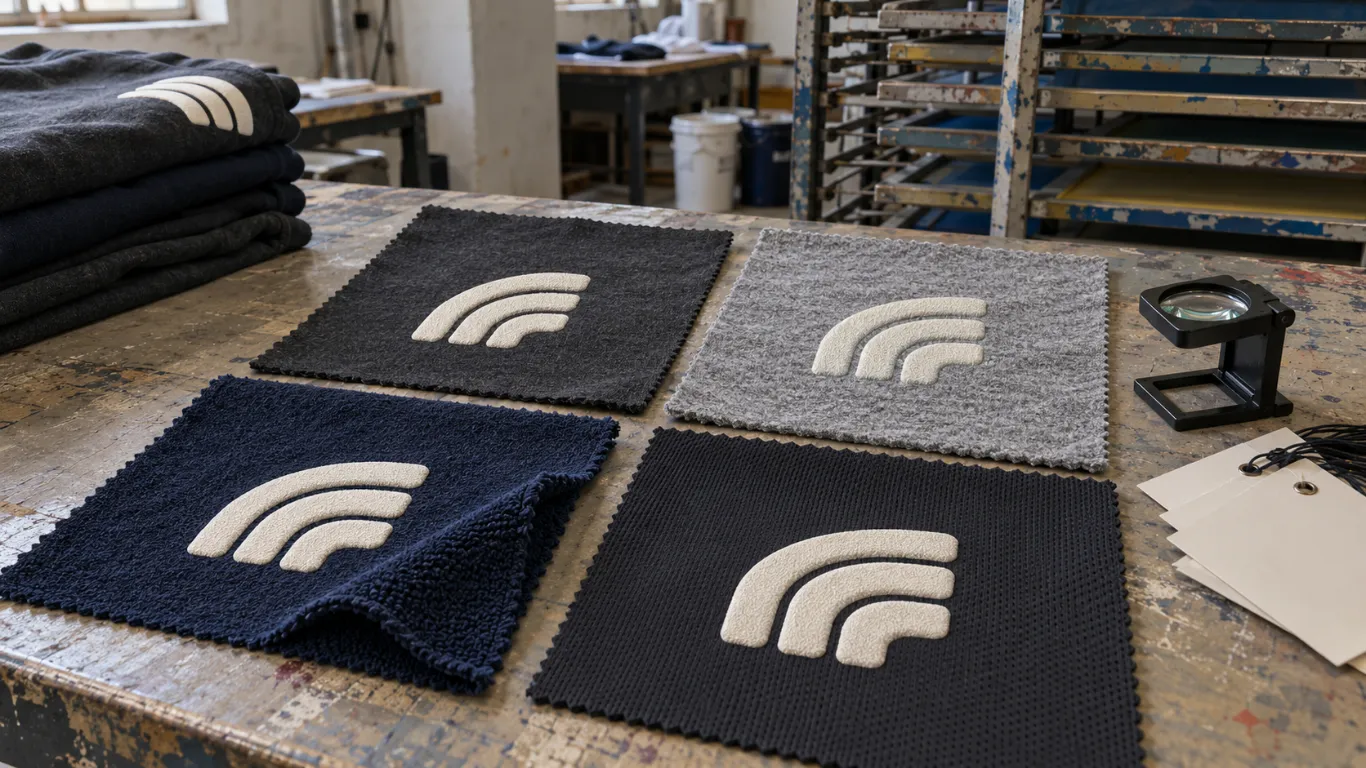
Fabric is one of the biggest variables in puff printing. Fiber content matters, but so do knit structure, surface finish, garment dye, stretch, coatings and fabric color. A method that performs cleanly on a smooth cotton T-shirt can behave differently on brushed fleece or heat-sensitive polyester.
| Fabric | Suitability | Production note |
|---|---|---|
| Heavy cotton jersey | Excellent | Stable surface supports bold raised details. |
| French terry | Very good | Test texture so expansion remains even. |
| Cotton fleece | Very good | Common for hoodies and sweatshirts; avoid seams and thick transitions. |
| Cotton/poly blends | Good | Test expansion, cure and migration behavior. |
| Polyester | Conditional | Heat and dye migration require careful chemistry selection. |
| Very stretchy knits | Conditional | Raised deposits can stress during repeated stretch; test recovery. |
Works well on stable cotton-rich garments after cure testing. That is a starting point, not a substitute for production testing. When your brand changes fabric supplier, garment color or dye lot, repeat the critical puff printing checks if the decoration result could change.
Heavyweight garments also need attention to seams and surface texture. For hoodies, sweatshirts and tracksuits, the print area should lie as flat as the method requires. If the artwork crosses a kangaroo pocket, zipper, placket or thick seam, the supplier should test that placement rather than assuming normal pressure or registration will work.
Artwork Requirements for Puff Printing
Good puff printing starts with production-ready artwork. A high-resolution file cannot fix a design that contains features too fine for the method, and a vector file cannot fix a placement that has never been measured. Brands should define the visible design and the physical production instructions separately.
- Final dimensions: state print width and height in inches or centimeters.
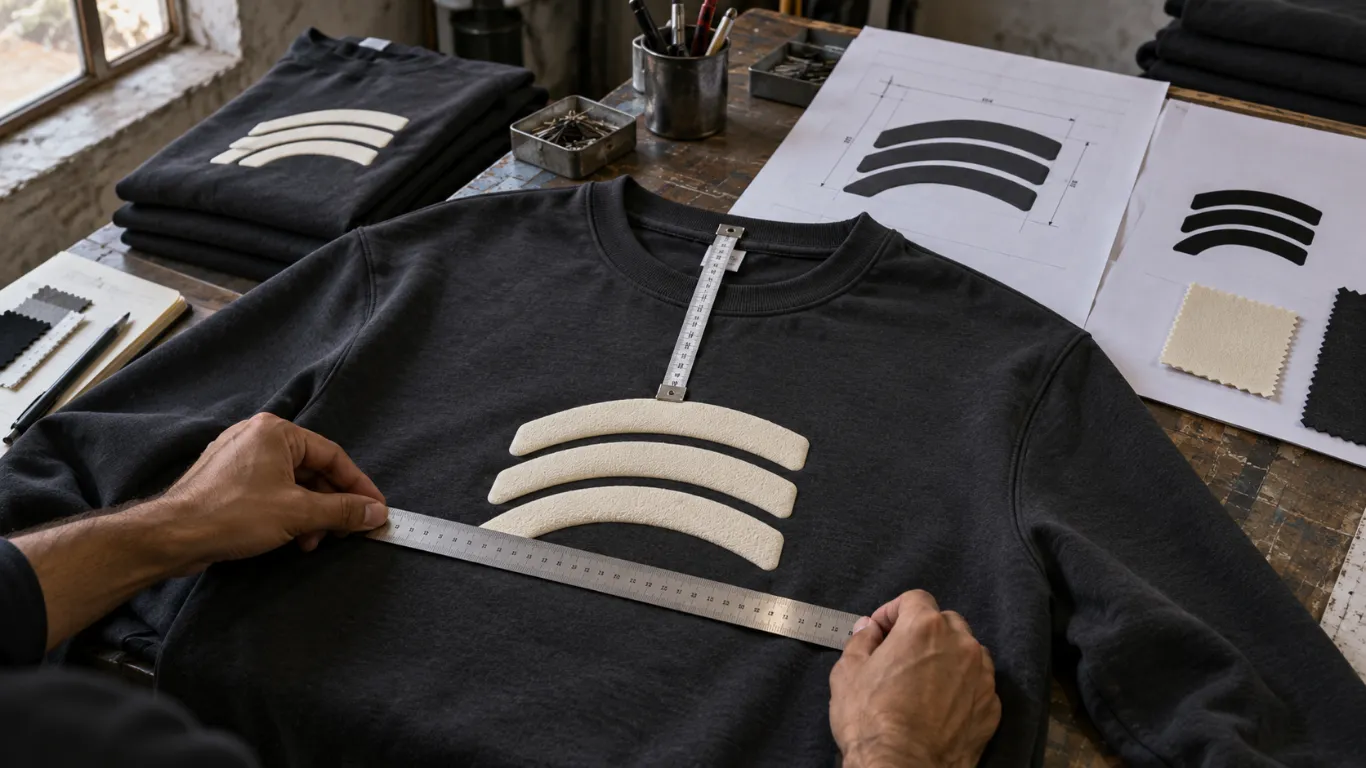
- Placement: measure from stable garment points such as neck seam, center front or side seam.
- Color: include Pantone or physical references when brand color matching matters.
- File quality: provide vector art for logos and clean high-resolution raster files for photographic content.
- Transparency: confirm which areas are true holes/negative space rather than a background color.
- Versions: use clear filenames so approved art cannot be confused with an earlier draft.
For puff printing, the artwork should be reviewed at actual production size. Tiny text, hairline strokes and tight negative spaces may look perfect on a large monitor but close, blur or lose definition in the physical process. The supplier should flag these risks before sampling.
Puff Printing Materials and Equipment
A buyer does not need to operate the equipment, but understanding the system makes quotations easier to compare. Puff Printing can require method-specific inks or transfer materials, artwork software, garment positioning tools, curing or pressing equipment and quality-control checks. The quality of puff printing is therefore a system result rather than a single “ink quality” question.
Ask the factory to identify the decoration route used on your sample and whether the same production system will be used in bulk. A sample made with one chemistry and a bulk run made with a cheaper substitute can change color, hand feel or durability even when the artwork looks similar in photographs.
For a repeat order, keep the approved puff printing recipe with the fabric article and a physical reference. That is more useful than asking for “the same as last time” months later.
How Much Does Puff Printing Cost?
There is no honest universal price for puff printing because a “print” is not one standard unit. A 7 cm chest logo and a 40 cm full-back graphic use different material and machine time. A one-color cotton job and a multi-layer dark polyester job can also need completely different preparation.
The main puff printing cost drivers are:
- Number of screen colors and placements.
- Puff ink chemistry or additive and its required deposit.
- Print area and desired raised height.
- Testing needed to control expansion on the production fabric.
- Multi-color registration around a dimensional layer.
- Curing time and sensitivity to garment heat response.
- Polyester migration control when used on synthetic blends.
- Quantity across which screen setup can be distributed.
Simple cost model
Decoration cost per garment = allocated setup + material/ink usage + application labor/machine time + special-process allowance + testing/reject allowance. Add the blank or custom garment, labels, packaging and freight to reach the landed product cost.
For transparent quoting, send the final artwork, exact finished dimensions, garment fabric/color, quantities and every print placement. If any of those are missing, a quoted number is only an estimate. Puff Printing can be very cost-effective when the production conditions suit it, but it should be compared on landed product value rather than a headline decoration price.
Why we do not publish one fixed dollar figure here: a fixed web price would be misleading for custom manufacturing. Your quotation should show the conditions that create the price so you can change quantity, artwork or placement intentionally.
Puff Printing MOQ and Small-Order Economics
For custom apparel manufacturing, our standing minimum is 10 MOQ per color per style and up to 3 sizes. The decoration method still has its own setup economics. With puff printing, a ten-piece run may be technically possible while a larger run delivers a lower decoration cost per piece because setup or preparation is shared across more garments.
That distinction matters for startups. “MOQ” answers whether the project can be produced; it does not tell you the most economical quantity. A new brand should ask for price breaks at realistic next steps—such as its first test quantity, a small restock and a larger proven reorder—then model its retail margin at each level.
Keep style/color combinations controlled when testing demand. Splitting a small budget across too many garment colors, artwork versions and placements can multiply setup and make quality approval harder. A focused first puff printing program normally teaches you more than a wide collection with only a few pieces of each variation.
Puff Printing Quality Control and Common Problems
Good puff printing quality control happens before, during and after production. The operator should not wait until the carton is packed to discover that placement drifted, cure was incomplete or the fabric reacted badly. For a new combination, a decorated sample and wash test establish what “approved” means.
| Problem | Likely cause | Production response |
|---|---|---|
| Print stays flat | Insufficient heat, wrong formula or too little deposit | Validate ink mix and cure with a strike-off. |
| Cracking | Over-expansion, incompatible base or brittle deposit | Reduce expansion/deposit and test flex after cure. |
| Fine gaps close | Artwork is too detailed for the amount of expansion | Open negative space and simplify small counters. |
| Uneven height | Deposit, mesh, squeegee or fabric surface varies | Standardize screen parameters and garment loading. |
| Discoloration | Heat or dye migration changes the raised layer | Lower cure where compatible and use migration control after testing. |
During bulk puff printing, inspect the first pieces and continue periodic checks rather than relying on a single end-of-run inspection. Measure the decoration, compare color and surface to the approved reference, and watch for changes caused by production heat, material buildup or operator loading.
For pre-shipment QC, decoration is evaluated as part of the garment. A technically perfect print on a garment with a twisted seam, shade variation or wrong label is not an acceptable finished product. The buyer is purchasing a complete branded item, not an isolated graphic.
Best Uses for Puff Printing
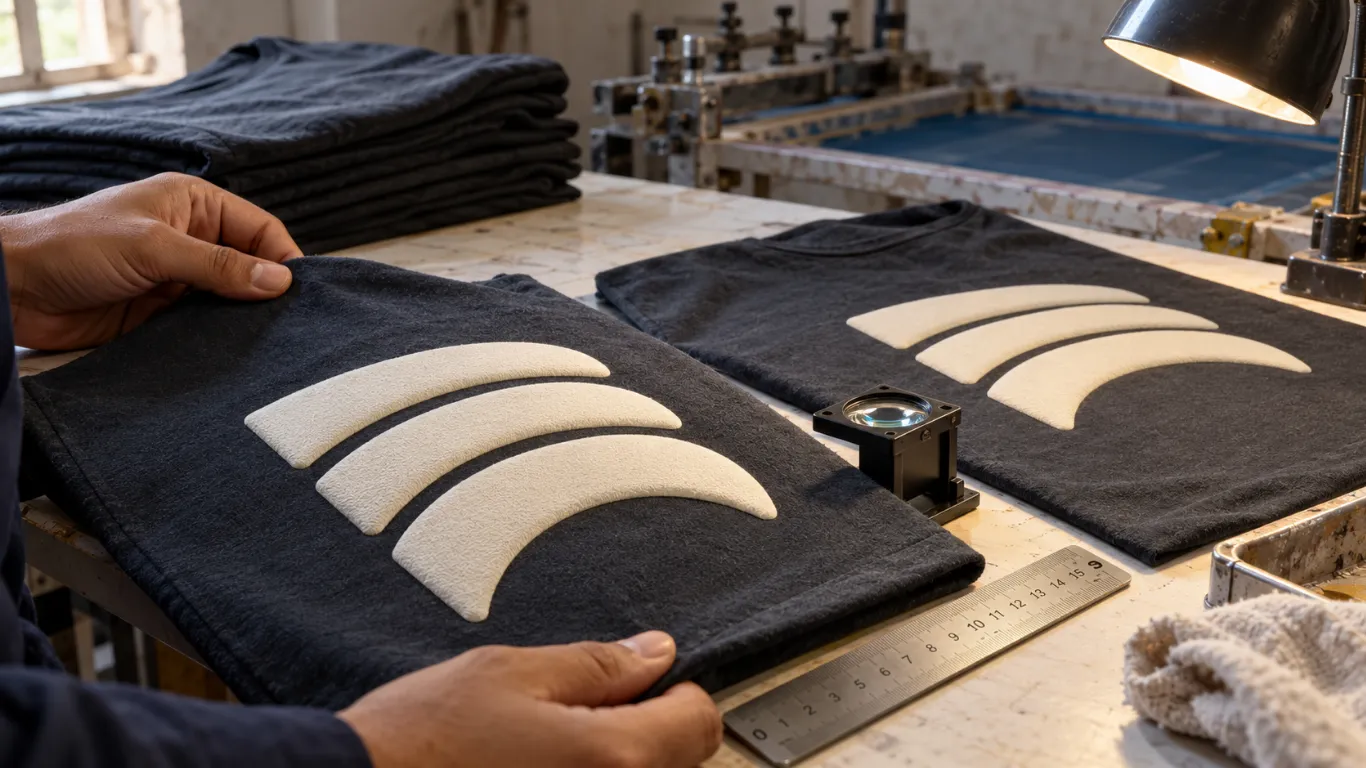
Puff Printing is most useful for streetwear logos, bold type, selected details and tactile raised graphics. It can be applied to T-shirts, hoodies, sweatshirts, tracksuits and other garments when the fabric and construction are compatible. Instead of asking whether puff printing is “good,” match it to the design objective.
A method can also be rejected for good reasons. If the artwork coverage, garment fabric or end use conflicts with the strengths of puff printing, choosing a different process is not a compromise; it is production engineering. The most durable brand systems are the ones where design and manufacturing constraints are considered together.
Puff Printing vs DTF, DTG, Screen Print and Sublimation
No printing process wins every category. Compare puff printing with other methods using the factors that affect the finished garment: setup, fabric compatibility, photographic detail, hand feel, opacity, special effects, repeat speed and expected quantity.
| Method | Best fit | Quantity economics | Typical hand |
|---|---|---|---|
| Puff Printing | streetwear logos, bold type, selected details and tactile raised graphics | Setup resembles screen printing, so repeated quantities usually improve economics | Raised and tactile; intentionally more dimensional than a flat print |
| Screen printing | Spot colors, bold graphics, repeat volume | Setup is higher; unit economics improve with repetition | Highly controllable by ink/deposit |
| DTF printing | Full-color transfers and mixed fabrics | Flexible for shorter runs | Transfer layer is noticeable |
| DTG printing | Photographic detail on cotton-rich garments | Low setup, slower per garment | Often soft on suitable cotton |
| Sublimation printing | All-over polyester graphics | Strong for planned panel production | No surface film on polyester |
The comparison table is intentionally qualitative. A factory should test the specific garment instead of making absolute promises from method names. If two processes are plausible, make the same artwork on the same production fabric and compare them side by side after washing. That gives a far more useful answer than a generic online ranking.
Puff Printing Durability and Washing
The durability of puff printing depends on more than the method label. Correct fabric preparation, compatible chemistry, deposit, pressure, curing and aftercare all influence the result. A decoration that survives on one fabric may fail on another if the same recipe is copied blindly.
For a new production combination, test appearance after repeated laundering and normal stretch. Look for cracking, peeling, excessive fading, edge lift, dye migration or loss of the intended special effect. The goal is not to promise an arbitrary wash count without test conditions; it is to prove that the actual garment meets the brand’s expected use.
- Wash printed garments inside out when practical.
- Use mild detergent and avoid unnecessary aggressive bleach.
- Limit high tumble-dry heat when the tested care system does not require it.
- Do not iron directly on surface decoration unless it is specifically designed for that heat.
- Base the care label on the complete garment: fabric, trims, decoration and wash treatment.
For puff printing, durability claims should be supported by the approved material and cure/press process used in production. If the brand changes that system, the old claim should not automatically be carried forward.
Puff Printing and Sustainability: What Brands Should Ask
Sustainability cannot be decided from the words “puff printing” alone. A meaningful evaluation considers ink or transfer chemistry, energy, water/cleanup, material waste, rejected garments, supplier controls and how long the finished item remains usable. Some methods reduce one impact while increasing another.
Ask for specific documentation when an environmental claim will appear on a product page or label. Avoid broad language such as “eco-friendly printing” unless you can define what that means for the actual chemistry and production route. Narrow factual claims are more credible for customers and easier for a brand to defend.
Waste reduction also starts at design. Efficient artwork nesting, fewer unnecessary samples, correct first-time placement and a durable finished garment can prevent more waste than switching methods only for marketing language. Treat puff printing as one part of the complete product footprint.
How to Order Puff Printing for a Clothing Brand
A complete puff printing enquiry gets a more accurate answer than “How much for printing?” Send the factory enough information to price the same product you intend to manufacture.
- Choose the garment style, fabric composition, GSM and color.
- Send final artwork files and identify the approved version.
- State finished width/height for every placement.
- List front, back, sleeve, hood, leg or panel locations separately.
- Provide order quantity by style and color, plus expected size split.
- State the required hand feel or visual effect and share physical references if available.
- Request a decorated sample or strike-off on the real production fabric.
- Approve color, dimensions, placement and finish in writing.
- Keep the approved reference and production specification for the reorder.
For clothing manufactured by CLOTHINGMANUFACTURER.US, the minimum wording is 10 MOQ per color per style and up to 3 sizes. Send artwork with your garment request so the decoration can be engineered at the same time as fabric, pattern and construction.
Information needed for a quote
Garment type + fabric/GSM + garment color + artwork file + exact print size + number of placements + quantity + destination + deadline. These details allow puff printing cost and production risk to be assessed together.
Advanced Puff Printing Production Notes
These notes go beyond a basic definition. They explain the small production decisions that determine whether puff printing feels intentional and repeatable when a brand moves from one sample to an actual collection.
1. Design for the production surface for Puff Printing
This decoration should be treated as part of the garment engineering plan. A garment is not a flat sheet of paper. Rib, fleece nap, seams, pockets, drawcords and zippers create pressure differences and positioning limits. Strong artwork can be adapted around those realities without losing its identity. During development, map the printable zone from garment measurements rather than scaling a mockup by eye. This also protects consistency when a design is graded across sizes. For this production program, record the final decision in the production specification so sampling, bulk work and reorders use the same reference.
2. Separate visual size from ink coverage for Puff Printing
This decoration should be treated as part of the garment engineering plan. Two graphics with the same outer dimensions can have very different production cost and feel. A thin-line illustration may cover only a small percentage of the area, while a solid rectangle fills nearly all of it. When comparing quotes, state both the finished dimensions and show the final artwork. This prevents a supplier from pricing a low-coverage draft and then changing the price after the final file arrives. For this production program, record the final decision in the production specification so sampling, bulk work and reorders use the same reference.
3. Use placement tolerances that reflect sewing reality for Puff Printing
This decoration should be treated as part of the garment engineering plan. Garment panels move slightly during sewing and finished garments are not identical rigid objects. For production, measure decoration from repeatable reference points such as center front, neck seam, side seam or pocket edge, and agree a reasonable tolerance. Overly precise instructions that ignore normal garment variation can create unnecessary rejects without producing a visibly better product. For this production program, record the final decision in the production specification so sampling, bulk work and reorders use the same reference.
4. Plan dark garments before light garments for Puff Printing
This decoration should be treated as part of the garment engineering plan. Dark bases often require an underbase, blocker, extra white, different pretreatment or additional cure control. This can change hand feel and cost. A collection that uses one graphic across white, black and polyester colorways should be tested as separate production conditions rather than assuming the light-garment recipe can simply be copied. For this production program, record the final decision in the production specification so sampling, bulk work and reorders use the same reference.
5. Control color with physical standards for Puff Printing
This decoration should be treated as part of the garment engineering plan. A hex code is designed for screens, not textile ink. For important brand colors, use a physical target or a standardized color reference and approve a real strike-off. Record the approved mix or digital workflow with the fabric article. This is especially important when a reorder may happen months later or when the same logo appears across print, embroidery, labels and packaging. For this production program, record the final decision in the production specification so sampling, bulk work and reorders use the same reference.
6. Sample the combination, not only the components for Puff Printing
This decoration should be treated as part of the garment engineering plan. A fabric swatch can pass, and a print on another fabric can pass, yet the final combination can still fail. Heat response, stretch, surface finish and dye behavior are specific to the actual garment material. A reliable sample uses the production fabric, production color, intended decoration method and realistic artwork coverage. For this production program, record the final decision in the production specification so sampling, bulk work and reorders use the same reference.
7. Cost the whole decoration program for Puff Printing
This decoration should be treated as part of the garment engineering plan. Brands often compare only the headline price per print. A better calculation includes setup, films or screens, multiple placements, special effects, sampling, expected reject allowance, labels and any added production time. Once these are combined with the garment and freight, the brand can compare landed unit economics rather than isolated print charges. For this production program, record the final decision in the production specification so sampling, bulk work and reorders use the same reference.
8. Keep a golden decoration reference for Puff Printing
This decoration should be treated as part of the garment engineering plan. When a print is approved, retain a physical sample with the final dimensions, placement, color and hand feel. Photographs are valuable for communication but cannot show texture or opacity accurately. A retained approved sample gives production and quality teams a concrete standard during reorders and helps resolve disagreements objectively. For this production program, record the final decision in the production specification so sampling, bulk work and reorders use the same reference.
9. Think about retail use before choosing a finish for Puff Printing
This decoration should be treated as part of the garment engineering plan. A display piece, gym garment, children’s item, uniform and streetwear hoodie experience different abrasion, stretch, washing and heat. Method choice should match the end use. The most visually dramatic sample is not automatically the best production decision if it becomes uncomfortable, difficult to wash or inconsistent at scale. For this production program, record the final decision in the production specification so sampling, bulk work and reorders use the same reference.
10. Avoid unsupported sustainability claims for Puff Printing
This decoration should be treated as part of the garment engineering plan. Water use, energy, chemistry, transfer waste and garment longevity all matter. A method name alone does not prove that a finished product is environmentally preferable. If sustainability is part of marketing, request specific documentation for inks, fabrics and processes and use narrow factual language instead of broad claims that cannot be substantiated. For this production program, record the final decision in the production specification so sampling, bulk work and reorders use the same reference.
11. Document changes between sample rounds for Puff Printing
This decoration should be treated as part of the garment engineering plan. If the print width, placement, ink, garment color or fabric changes, update the written specification immediately. Do not rely on a chat message buried in a long thread. Versioned artwork and a short approval log help prevent an earlier file from being used accidentally during bulk production. For this production program, record the final decision in the production specification so sampling, bulk work and reorders use the same reference.
12. Design a scalable decoration system for Puff Printing
This decoration should be treated as part of the garment engineering plan. A method that works beautifully for ten pieces may become slow or costly at one thousand, and a high-setup method can be inefficient for frequent tiny drops. If the brand expects growth, discuss the likely volume path early. Sometimes the right strategy is to launch with one process and deliberately convert to another after the artwork and demand are proven. For this production program, record the final decision in the production specification so sampling, bulk work and reorders use the same reference.
Related Printing and Manufacturing Guides
Use these pages to compare puff printing with the rest of the decoration cluster and then connect the method to the garment itself.
For broader manufacturing context, see our T-shirt manufacturer, hoodie manufacturer and clothing manufacturing process pages. For general background on the underlying print technology, this page also links to an external reference.
Puff Printing FAQs
These questions cover the issues clothing brands commonly need to resolve before approving puff printing for samples and production.
How high can puff printing rise?
There is no single reliable height for every ink and fabric. Expansion depends on formula, deposit, mesh, cure and artwork geometry. A strike-off should establish the visual target rather than specifying a height that the chosen chemistry cannot reproduce consistently.
Can puff printing be combined with normal screen printing?
Yes. Flat layers and puff details can be combined, but the production sequence, flash temperatures and final cure must be planned so the raised layer expands correctly without damaging earlier colors.
Is puff printing good for very large solid graphics?
It can create a dramatic result, but a very large raised solid can feel heavy and may be harder to cure uniformly. Strategic negative space often improves comfort, consistency and design definition.
Is this method suitable for startup clothing brands?
Yes, when the artwork, fabric and order economics fit the method. A startup should compare setup cost, print area, number of placements, expected reorder volume and the finish it wants customers to feel. A small first run is most useful when it is treated as a controlled test rather than a miniature bulk order. For this method, confirm the final decision on the real production garment rather than from a mockup alone.
Does the printing MOQ change the clothing manufacturing MOQ?
The factory clothing MOQ is stated as: 10 MOQ per color per style and up to 3 sizes. The economical print quantity can still differ by method. A process with screens or long setup may become cheaper per unit as volume rises, while a digital process can be efficient on shorter runs. For this method, confirm the final decision on the real production garment rather than from a mockup alone.
Why can the same artwork cost differently on two garments?
Fabric chemistry, color, texture, stretch, garment construction and print location all affect production. A white cotton T-shirt and a black polyester hoodie may require different pretreatment, underbases, blockers, curing conditions or handling even when the artwork dimensions are identical. For this method, confirm the final decision on the real production garment rather than from a mockup alone.
Should I approve a print sample before bulk production?
Yes. Approve the artwork size, exact placement, color behavior, print hand, cure result and the way the decoration looks on the real production fabric. A digital mockup is useful for position, but it cannot prove adhesion, texture, migration control or wash durability. For this method, confirm the final decision on the real production garment rather than from a mockup alone.
How should a brand prepare artwork for printing?
Keep the highest-quality source file available, preferably vector artwork for logos and spot-color graphics. Provide intended print width and height, Pantone references when color matching matters, and separate instructions for each placement. Do not rely on a screenshot as the only production file. For this method, confirm the final decision on the real production garment rather than from a mockup alone.
What affects print durability the most?
Correct chemistry for the fabric, proper pretreatment where required, controlled ink or adhesive deposit, sufficient curing and realistic wash care. Durability problems often come from process control rather than from the name of the method itself. For this method, confirm the final decision on the real production garment rather than from a mockup alone.
Can I mix printing and embroidery on one garment?
Yes. Many streetwear and private-label programs combine decoration methods. The production sequence matters because heat, hooping, wash treatments and large prints can interfere with one another. The factory should plan the order of operations before bulk work begins. For this method, confirm the final decision on the real production garment rather than from a mockup alone.
Can I print over seams, zippers or pockets?
Sometimes, but these placements are harder to keep level and evenly pressured. Seams and hardware can prevent a flat printing surface. A test strike-off or decorated sample is recommended whenever artwork crosses a construction feature. For this method, confirm the final decision on the real production garment rather than from a mockup alone.
How do I compare quotations from two factories?
Compare the same artwork size, number of colors, number of placements, garment fabric, order quantity, special effects, labels, packing and delivered freight terms. A lower print price may exclude screens, films, pretreatment, setup, rejects or additional placements. For this method, confirm the final decision on the real production garment rather than from a mockup alone.
Can the exact print color be guaranteed from a phone screen?
No. Screens display color differently and do not show how ink interacts with the garment base. Use a physical reference, Pantone target when appropriate and a production strike-off for important brand colors. For this method, confirm the final decision on the real production garment rather than from a mockup alone.
What should be recorded for a reorder?
Keep the approved artwork file, print dimensions, placement measurements from fixed garment points, ink or transfer system, color references, cure settings where relevant, fabric article, wash result and an approved physical reference. Those records reduce variation on repeat production. For this method, confirm the final decision on the real production garment rather than from a mockup alone.
Does a softer print always mean a better print?
No. Soft hand can be desirable, but opacity, stretch, reflectivity, dimensional effect or durability may require a different deposit. The correct finish is the one that matches the design purpose and survives the intended use. For this method, confirm the final decision on the real production garment rather than from a mockup alone.
Can printing be done before the garment is sewn?
Yes. Panel printing is useful for oversized artwork, all-over placement and designs that would be difficult to print on a finished garment. Finished-garment printing is simpler for normal chest, back and sleeve placements. The choice should be made during product development. For this method, confirm the final decision on the real production garment rather than from a mockup alone.
What wash instructions should be used for printed clothing?
Follow the tested decoration system and garment fabric. A conservative starting point is washing inside out with mild detergent, avoiding aggressive bleach, limiting high heat and avoiding direct ironing on the decoration. Final care labels should be based on the actual tested garment. For this method, confirm the final decision on the real production garment rather than from a mockup alone.
Do you need a tech pack for print placement?
A full tech pack is helpful but a clear decoration specification can also work. It should show artwork filename, finished dimensions, placement measurements, colors, method, garment color and any special effect. Ambiguous terms such as “large back print” should be replaced with measurements. For this method, confirm the final decision on the real production garment rather than from a mockup alone.
How are multi-placement prints priced?
Each placement normally adds handling and production steps. Front, back, sleeves, hood, leg and pocket placements should be quoted separately, then combined into the finished-garment price. Difficult placements can also require special pallets or manual positioning. For this method, confirm the final decision on the real production garment rather than from a mockup alone.
What is a print strike-off?
A strike-off is a small production test made to confirm color, texture, scale or process behavior before a full run. It is especially useful for new inks, unusual fabrics, high-value garments, brand-critical colors and special effects. For this method, confirm the final decision on the real production garment rather than from a mockup alone.
Can one printing method work on every fabric?
No. Cotton, polyester, nylon, fleece, stretch knits and coated fabrics behave differently under ink, adhesive, pretreatment and heat. A supplier should match the process to the specific fabric rather than promise one universal system. For this method, confirm the final decision on the real production garment rather than from a mockup alone.
Why does polyester need extra testing?
Polyester dyes can migrate into decoration under heat, changing light-colored inks or transfers. Fabric can also react to pressing temperature. Low-cure chemistry, migration blockers or adjusted press conditions may be needed after testing. For this method, confirm the final decision on the real production garment rather than from a mockup alone.
How do I reduce decoration cost without making the product look cheap?
Simplify unnecessary placements, keep artwork sizes intentional, use one method consistently across a small collection, avoid effects that do not add value, and plan order quantities around the setup economics. Cost engineering works best before the sample is approved. For this method, confirm the final decision on the real production garment rather than from a mockup alone.
Will a larger print always cost more?
Usually it uses more ink, film, powder or machine time and can need larger equipment, but the relationship is not perfectly linear. The print method, coverage percentage, colors and production setup matter as much as the outer dimensions.
Can you print on heavyweight hoodies and sweatshirts?
Yes, but fleece texture, seams, pockets and thickness change how the garment sits during production. The decoration system should be tested on the actual fabric and the placement should avoid uneven areas when a flat surface is required.
What quality checks should happen before shipping?
Check placement tolerance, dimensions, visual defects, adhesion, cure, color consistency, contamination, cracking or lifting, and a wash sample where appropriate. The decorated garment should be evaluated together with stitching and finishing rather than as a separate product.
How early should printing be planned in product development?
Plan it before the final sample. Decoration affects fabric choice, panel construction, seam positions, labels, wash sequence, lead time and cost. Treating it as a last-minute add-on creates avoidable compromises.
Can custom labels and packaging be included with printed garments?
Yes. Decoration can be combined with woven or printed neck labels, care labels, hangtags, size stickers and retail packaging. Keep branding files and placement specifications organized so the final sample represents the production version.
How do I choose between two printing methods that both seem suitable?
Run the same artwork on the same fabric using both methods, then compare appearance, hand feel, wash result, repeatability, setup cost and expected volume. The best method is a product decision, not only a print-shop decision.
Need Puff Printing for Your Clothing Brand?
Send your artwork, garment type, fabric/GSM, color, print dimensions, quantity and delivery destination. We can review whether puff printing is the right production route and quote it as part of the finished garment.
Manufacturing MOQ: 10 MOQ per color per style and up to 3 sizes. · Email: info@clothingmanufacturer.us