
Minimum Order Quantity (MOQ) Explained for Clothing Brand Startups
MOQ is the single number that stops most clothing brand founders dead in their tracks. This guide explains what minimum order quantity actually means, why manufacturers set it, what typical numbers look like across the industry — and why starting at 10 pieces changes everything.
Minimum order quantity (MOQ) in clothing manufacturing is the fewest number of garments a factory will produce in a single order. Most clothing manufacturers set MOQs between 100 and 500 pieces per style. Manufacturers that genuinely serve startups set MOQs between 10 and 50 pieces. At ClothingManufacturer.US the minimum order quantity for clothing is 10 pieces per style, with colorways splitting from 5 pieces each.
per style
average MOQ
turnaround
production
What Is Minimum Order Quantity (MOQ) and Why Does It Exist?
Minimum order quantity — MOQ — is the minimum number of units a clothing manufacturer will agree to produce for a single style in a single run. It is not an arbitrary gatekeeping number. It is a direct reflection of how garment production economics actually work.
Every order, regardless of size, triggers the same fixed costs. A pattern must be drafted. Fabric must be cut from a marker. A print screen must be burned or an embroidery design digitized. Quality checks must be run. These costs do not scale down when quantity drops. A 10-piece run shares those fixed costs across 10 garments. A 500-piece run shares them across 500. The math is why manufacturers set a floor — below that floor, the economics do not work for either party.
Understanding this reframes MOQ from a barrier into a calculation. When a factory quotes you a 300-piece minimum, they are not trying to exclude you. They are telling you the minimum quantity at which their cost structure produces a price they can stand behind.Understanding manufacturer cost structures is one of the most overlooked steps for first-time clothing brand founders.
The Three Cost Categories Behind Every Minimum Order Quantity
Setup and preparation costs are the primary driver. Pattern making, grading across sizes, digitizing embroidery, preparing print separations, and creating spec sheets are all done before a single stitch is sewn. These costs are real, fixed, and identical whether you make 10 pieces or 1,000.
Fabric minimum dye lots are the second factor. When you request a custom Pantone color not held in mill stock, the mill requires a minimum quantity of yarn or fabric to set up the dye bath. That mill minimum cascades directly into the manufacturer's minimum order quantity for that option.
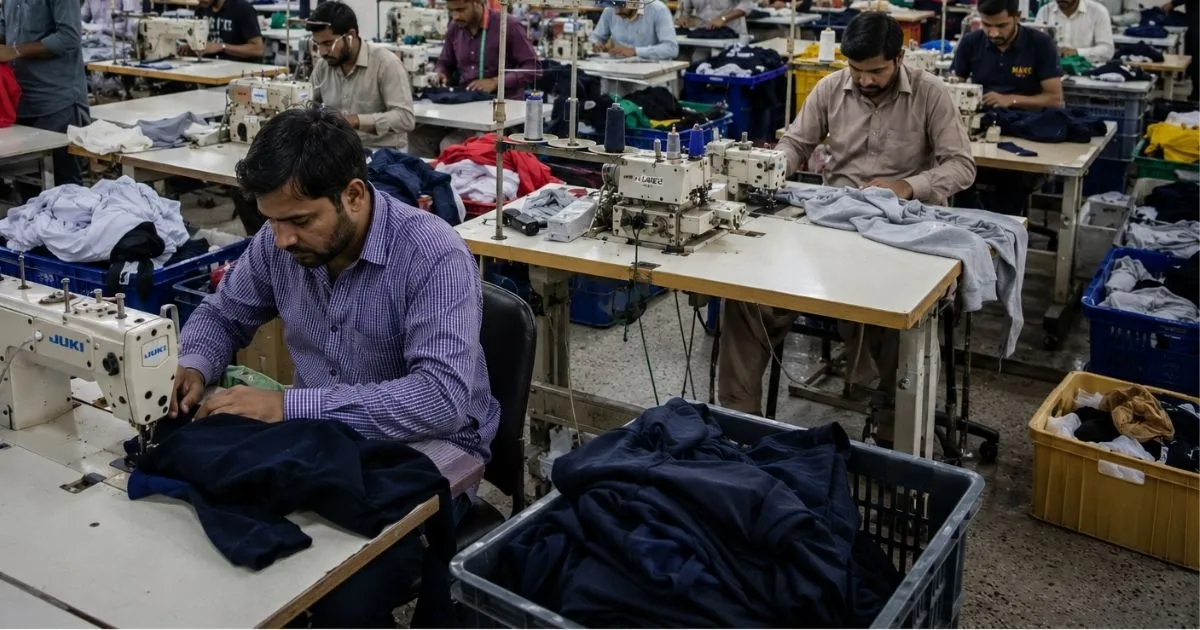
Production efficiency is the third factor. A sewing line runs most efficiently at longer uninterrupted runs. Very short runs require line changes, machine setups, and supervisory time that larger runs absorb efficiently. Manufacturers compensate through a higher per-unit price or a minimum that keeps the run viable.
What MOQ Numbers Look Like Across the Industry
The range is wide and the differences between supplier types are significant. Every MOQ clothing manufacturer sets their floor based on their own cost structure — not an industry standard. Here is an honest breakdown of what you will encounter when reaching out to manufacturers for minimum order quantity clothing quotes.
| Supplier Type | Typical MOQ Range | Who It Suits | Trade-Off |
|---|---|---|---|
| Large export factories (China, Bangladesh) | 500 – 3,000+ | Established brands, retailers, volume buyers | Low per-unit cost, but capital requirements kill startups |
| Mid-tier factories (Pakistan, Vietnam, India) | 100 – 500 | Growing brands with proven demand | Good pricing, but too high for first-time founders |
| Startup-focused manufacturers | 10 – 100 | New brands, product testing, limited drops | Small-run premium on per-unit cost (disclosed, not hidden) |
| Print-on-demand services | 1 unit | Solo creators, Etsy sellers, low-risk testing | No customization, no private label, no garment ownership |
| Domestic US cut-and-sew (LA, NYC) | 24 – 150 | Made-in-USA label requirement, premium positioning | 2–4× higher unit cost than factory-direct overseas |
MOQ ranges are typical at time of writing. Always confirm the actual minimum before building your budget around it.
The number that changes everything: The difference between a 100-piece MOQ and a 10-piece MOQ is not just 90 garments. It is the difference between needing $550 versus $5,500 for a first order — before branding, freight, or any other cost. For most first-time founders, that gap is the entire business.
MOQ and Per-Unit Price: Understanding the Trade-Off
Lower minimum order quantity almost always means a higher per-unit manufacturing cost. This is not a trick — it is fixed-cost math. Understanding it protects you from two mistakes: choosing a manufacturer on headline MOQ without understanding true cost, and misbudgeting your first order.
Here is what the actual numbers look like for a standard heavyweight hoodie at ClothingManufacturer.US:
| Order Quantity | Per-Unit Cost (Hoodie) | Small-Run Premium | Total Order Cost (est.) | Private Label? |
|---|---|---|---|---|
| 10 – 24 units | $12 – $16 | ~+25% | ~$120 – $384 | ✓ Included |
| 25 – 49 units | $11 – $14 | ~+12% | ~$275 – $686 | ✓ Included |
| 50 – 99 units | $9 – $13 | Standard | ~$450 – $1,287 | ✓ Included |
| 100 – 299 units | $8.50 – $12 | −10% | ~$850 – $3,588 | ✓ Included |
| 300 – 499 units | $7.50 – $11 | −16% | ~$2,250 – $5,478 | ✓ Included |
| 500+ units | $7 – $10 | −25% | ~$3,500+ | ✓ Included |
Per-unit estimates for a 380–420 GSM pullover hoodie with woven label, care label, and hang tag. Freight additional. Use the cost calculator for your specific garment and quantity.
Even at the 10-piece minimum, the total hoodie order cost starts under $200. That is a first-order risk most brands can absorb — which is the entire point of a genuine low minimum order quantity clothing manufacturer.
Price Your Exact Order in 60 Seconds
100+ products · 20+ fabrics · full private label branding included. Get an instant estimate before you commit to anything.
The Hidden MOQ: Fabric Minimums You Need to Know
Most founders fixate on the garment MOQ without realizing there is often a second minimum hiding underneath it: the fabric minimum. This is one of the most common sources of surprise in a first manufacturing conversation, and understanding it upfront saves significant frustration.
Stock Colors vs. Custom Pantone Colors
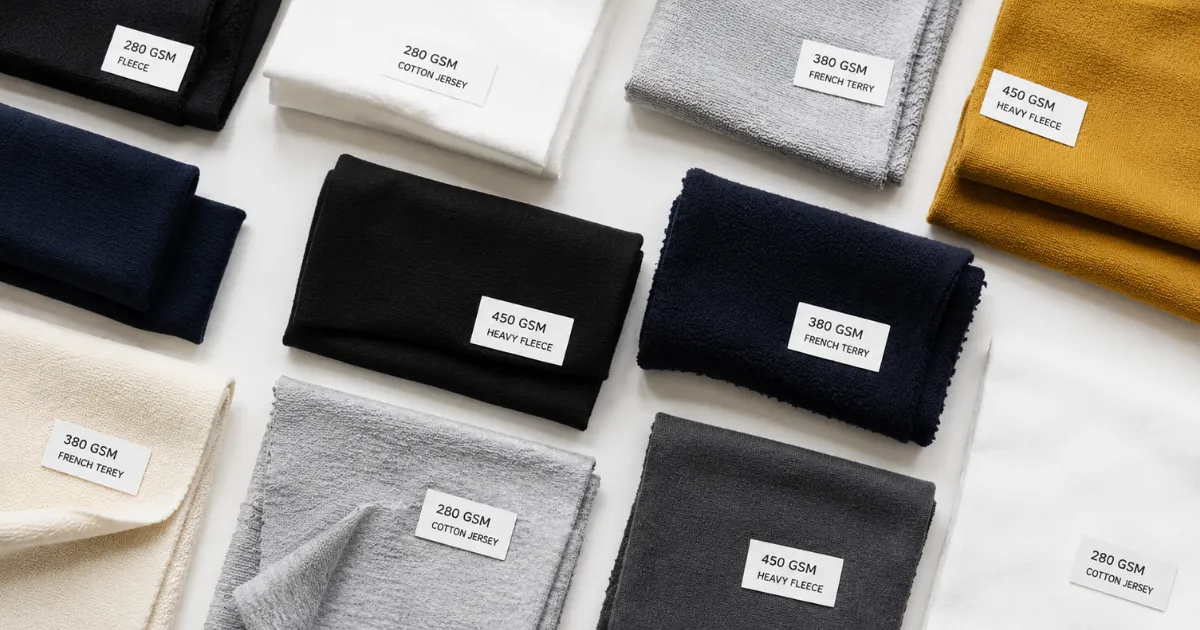
Every manufacturer keeps a library of stock fabric colors — typically 30 to 80 standard shades. Ordering in a stock color means no fabric minimum beyond the garment MOQ. The fabric already exists.
Ordering a custom Pantone color means the mill must dye a fresh batch. Mills set their own minimum dye lots, typically 100 to 300 kilograms depending on the fiber and facility. For 380 GSM fleece, 200 kg translates to roughly 250–350 garment fronts and backs. That mill minimum becomes your effective minimum order quantity for that colorway.
The practical advice for new brands: start on stock colors. Test your design, validate demand, then invest in a custom Pantone match once volume justifies it. Most successful brands run stock colors for their first two or three seasons.
How Colorway Splitting Works
At ClothingManufacturer.US a 10-piece order can run in two colors — 5 pieces per color — because both colorways share the same pattern, cutting marker, and production setup. Fixed costs are covered across the 10-piece total. Learn more on our low MOQ clothing manufacturer page.
This matters for product testing. Run a black and white colorway in your first order, put both in front of customers, and reorder only what sells. That market feedback on a sub-$400 first order separates brands that scale from brands that stall with a warehouse of the wrong color.
MOQ by Product Type: What to Expect
Apparel minimum order quantity is not uniform across all garment types. Complexity, component count, and machinery required all influence where a manufacturer sets the floor. Here is a realistic breakdown by category.
| Garment Type | Our MOQ | Price Range (50–100 units) | Complexity Note |
|---|---|---|---|
| T-Shirts (standard and oversized) | 10 units | $4 – $6 / unit | Low complexity. Best first product for testing. |
| Hoodies (pullover and zip) | 10 units | $8 – $14 / unit | Medium complexity. Pocket, drawstring, cuff detailing. |
| Sweatshirts / Crewnecks | 10 units | $7 – $11 / unit | Simpler than hoodies, similar fabric weight range. |
| Joggers / Sweatpants | 10 units | $7 – $11 / unit | Waistband, cuff, and pocket construction variables. |
| Tracksuit Sets (top + bottom) | 10 units | $16 – $26 / set | Two-piece. MOQ per set, not per piece. |
| Polo Shirts | 10 units | $6 – $12 / unit | Collar knitting adds complexity vs plain tees. |
| Varsity Jackets | 25 units | $18 – $28 / unit | Multiple materials (wool, leather sleeves, chenille). Higher MOQ reflects complexity. |
| Medical Scrubs | 10 units | $9 – $15 / unit | Woven fabric. Multiple pockets. Antimicrobial spec. |
| Crop Tops | 10 units | $3.50 – $6 / unit | Low complexity, low fabric usage = lowest price point. |
| Leggings / Activewear | 10 units | $7.50 – $12 / unit | 4-way stretch. Seam placement critical for performance. |
Prices per unit at 50–100 units, private label included. Run exact numbers with the cost calculator.
Minimum Order Quantity Red Flags: What to Watch For
Not all low-MOQ claims are created equal. The apparel industry has a pattern of manufacturers advertising a low headline minimum that is technically true but practically meaningless. Here is how to spot the gap.
5 MOQ Red Flags in Clothing Manufacturing
- Low garment MOQ, high fabric dye-lot minimum. A manufacturer quotes 30 pieces but requires 300kg of custom-dyed fabric. The 30-piece MOQ is real, but the custom color forces you to buy fabric for 400 garments. Ask about dye-lot minimums separately.
- MOQ "per colorway" not "per style." If the 50-piece minimum applies per color not per style, a two-color order requires 100 pieces. Always confirm whether the minimum is per style, per colorway, or per size run.
- Setup fees not disclosed until after you commit. Screen charges, embroidery digitizing, and label setup costs can add $200–$600 to a small-run order. A transparent manufacturer includes them in the quote upfront.
- Sample-only MOQ different from bulk MOQ. A manufacturer may accept 10-piece samples but require 300 for bulk. Ask about both minimums before commissioning a sample.
- Vague answers about the actual minimum. "We work with startups" means nothing. Any genuine low MOQ clothing manufacturer gives you a specific number immediately. If they hedge, move on.
How Startups Should Approach MOQ: A Practical Strategy
The mistake most first-time founders make is not the MOQ itself — it is ordering too many units of something unproven because the per-unit math looked better at 200 pieces than at 20. Treat your first order as market research, not a business launch. Small batch clothing production at 10–25 pieces is not a compromise — it is the strategically correct starting point for any unproven product.
The One-Style-First Rule
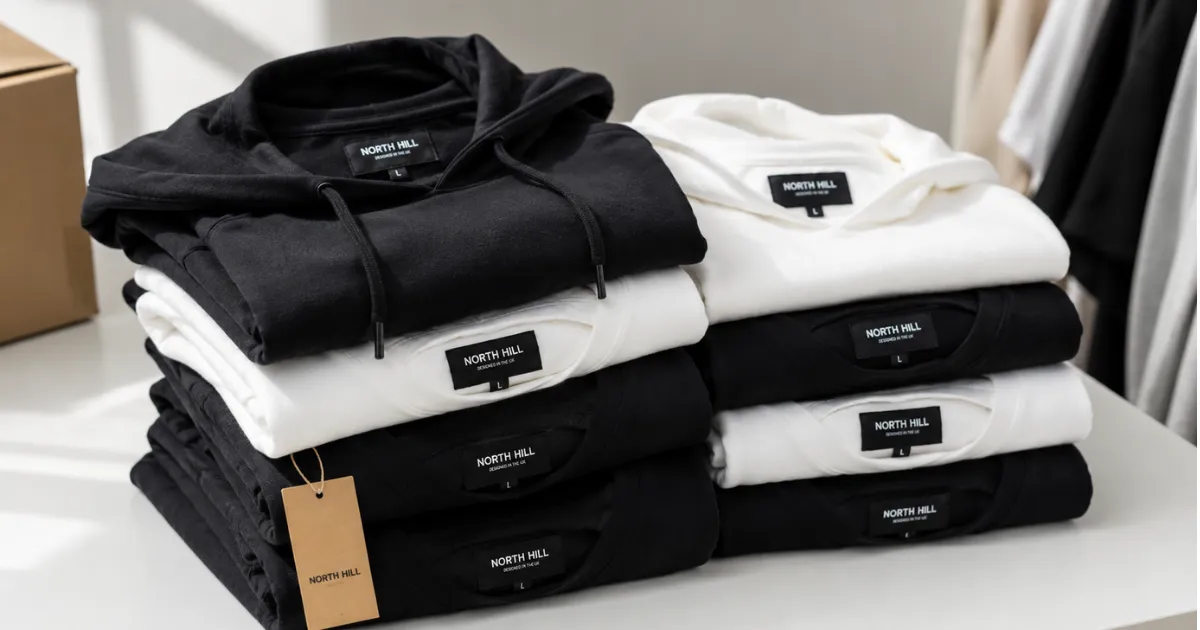
Start with a single garment. Not a full collection. One style, one colorway, one size run. Brands that fail in their first year almost always die from over-commitment to inventory, not under-committing. Validate one product. Reorder when it sells. Add styles once you know what your customers actually buy. Read the full guide on how to start a clothing brand.
Sample Before You Scale
A pre-production sample — ready in 7 to 10 days from ClothingManufacturer.US — is the single highest-return investment in a first manufacturing project. You see and feel the exact garment, branding, and fabric before a single bulk unit is cut. Sample fees are credited against your bulk order, making it effectively free if you proceed.
Plan Your Reorder Before You Place Your First Order
Once a first order is in production, ask your manufacturer what the reorder timeline and cost looks like. Reorders complete in 2 to 3 weeks versus 5 to 7 for first orders, because patterns, files, and specifications are already archived. If a product performs, you want to reorder fast.
Understand Your True Landed Cost
The unit price quoted is never your actual cost per unit. Freight, duties, and import fees add to the number. On DDP (Delivered Duty Paid) shipments — which ClothingManufacturer.US ships on — those costs are pre-calculated and included in the quote. On DAP or DDU terms, customs costs arrive separately and surprise founders who did not budget for them.
Low MOQ vs. High MOQ Manufacturer: Full Comparison
| Factor | High MOQ Manufacturer (300–1,000+ units) | Low MOQ Manufacturer (10–100 units) |
|---|---|---|
| Upfront capital required | High ($3,000–$15,000+) | Low ($120–$1,500) |
| Per-unit cost | Lower | Higher (small-run premium) |
| Market validation risk | High (large inventory) | Low (small test runs) |
| Private label included | Often extra cost | Typically included |
| Customization flexibility | Moderate | High |
| Communication | Often via trading company | Usually direct with factory |
| Suitable for first-time brands | Generally no | Yes — designed for this |
| Reorder cycle | 4–8 weeks | 2–3 weeks (files archived) |
Related Guides on ClothingManufacturer.US
Frequently Asked Questions About MOQ in Clothing
The Bottom Line on Minimum Order Quantity
Minimum order quantity is not the enemy of a clothing brand startup. It is a manufacturing reality that becomes a genuine opportunity when you understand the numbers behind it and find a manufacturer whose floor matches your stage of growth.
The critical things to know: most manufacturers set MOQs far above what a first-time founder needs. A genuine minimum order quantity for clothing of 10 pieces exists and is available right now. The per-unit cost will be higher on small runs, and a transparent manufacturer discloses exactly how much higher. Private label branding should be included, not billed afterward. And always commission a sample before committing to bulk production.
The minimum order quantity clothing brands actually need at the start is almost always smaller than they think. Prove the product. Then scale.
For any clothing brand startup, getting the minimum order quantity clothing decision right — starting small, sampling first, and scaling only on proven demand — is the single most important production decision you will make in your first year.

1 Comment